|
By C.C. Sullivan
Stick-built robotics
For many architects, the European tradition
of customizing an off-the-shelf, unitized, double-wall product
presents a safe and effective entrée into the world
of interactive facades. Less prevalent is the craft-based
approach used by Thom Mayne for Caltrans District 7 Headquarters
in Los Angeles, which opened in late 2004. There, Morphosis
Architects pulled apart the envelopes functional elements,
redelegated them, and coordinated their job-site
reassembly among seven exterior subcontractors,
says project leader Pavel Getov.
| click
images to view them larger |
 |
 |
 |
Caltrans
District 7 Headquarters, Los Angeles
Different elevations of the building have
different systems. On the south side (left),
large photovoltaic panels form a brise-soleil.
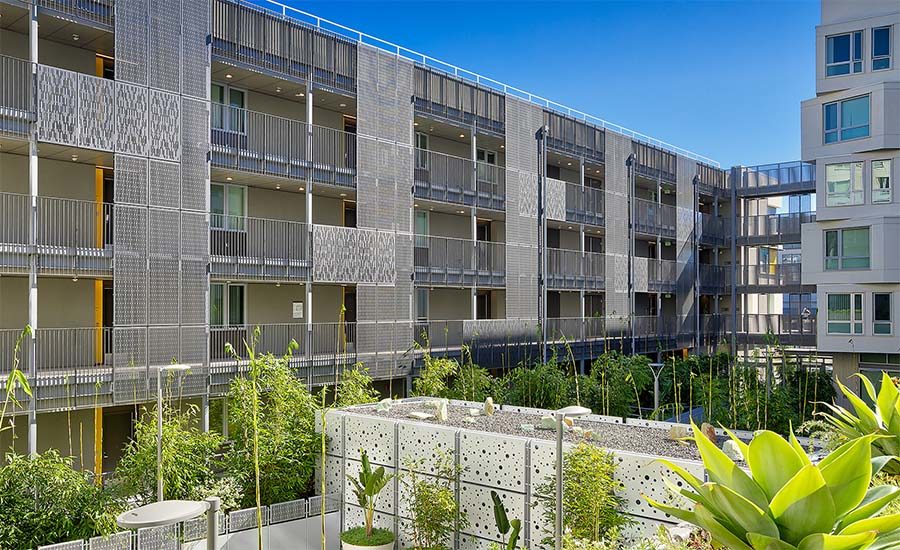
On the east and west facades, perforated solar-shading
screens hang a foot from the exterior wall.
When they heat, air around them rises, which
draws cooler air from ground level. Each day,
about 1,000 screens (middle), which are located
in front of windows, open and close.
Photography: © Roland Halbe |
|
|
The result combines a large photovoltaic
array and independently controlled, automated elements within
a multiple-layer facade. The prominent shading layer of perforated
metallic panels on east and west facades cuts initial solar
heat gain by about 15 percent. The screen hangs about 1 foot
from the slab edges of a weather-wall of metal framing, gypsum
sheathing, and PVC membrane. In this way, the intervening
space functions partly as convective cavity. One thousand
or so of the scrim panels, corresponding to ribbon windows
behind, open or close daily. Those on the east close in the
morning, those on the west in the afternoon. For longevity,
the architects specified stainless-steel hardware and a single
pneumatic lift per panel, rather than the pair of electrical
actuators originally considered. A rooftop sensor signals
the panels to close during high winds.
According to Getov, 3D modeling and mock-up
testing ensured the performance of the stick-built envelope
under wind, rain, and seismic conditions. The firm shared
a single building-information model among consultants and
manufacturers, and component prototypes made on a 3D printer.
Still, says Getov, A lot of the design is resolved through
the mock-ups. Even with extensive reviews and site visits
for the customized, kinetic countenance, the project penciled
out at $165 per square foot, including finished interiors
and design feesabout the same as an average office building.
The buildings small facade area in relation to its floor
plate accounts in part for the cost-effectiveness. Energy
savings are projected at about 40 percent. Getovs advice
for architects interested in the process seems counterintuitive.
The small manufacturers can be
the most helpful because they dont already have a set
solution in place, affording architects more conceptual
control and collaboration, he explains. It allows you
to break down the process.
|