|
Advertising supplement provided by
Duradek
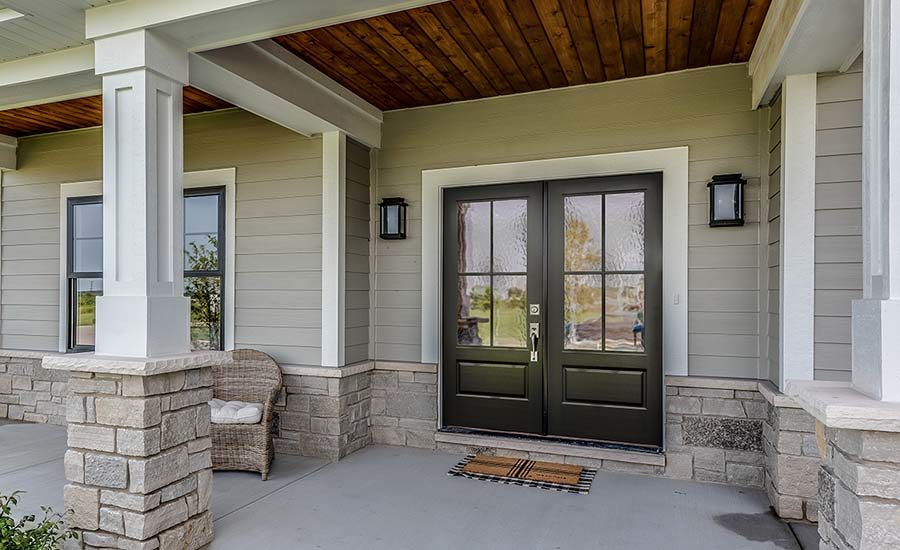
Many decks have posts and columns that require proper construction
and sequencing of moisture barriers to prevent water from
seeping under the PVC membrane. Water may find an entry point
in the post itself and get in behind the waterproof membrane.
As wood posts or columns will crack and allow water to get
into the subsurface, they should be covered with a moisture
barrier and then finished with siding. Where the dramatic
effect of a rough-hewn wood post is required, special consideration
must be made for post attachment. When fastening metal rails
or posts to the deck surface, all pilot holes should be filled
with a sealant before screws are inserted. Curbs, knee walls,
posts, and wall openings must be constructed and detailed
properly to ensure the performance of the membrane. In constructing
or modifying door openings, door sills should be sloped toward
the deck surface for optimum drainage. In addition, the waterproof
membrane should continue into and waterproof the rough door
opening saddle in order to deflect any moisture intrusion.
Building authorities may require overflow drains or scupper
boxes on trapped decks to provide a path for water to drain
from the deck. Drains and scuppers should be sloped toward
the outside, and scuppers should be inserted into the deck
surface so as to prevent ponding. In general, scuppers are
very difficult to detail in such a way as to make them truly
impervious to wind, rain, snow, and structural deflection.
ABS-shower drains are only approved for showers and are not
suitable for any roof deck or multi-family building applications.
Drains should be approved roof drains. PVC-coated drains or
drains with a positive clamping system are suitable to allow
water to drain into the building's storm water system. With
PVC-coated overflow devices, the PVC decking membrane can
be welded directly to the PVC-coated surface, with no caulking
required.
Drying refers to any features of the building assembly that
speed the drying of materials that have been exposed to moisture.
Drying can be aided by the use of a rain screen wall assembly
or by the venting of trapped air spaces. Proper ventilation
is critical and insufficient ventilation of the deck space
can lead to mold, mildew, and rot. Venting of the air space
underneath decks, balconies, and walkways with a closed soffit
or ceiling is especially important for adequate drying. If
the underside of a roof deck, balcony or walkway has a closed
soffit or ceiling, venting is required in order to reduce
moisture buildup. To be effective, the vent area should be
a minimum of 1/150th of the insulated ceiling area. If equal
venting cant be provided at both ends of the joist runs,
then purlins should be installed above the joists in order
to allow for cross ventilation.
To facilitate ventilation, some manufacturers offer deck
ventilation systems that allow for venting of the roof space
joists in new and retrofit construction. These deck
ventilation systems work by allowing air from the roof space
to circulate up and through a type of snorkel vent which includes
a perforated mesh bug screen, says Ogilvie. And
they can be installed without altering the elevation of the
deck, door openings, railings or through-wall flashing details.
Durability refers to assemblies and materials that stand
up to foot traffic, moisture, mildew, chemicals, and environmental
conditions. The durability of the assembly will be affected
by the quality of the waterproofing membrane, and by its overall
maintenance. While two waterproofing membranes may have a
similar appearance, the quality of their ingredients can give
the product a price differential of up to 25 percent, and
a difference in life expectancy of as much as 75 percent.
Model building codes that dictate the requirements for roof
and walking deck membranes should be consulted. Roof membranes,
for example, are tested in accordance with nationally recognized
standards, such as the American Society of Testing and Materials
(ASTM) E-108 (International Codes), ULC-S107 (NBC), for Class
A, B or C Fire Endurance
Rating. PVC roof and walking deck membranes must conform to
the same material standards as PVC Roofing and Waterproofing
Membranes.
Any alternative material, type or method of construction
can be accepted as long as it demonstrates compliance with
the performance features of the applicable code. In the United
States, the International Code Council Evaluation Service
(ICC-ES) evaluates Roof and Walking Deck Membranes in accordance
with the ICC-ES interim Criteria for Walking decks (AC39),
dated March 2000.
In addition, waterproofing membrane products must be manufactured
under an approved quality-control program with inspections
by an inspection agency accredited by the International Accreditation
Service (IAS).
Also key to the durability of a PVC membrane is to ensure
that all components of the waterproofing system are compatible
and will not adversely affect performance. This includes the
membrane, along with any tapes, sealants, adhesives, drains,
scupper boxes, flashings, or perimeter fastening devices.
|