




|
Advertising supplement provided by
American Hydrotech, Inc.
By Celeste Allen Novak, AIA, LEED AP
Standards For Green Roofs
New codes are being developed for green roofs and testing
standards by the ASTM International Green Roof Task Group.
These standards include standard guides for selecting plants,
determining dead loads and live loads, tests for water retention,
wind loading, and definitions of components.
Manufacturers typically provide warranties for green roofs,
and guarantee that their products will last with proper installation.
Green roof suppliers should provide green roofs with the following:
- All of the components of the entire system, from waterproofing
membrane to the growing medium.
- Proper considerations for wind loading and fire safety
- Material data proving that the system conforms to FLL
and ASTM standards
- The total weight of the system
- Stormwater calculations for the site location
- Plant recommendations, especially for extensive roofs
- Specifications for all products
- A single source warranty for all components from the deck
up
- Authorized trained installars ensure good workmanship
- A portfolio of successful projects
An Environmental Tool
Architects, owners, and contractors who care about the environment,
love green roofs. They help the environment by mimicking the
natural cycle of rainfall on the earth, while adding new outdoor
spaces in dense urban environments. Green roofs lower heating
bills by adding insulation, and extend the life of the roof
by protecting it from ultraviolet rays. They create visual
excitement and new uses for leftover building areas. Green
roofs provide many environmental benefits to building owners
and communities. Tenants living in mixed-use projects with
green roofs have the advantage of a place to get some fresh
air and quiet respite in urban environments.
The U.S. Green Building Councils rating system, LEED,
grants points that certify a building as green. Green roofs
will allow points based on the LEED 2.1 rating system. Points
can be given for numerous benefits including stormwater management,
since the effect of a green roof is that it decreases the
impervious surface of a site. A specific credit addressing
reduction of heat islands is available and green roofs qualify
as long as they cover at least 50 percent of the roof surface.
In addition, some green roof manufacturers use recycled content
in the waterproofing membrane, granting additional points
towards certification. Green roofs can provide credits for
supplying materials within a 500-mile radius of the site,
and also count for the reduction of site disturbance. Innovation
credits are often given to projects that incorporate green
roofs. Leaders in the environmental movement know that adding
a green roof contributes to the environmental qualities of
a project.
To create a garden is to search for a better world.¹
Visions of Paradise: Themes and Variations on the Garden.
Photographs: Maria Schinz, text: Susan Littlefield. New York:
Stewart, Tabori & Chang, 1985
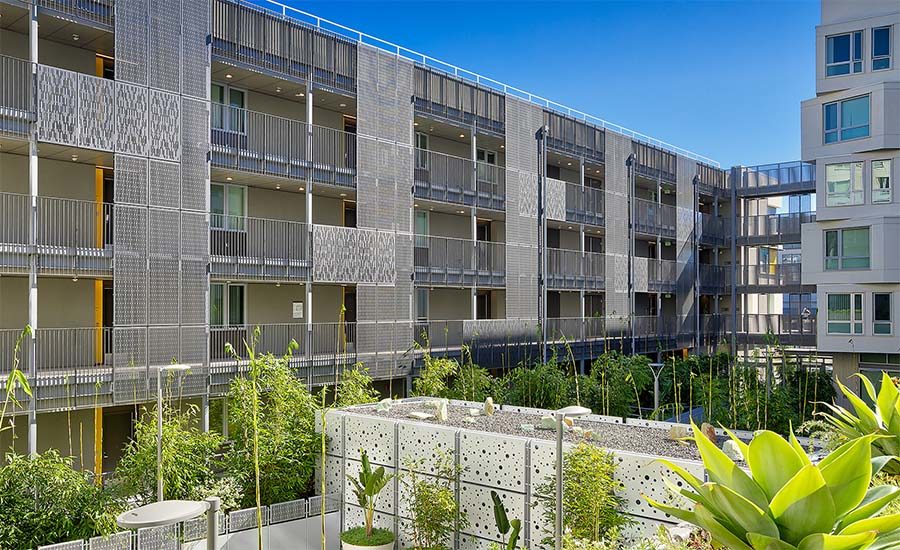
Roof gardens change the nature of the built environment.
They also add to biodiversity. Reid R. Coffman, University
of Oklahoma assistant professor of landscape architecture
who researches green roof fauna and habitats says, Longstanding
living examples in Switzerland have shown green roofs can
be viable habitats for threatened and endangered species.
The wonderful part about biodiversity is the challenge designers
will face with regards to context. This demand for contextualism
will perpetuate a flurry of wonderful, innovative projects.
These attempts, trying to connect the extremes of rooftops
and viable habitats, will subsequently uncover essential knowledge
in the mission of ecological design.
By providing sustainable, aesthetic and functional outdoor
spaces, design professionals can plan projects with exciting
new elements, added value, and significant, tangible benefits,
thereby enhancing the built environment, and creating new
landscapes for the 21st century.
Celeste Allen Novak, AIA, LEED AP, is an architect, environmentalist
and writer in Ann Arbor, Michigan.
Source:
- Visions of Paradise: Themes and
Variations on the Garden.
Photographs: Maria Schinz, text: Susan Littlefield. New
York: Stewart, Tabori & Chang, 1985
|