|
Despite liability issues, A/E/C
teams are benefiting from sharing their 3D models
By Michael Bordenaro
Realizing the impossible
Idaho Place is on hold until Spring 2003,
so the structural-steel fabrication has not been bid, and
it is uncertain how much of the 3D model will come into play
during manufacturing. However, NBBJs design of two 30-foot
tall steel staircases for Amgens Seattle headquarters
has made it through design, engineering, and manufacturing
with the assistance of 3D modeling.
 |
 |
|
Computer modeling of steel for
Chicago’s Soldier Field renovation assisted the need
for complex structural connections to be designed and
manufactured in a short time frame. As many as 20 angled
and beveled members come together in connections that
are smoothly erected in the project’s 16-month schedule.
Renderings: Courtesy Wood + Zapata
|
Amgen, which bills itself as the worlds
largest biotech company, wanted to encourage personal interaction
among scientists through the use of communication
stairs that would both foster and be a place for discussion.
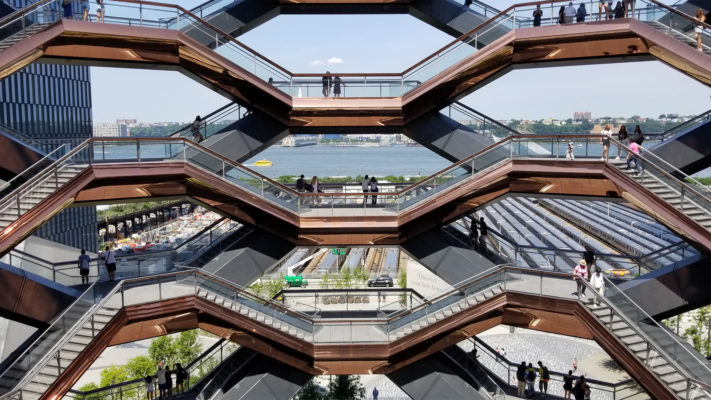
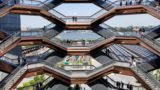
One stair represents chaos through its cacophony of forms,
and the other is modeled on a double helix. Both are self-supporting
structural-steel sculptures.
NBBJ architect Robert Leykam created
numerous hand-drawn sketches and a 3D computer model in AutoCAD
to help communicate the complex geometry of the stairs. He
shared 2D AutoCAD drawings with the project structural engineer,
KPFF Seattle, which used the drawings to help create a 3D
model in its SAP 2000 structural engineering analysis program.
You could not create a design like
this by yourself as an architect, and KPFF could not have
done it without the current technology available, says
Leykam. The connection analysis at welds, test loading
diagrams, distribution of uniform loads, and analysis of other
scenarios resulted in the use of less steel and less welds
than I thought possible, and greatly contributed to the hovering
effect of the helix stair.
Carolyn Weiss, project engineer for KPFF,
says, SAP 2000 provides 3D modeling and dynamic property
analysis, so we were able to provide fundamental periods and
other data in addition to presenting detailed images of how
the stairs would look.
Leykam used the images to make subtle
changes in details impacting the structures, but more importantly,
the SAP 2000 3D models were provided to Portland, Oregonbased
Columbia Wire & Iron Works, a 100-year-old iron and steel
fabricator. However, because of legal implications, KPFFs
3D model was only used as a check set against Columbias
model, which was created on SDS2, a structural-steel-detailing
software program. Weiss says, We simply provided it
for reference and included a disclaimer saying the dimensions
have to be verified, but Columbia used it to make sure their
working points were coming out right when they laid out the
steel.
|