|
Growth is good when in accordance
with natures own time-tested blueprint.
By Nancy B. Solomon, AIA
Finding our place
Why does a 400-year-old structure still work and feel
right? muses Boston-based architect Bill Reed, AIA,
vice president of Natural Logic. Not because of its
styletimeless buildings exist in any stylebut
because it grew out of its place. The master builder,
who was local, had all the local data he neededincluding
climate, available materials, and labor, culture, and economyto
influence his architectural solution. Local conditions
allow a building to be part of its place, sums up Reed.
Consider another scenario: Until 1860, Paris fed its
entire population with food that came from no farther than
40 miles away, says Reed. It was a closed-loop system:
Vegetables were eaten, and the resulting human waste became
fertilizer. Once the city sewage system was constructed, however,
the nutrients flowed out and the loop was broken.
In our rational Cartesian frameworkin which everything
can be logically mapped out in quadrants or dissected into
discrete unitswe have, for the most part, lost sight
of such underlying flows, cycles, and connections. Even worse,
we have become indifferent to them, believing our technological
wizardry can outdo Mother Natures organic schemes. But
our technological hubris has come home to roost.
 |
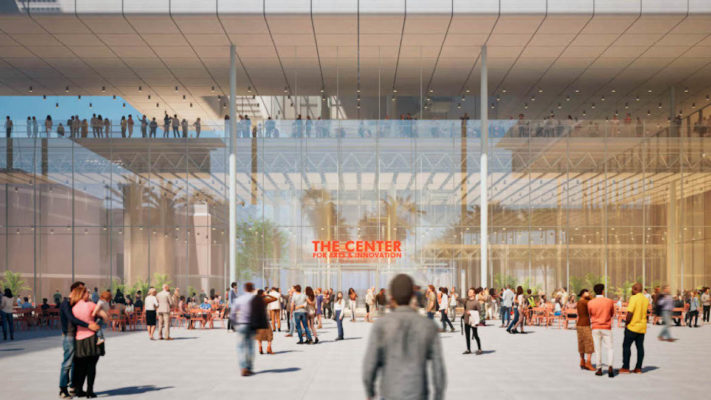
Proposed Power
Plant Brooklyn, N.Y.
Artist Michael Singer of Wilmington, Vermont, and
a team of designers, including Marcus Springer of
Cannon Design in Boston, conceived of a community-friendly
power plant for an industrial site along the East
River in New York City (right). Waste heat from
the utility plant will help to grow garden plants
in greenhouses built along the exterior structure
of the building (below). The public will be able
to walk through a riverfront garden next to the
power plants facade. |
 |
| Images © Photomontage
by Stephen Solzhenitsyn (top); Namhoon Kim and Stephen
Saude (bottom). |
|
We are a society that seeks to create manageable uniformity,
said landscape architect John Tillman Lyle, author of Regenerative
Design for Sustainable Development (John Wiley & Sons,
1996) and a professor at California State Polytechnic University
at Pomona until his death in 1998. In creating such regularity,
however, we destabilize life-giving processes. Americas
ubiquitous turf grass, for example, yearns to evolve into
a meadow and then a forest. Yet we beat it into submission
by mowing and dumping chemicals on it. In the process, we
inhibit groundwater recharge; poison air, land, and water;
and waste not only precious fossil fuels but also our own
precious time.
To heal the Earth, and ourselves, says Reed, we have
to fundamentally change our relationship with natural systems,
from energy and water flows to nutrient cycles. Instead
of fighting against Mother Nature, we need to work with her
to help stabilize natures life-giving processes. It
is just not up to the Earth to heal herself, because we, too,
are part of the Earth.
This kind of design goes beyond sustainable; it is regenerative.
It revitalizes the underlying systemsboth cultural and
naturalso that all can work efficiently and in concert
to achieve and maintain a healthy environment. Regenerative
design grows out of various ecological movements, including
permaculture. The word, originally intended as a hybrid of
permanent and agriculture, was coined in 1978 by Australian
ecologist Bill Mollison and one of his students. Reed boils
the discipline down to its essence: Permaculture basically
says that gravity happens. Water flows down and takes nutrients
with it. By acknowledging such forces and working with
them, permaculture designers strive for systems that reap
the greatest benefits with the least amount of effort and
resources.
Page 2 of 6
       
|