|
Client, architect, and Construction
manager must perform a delicate balancing act to shrink the
construction process and save time and money.
By Barbara Knecht
 |
Continuing
Education
|
Use the following learning objectives
to focus your study while reading this months ARCHITECTURAL
RECORD / AIA Continuing Education article.
1 LU/1 HSW
Learning Objective:
After reading this article, you will be able to:
1. Describe situations where fast-track
construction is used.
2. Explain how fast tracking works.
3. List the advantages of fast-track
construction.
|
A Manhattan developer accelerates construction to accommodate
a tenant displaced when the World Trade Center was destroyed
on September 11. A Connecticut school needs a new dormitory
ready for occupancy when students arrive. Researchers must
be in their companys new laboratory in order to beat
the competition to market with a new product. A sports-apparel
company, forced to vacate its leased facility, gives its architect
a scant eight months to design its new headquarters. All these
projects were fast tracked into existence because clients
are increasingly unable and unwilling to accept the protracted
schedule of conventional construction.
 |
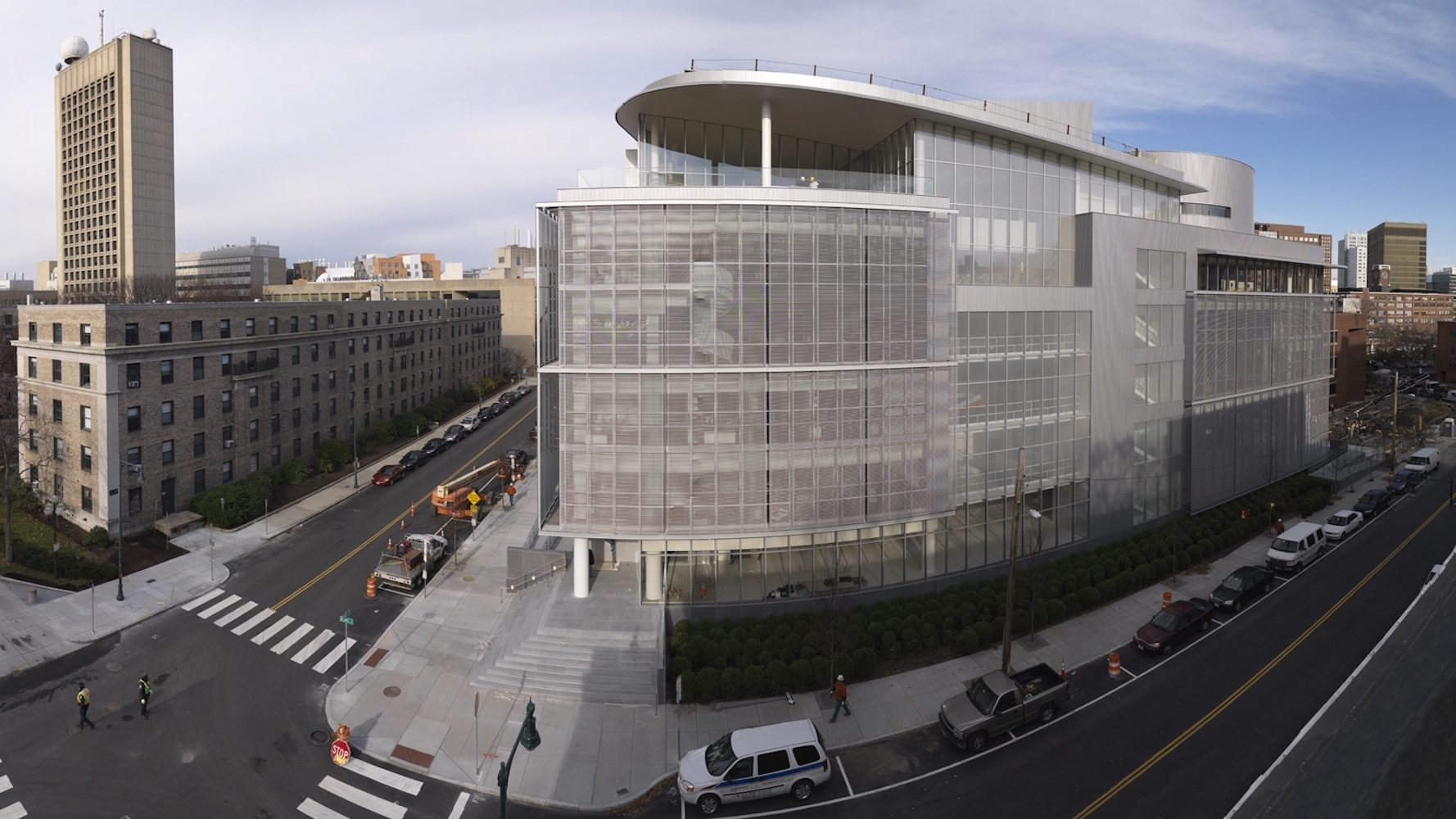
Photography: © Assassi Productions
 |
| The structural system for the 330-foot,
curved-and-canted spine curtain wall was the most technically
difficult problem NBBJ faced in designing the Reebok Headquarters. |
Fast-track construction has been around for decades (see
Digital
Architect) and now, according to some industry associations,
accounts for as much as 40 percent of building projects. Briefly
stated, fast tracking compresses the project schedule by running
design and construction phases simultaneously. For example,
in a typical fast-track project, foundation and steel packages
are purchased before the building layout is fixed. Design
may run as little as a week ahead of construction, and myriad
design decisions are made in the field.
Time is money
Paradoxically, while the decision to fast track a project
is nearly always an economic one, the final costs are generally
unknown during the process. For commercial owners, the potential
for profit is worth the risk; whereas, for many not-for-profit
and government owners it is essential to know the total cost
going in, so that they do not pay too much for any one item.
(This is often true even if they underpay for other items
and the total cost is the same.) These kinds of assurances
are unlikely to exist in a fast-track project. I think
it is safe to say, depending on the construction manager and
the level of documentation, you may need to buy at a little
more inflated price, but if you are saving time, you should
be able to make it up on the interest on the construction
loan and should be able to collect rent sooner [on a commercial
building], says Joe Aliotta, principal of New Yorkbased
Swanke Hayden Connell, who estimates that about a third of
his firms work is fast tracked.
The usual way of controlling cost is to have a guaranteed
maximum price given by the construction manager during the
later phase of design development or early phase of construction
documents that is based on a good understanding of the architectural
intent. In the early stages, the architect has to anticipate
and describe design elements not yet shown, while the construction
manager will need to extrapolate potential costs based on
experience, and both must communicate their assumptions to
the owner. As the design progresses, it is the construction
managers role to manage the costs. As the price of one
item escalates, the cost of another will have to be reduced.
Some contracts will carry a design contingency, which is likely
to be consumed by the end of this phase. An experienced team
with good communication skills will keep to the budget through
construction. Still, it is a journey into uncertainty.
|