subscribe
free e-newsletter
contact us
advertise
print this article   |    e-mail this article    |   comment     

zeroHouse

Specht Harpman

With the help of state-of-the-art technology, the zeroHouse runs on nothing.

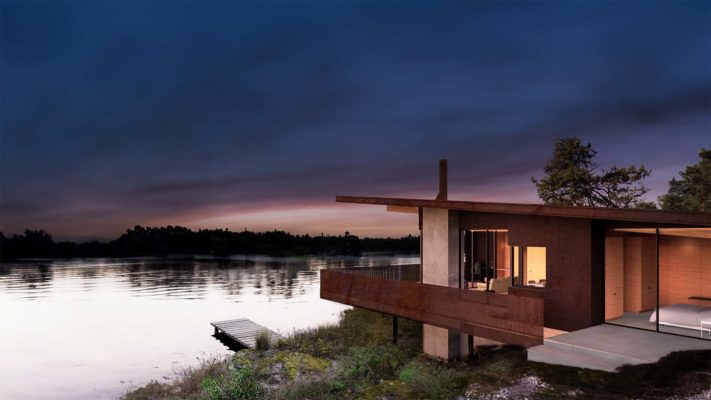
The zeroHouse by Specht Harpman, a New York City-based firm, is deliberately placeless. It could be erected in Vermont or in Texas, where its unbuilt design won the 2007 Studio Award from the Texas Society for Architects. A slew of high-efficiency techniques afford the house its full energy independence: solar panels store and produce power, allowing a fully charged zeroHouse to operate continuously for up to one week with no sunlight; a rainwater collection plane gathers and diverts water into an elevated 2200-gallon cistern; gravity-fed plumbing fixtures eliminate the need for power-consuming pumps; a compost unit beneath the house processes organic waste and converts it into clean, dry fertilizer that needs to be removed only twice a year; and a high-efficiency heating and air-conditioning system is separately zoned for sleeping and living areas.

zeroHouse
Image courtesy Specht Harpman

Rate this project:
Based on what you have seen and read about this project, how would you grade it? Use the stars below to indicate your assessment, five stars being the highest rating.
----- Advertising -----

The structure of the house contributes to its low environmental impact. Made from prefabricated components, the walls, roof, and floor are all insulated with closed-cell structural foam and achieve a thermal resistance rating of R-58. The full-wall windows in each room are triple-insulated and fabricated from low-e heat-mirror glass. Exterior doors feature vacuum-sealed aero-gel panels to maintain maximum thermal performance. Last but not least, zeroHouse employs a helical-anchor foundation system that touches the ground at only four points and requires no excavation, meaning minimal disturbance to the earth.

While it's Specht Harpman's smart design that keeps the house running on nothing, all functions of the house are monitored by an array of sensors and regulated by a “house brain” that can be controlled through any laptop computer. Fully customizable for personal usage patterns, zeroHouse can be used as a weekend getaway or for an extended stay.

Formal name of project: zeroHouse

Location: The zeroHouse is being marketed worldwide.  It has been designed to work within an operational range of 36 N to 36 S latitude for year-round occupancy, and 47 N to 47 S for partial-year occupancy.

Gross square footage: 650 sq. ft.

Completion Date (Month and Year): Unbuilt

Total construction cost: $350,000

Architect:
Specht Harpman
338 West 39th Street, New York,
New York 10018

Reader Comments:

Submit a Photo
----- Advertising -----
Off the Record: Recent Blog Posts
The blog written by the staff of Architectural Record
View all blog posts >> Sponsored by:
Alpolic Materials
Reader Commented / Recommended
Most Commented Most Recommended
Rankings reflect comments made in the past 14 days
Rankings reflect votes made in the past 14 days
Find building materials in Sweets
McGrawHill
Search

© 2008 The McGraw-Hill Companies, Inc. All Rights Reserved