subscribe
free e-newsletter
reader service
widget
advertise
Subscribe to Architectural Record
and save 60% off the newsstand price
print this article   |    e-mail this article    |   comment     

Cradle to Cradle (C2C) Home

Roanoke, Virginia
Coates Design Architects

The C2C Home takes "green" literally.

When Matthew Coates and Tim Meldrum won the 2005 C2C Home competition (judged by William McDonough, Daniel Libeskind, among others), they hoped to see their renderings develop into an actual residence. But three years later, the team is waiting for technology, and funding, to catch up to their vision of a home that is off-the-grid, thanks to the help of Popeye’s power: spinach.

Cradle to Cradle (C2C) Home
Image courtesy Matthew Coates and Tim Meldrum

Spinach Power: Read about how scientists at MIT are developing solar cells that use spinach protein to convert light into electricity.
Rate this project:
Based on what you have seen and read about this project, how would you grade it? Use the stars below to indicate your assessment, five stars being the highest rating.
----- Advertising -----
C2C Design Team
Photo © Coates Design Architects
C2C Design Team

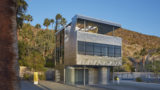
The C2C design reinterprets an age-old concept: the hearth. Made from concrete and steel, the 1,600-square-foot L-shaped home is topped with a tapered whirling chimneylike core that extends high above the roof plane. This core serves as a louvered skylight and temperature-stabilizing heat sink for the one-story home, and could one day support its revolutionary cladding: a conductive material that produces photosynthetic energy generated from spinach protein.

Based on emerging technology and scientific research, spinach protein cells sandwiched between glass may have the potential to generate energy. This living facade would not only be photosynthetic, but phototropic too; it would grow to follow the path of the sun, generating electricity. 

The facade is not the only green element of this home. Glass and metal panels insulated with soy foam comprise the exterior walls. A green roof absorbs and filters storm water through vegetation and soil while two large openings in the roof funnel rain to the building core. There, the rain is stored to serve for plumbing, flushing toilets, and other household needs. A bio-filtration system naturally breaks down and separates solid human waste from black water and then filters the black water under and alongside the house through a series of subsurface gravels and soils, from coarse to fine. Thus, the house does not require connection to a sewer or septic tank.

Formal name of project: Cradle to Cradle (C2C) Home

Location: Roanoke, Virginia

Gross square footage: 1,600 sq. ft.

Architect:
Coates Design Architects
921 Hildebrand Lane
Suite 210
Bainbridge Island WA 98110

Reader Comments:

We welcome comments from all points of view. Off-topic or abusive comments, however, will be removed at the editors’ discretion.

----- Advertising -----
Submit a Photo
RECORD Blogs: Recent Posts
View All: Off the Record, News Notebook, Design Down Under
Reader Commented / Recommended
Most Commented Most Recommended
Rankings reflect comments made in the past 14 days
Rankings reflect votes made in the past 14 days
Find building materials in Sweets
McGrawHill
Search

© 2009 The McGraw-Hill Companies, Inc. All Rights Reserved