


La Crescenta, California
Additional Content:
Jump to credits & specificationsPittman and Dowell, both respected painters and teachers, lived in a 1,200-square-foot Richard Neutra—designed house on the northern edge of Los Angeles and needed more space. Although small, their 1952 house — designed for Neutra’s secretary, Dorothy Serulnic, and her husband, George — sits on a 6-acre site that Neutra planned so it could be subdivided into three parcels. Since purchasing the entire property in 1997, Pittman and Dowell had built a small pavilion and cactus garden on the second parcel and saw how the site’s various pieces all worked together. So instead of just building a bigger house on the third parcel and using the Serulnic residence as a guesthouse, they approached the new building as an integral part of a larger composition.
Maltzan responded with a design that at first blush seems to contradict Neutra’s — introverted and opaque rather than outward-looking and transparent, polygonal rather than orthogonal. But the more you get to know his house, the more you see how it picks up Neutra’s ideas and gives them a new spin. While Maltzan certainly uses contrast as one means of relating the new to the old, his strategy is more sophisticated than simply doing the opposite of what Neutra did.
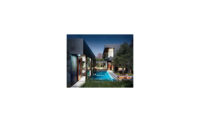
“The new house had to work with the entire environment, not just the Neutra house,” explains Maltzan. A driveway winds its way up the site with the existing home at the top, so he used that processional element to help generate an asymmetrical, spiraling geometry connecting the new building to both the cactus garden and the old residence. To anchor the dynamic composition, the architect focused certain elements — such as an internal courtyard and an oval skylight in the master bathroom — on an imposing stone-pine tree in the Neutra house’s backyard. And since the old residence looks down onto its new sibling, Maltzan designed the roof of his building as an additional facade that clearly expresses the floor plan inside.
Neutra layered space in his house, taking visitors from a relatively enclosed entry to an open living room that flows directly onto a backyard overlooking a valley and the city beyond. Maltzan reinterprets this concept, layering spaces, but in a pinwheel manner that opens each room onto the next and the jagged court in the center. Instead of unfolding in a linear progression, his plan takes visitors on a spiraling journey that offers surprising views through the house, into the court, and out to the valley. “I thought of the house as a perspective machine generating views across and through the building,” says the architect. Indeed, the house presents visitors with an almost cinematic experience, as it frames a series of shots both outside and in and offers a number of unexpected moments — such as the view of the stone pine through the oval-shaped skylight in the bathroom, and the way a wall in the library turns into a bladelike edge as you turn the corner into the bedroom.
By slicing and dissecting his seven-sided structure into a series of triangles and polygons, Maltzan creates a geometry that challenges conventional notions of household order. As soon as you enter, you can look into the master bathroom on one side or to the living room in front. From the living room, you can walk out to a covered balcony overlooking the valley or up one step to the courtyard. The bedroom on the other side of the court faces the living room with floor-to-ceiling glass (though shades can be pulled down). A galley kitchen occupies an interstitial space between the dining room and a library. Noting that the Serulnic house broke many rules when it was built, Pittman says that living in it for many years “radicalized us.”
Built on a concrete slab with hidden steel columns and laminated-wood beams, the new, 2,500-square-foot house cost $1.5 million. A conventional structural system and simple materials (plaster exterior, concrete pavers in the courtyard, and Scandinavian oak floorboards) kept expenses down. Although green-design strategies didn’t play a major role in the project, Maltzan carefully oriented the house to catch prevailing breezes and specified double-layered, UV-protected glass to reduce solar loads.
On paper, Maltzan’s design seems a bit like a mathematical conceit and an odd response to the Neutra house. But in person, it feels remarkably comfortable — more sunlit and extroverted than you might imagine, and more connected to California’s heritage of Modern architecture than it appears at first. For all its radical notions of subverting residential norms, it has an easy charm, welcoming to many types of people. Maltzan, who lives with his wife and two children in a 1920s bungalow and has never built a house for himself, says that for the first time in his career he could imagine taking up residence in one of his designs.
CreditsArchitect: Personnel in architect's firm who should receive special credit:
Architect of record:
Engineer(s): Geotechnical & Soils Engineer: The J Byer Group Civil Engineer: Paller-Roberts Engineering, Inc. Arborist: Robert W. Wallace
Consultant(s):
General contractor:
Photographer(s): Mobile +31 (0)6 5463 0468 New York, USA Beijing, China Mobile +86 139 1050 2292
Renderer(s):
CAD system, project management, or other software used: |
SpecificationsStructural system: Exterior cladding EIFS, ACM, or other: Shamrock Roofing Roof ballast: Vermont Natural AG Products Windows Glazing Skylights: Doors Sliding doors: CLK Installation / Heritage Hardware Interior Hinges: Soss Cabinet hardware: Sugatsune Interior finishes Countertops: Caesarstone (Blizzard White) Paints: Master Bathroom Floor and Wall Tile: Ann Sack Paris Penny Round Tile (Masterbathroom) Wood Flooring: Dinesen Lighting Downlights: RSA QCM5101 Wall Washers: RSA QCM5102 Task lighting: Alkco Aris LED Exterior: Selux & Targetti Poulsen Controls: Lutron Plumbing Fixtures W.C. Sinks: Duravit Service Room & Kitchen Sink: Kohler Toilets: TOTO Custom Balcony Railing and Canopy: |



Post a comment to this article
Report Abusive Comment