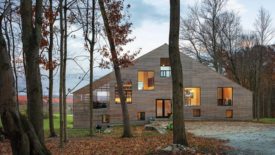
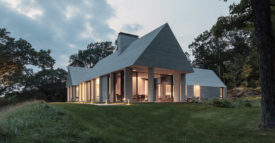
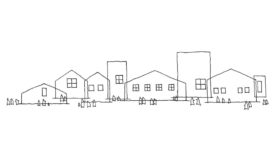
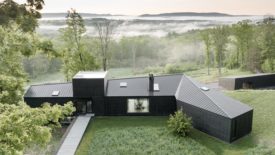
In their selection of RECORD Houses, the editors seek both innovative design and timeless architectural responses to the residential program. While the adjectives “innovative” and “timeless” verge on the oxymoronic, we would like to think we can make a case for conjoining them with these projects.
One such example, we would argue, is a substantial expansion built in 2010 for a house that RECORD profiled in 1957. The house addition, designed by Japanese architect Kengo Kuma for a couple in Connecticut, demonstrates that the classic lines and clean, clear, taut planes of architect John Black Lee’s original can be retained — and transformed with a new design. Indeed Kuma’s extension, by taking advantage of up-to-date glazing and building techniques, emphasizes the ethereal presence of a house floating above a wooded landscape.
Similarly, a house Barton Myers Associates designed in Montecito, California, retains a Modernist vocabulary. But in this case, it shows that a discrete rectilinear form rendered in steel and glass can still seem to merge with the landscape. Its quasi-organic siting gives us a new look at the machine in the garden.
In a secluded community in Salvador, Brazil, Marcio Kogan of Studio MK27 arranged a house around a grassy courtyard, much like Mies van der Rohe’s court house schemes of the 1920s and 1930s. In this instance, Kogan executed Modernism’s planar forms in rustic stone, wood, and clay tile. The both/and quality helps smoothly integrate the house into its residential context.
A weekend retreat in Connecticut, designed by Daniel Libeskind, may be the antithesis of Miesian principles, but it pays deference to other contemporaneous architecture of the early 20th century. Its roots in German Expressionism and Russian Constructivism show that the avant-garde past can be parlayed into a cozy and edgy solution today.
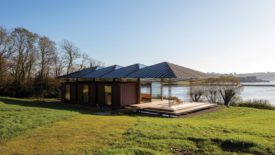
A timeless vernacular form combined with a note of the surreal manifests itself in a house in Leiria, Portugal, where architects Aires Mateus & Associates placed the bedrooms underground for privacy in a dense residential neighborhood. Five courtyards, including a partially covered central one, admit daylight to the lower level, while more light comes in through an opening carved out of a plastered, gabled roof. Another house assumes a villagelike approach: In Karuizawa, Japan, Koji Tsutsui Architect & Associates has created a series of wood pavilions, connected by a roof, that fan around a sloping, wooded site.
The response to the landscape obviously provides an interesting subtext to this collection: Houses float over the land, or perch on it; some are embedded in the earth, and others turn inward for privacy. By rethinking the house’s relationship with nature, architects have brought the timeless and the innovative together in unexpected ways.
—Suzanne Stephens