


Record Houses 2008
Glenburn House  H16 Maltman Bungalows Palmyra House The Rolling Huts Wall House Dairy House Nora House VH r-10 gHouse
Santiago de Chile, Chile
FAR frohn&rojas
With a limited budget of $147,000 and a 1.25-acre parcel of land in the suburbs of Santiago, Chile, a retired couple approached Marc Frohn and Mario Rojas of the firm FAR frohn&rojas to design a house for themselves and their son. While the couple initially imagined a building with strong interior/exterior separation, defined windows, and explicit door openings, FAR rejected this scheme and instead proposed a design based on a gradual transition between indoors and out, as well as a unique spatial hierarchy.
As Frohn explains, the house’s design was partly inspired by the ambiguous nature of the couple’s plot of land. While technically part of a subdivision, the site has a rural character, with dirt roads and mature trees that form hedges. “The hedges, while blocking off any visual connection to the immediate suburban context, opened to the views of the distant Andean mountains,” says Frohn, “which could easily be understood as the ultimate outer layer, in terms of building skin. And so this became the starting point for the project concentrating on the idea of a house based on a series of separated layers capable of structuring volume and, at the same time, fading it out, starting from its rough, intimate core to its delicate encasing.”
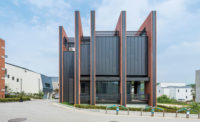
Opposed to the assumption that our living environments must be separated into discrete spaces with defined functions, the residence, dubbed the Wall House, investigates how the qualitative aspects of the wall, conceived as a complex membrane, structure our interactions with others and ourselves. The layers provide an attractive range of experiences, playing with a visitor’s perception of space. The house’s boundaries of the indoors and outside are blurred as one moves deeper into or farther away from the structure: Here, one doesn’t just move from room to room, but through different climatic zones.
Cheekily named, the house does not have just one set of walls enclosing a single space, but four, each with different structural, functional, atmospheric, or climatic qualities affecting the interior areas. At the building’s center is a rectangular concrete core and the ground-floor concrete slab containing gas-powered radiant heating that calibrates the house’s climate, as well as PEX hoses that cool down the house in summer. (This system uses far less energy than conventional HVAC.)
PeopleArchitect
FAR frohn&rojas
FAR köln
Germany
Design team: Engineer(s):
Structural Planning Wood:
Structural Planning Concrete:
HWAC General contractor: Constanzo ERIL Photographer
Cristobal Palma
|
Products |



Post a comment to this article
Report Abusive Comment