home
subscribe
free e-newsletter free e-newsletter
reader service
widget
advertise
Subscribe to Architectural Record today
and save 60% off the newsstand price.
Photo © Jayna Cooper

La Brea Avenue Residence

Jayna Cooper

Los Angeles, California
August 2010

By Ingrid Spencer

share:
print email comment
rate this project:
text size: A A

Talking to 27-year-old architect Jayna Cooper about the house she designed and built for herself on busy La Brea Avenue in Los Angeles, you’d think it all came about through luck and happenstance. But, as someone smart once said, luck is no accident.

It all started when Cooper’s boss and mentor, David Gray, FAIA, of David Lawrence Gray Architects, gave her the task of researching real estate to find properties that might be a fit for the development side of his firm. She found a 2,300-square-foot lot half way between Los Angeles and Santa Monica for $225,000, and though it wasn’t right for the firm, she couldn’t stop thinking about it. “I thought that it must be an error,” she says. “Nothing in LA is this cheap, even on a busy street right off the I-10 and a few blocks away from South Central.” It turns out there was no error. Cooper’s offer was accepted, but complications soon unfolded, leaving Cooper in escrow for a year, as the owner tried to force her to walk away from the deal. As evidence of her character, Cooper hung on. “I said no way am I going to let anyone bully me out of this. I waited it out, and during that year I designed about 20 houses for the lot.” The lot was finally hers, but the design she decided on—a renovation of the existing bungalow with two more detached structures—was rejected by the city. “They wanted me to connect the roofs and I wouldn’t do it,” she says. Cooper decided she couldn’t fight City Hall, and went back to the drawing board.

Thank goodness. With Cooper serving as architect, owner, and general contractor, the resulting 1,600-square-foot house (with a fourth-floor roof deck) satisfies all the zoning and site challenges (noise, privacy, security) to a T. Because the house is on such a high-traffic street, the city requires complete turnaround space for a car. With such a small property that means that almost the entire ground floor is dedicated to the driveway, carport, and turnaround space. Some ideas went by the wayside, including a Lazy Susan concept that actually might have worked. “My uncle owns a steel shop in South Carolina, and we designed the whole thing before deciding it wouldn’t be cost effective for the project,” she says. Instead, she designed a structural steel system to cantilever a portion of the house and separate the stair tower into its own massing component. “I was able to gain a secure ground-floor access point while providing an uninterrupted rectangular footprint for the floors above,” Cooper says. She calls her approach “an upside-down urban townhouse,” with the two bedrooms and baths on the second floor, and the third floor designed like a large open loft with living, dining, kitchen, and a small office. The third floor boasts 360-degree views of Los Angeles, lots of natural light, and a large balcony off the dining area. Having outside space in California is a must and Cooper maximized Los Angeles’s agreeable climate with the fourth-floor roof deck that takes up the entire 600-square-foot footprint, and a small backyard garden with a patio and fire pit.

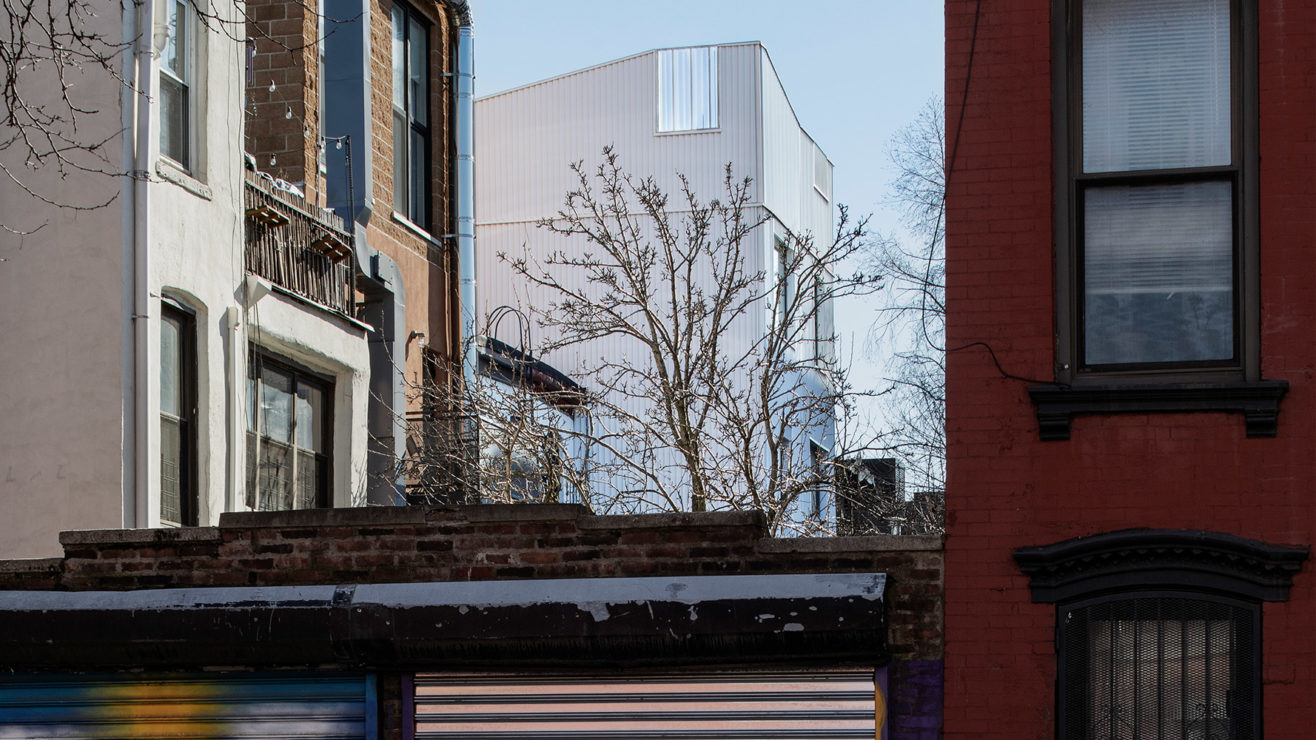
For security, Cooper limited ground floor access and secured it by doubling up on security systems and, using leftover materials, designing a front fence and gate with a solid top half for privacy and a transparent bottom half to keep any fence-jumpers from having a place to hide. For the inescapable noise, Cooper buffered the sound by placing bathrooms, cabinetry, and insulated windows against the street-side wall. “I think it’s disrespectful to the neighborhood to turn a house’s back to the street and completely close it off,” says Cooper. “I opted for a stimulating street elevation that contributes liveliness and inspiration to an otherwise architecturally unremarkable neighborhood.”

That unremarkable neighborhood is poised for change, though, as plans develop to build a metro station for the city’s new light-rail system just blocks away, and more people realize the potential of the area. “The feedback from the neighborhood has been pretty remarkable,” Cooper says. “One guy came up and shook my hand. I get people driving by who yell out ‘cool house!’ Clearly it’s different from other houses around it, but everyone around seems to accept it, and me. And the house itself, it’s been a revelation on so many levels. The amazing views were unanticipated. The flaws—I own them.” For Cooper, living in a house she designed and built has been a tremendous experiment as well as a huge upgrade in living conditions. “Every day brings a new discovery or simply an exciting idea for next time,” she says.

August 2010
 Reader Comments:

Sign in to Comment

To write a comment about this story, please sign in. If this is your first time commenting on this site, you will be required to fill out a brief registration form. Your public username will be the beginning of the email address that you enter into the form (everything before the @ symbol). Other than that, none of the information that you enter will be publically displayed.

We welcome comments from all points of view. Off-topic or abusive comments, however, will be removed at the editors’ discretion.
----- Advertising -----
View all
Reader Feedback
Most Commented Most Recommended
Rankings reflect comments made in the past 14 days
Recently Posted Reader Photos
View all photo galleries