subscribe
e-newsletter
contact us
advertise
from our archive
Projects   Residential – House of the Month – October 2005
Off the Record: Recent Blog Posts
The blog written by the staff of Architectural Record
View all blog posts >>
Recently Posted Reader Photos

View all photo galleries >>
Reader Commented / Recommended
Most Commented Most Recommended
Rankings reflect comments made in the past 14 days
Rankings reflect votes made in the past 14 days

Spur Lane House
 
 
Click here to view more images.

Photos © Tim Brown, Balance Productions

Ketchum, Idaho
SPG Architects

By Randi Greenberg

Architect Coty Sidnam and her former partner William Patrone of SPG Architects believe that materials, not decorative ornamentation, should represent spatial areas in architecture. Because this basic tenet clicked with the clients, Sidnam and Patrone became the architects of choice to build a year-round retreat for a couple who are connoisseurs of Modern architecture. The architects found themselves aced with the challenge of building a modern, five- bedroom residence on a half-acre lot in Ketchum, Idaho. As if the lot's confined spatial parameters, including a 20-foot grade change, were not enough, the area, which Sidnam describes as "highly built out, a neighborhood where houses sit cheek to jowl," had a serious privacy factor to consider. While ensuring that the clients' private lives would be hidden from neighbors, the architects also had to design the home to allow for maximum access to views of the surrounding landscapes.

The long and narrow shape of the site informs the home's design. Placement of large, glazed facades and entrances at the north and south ends takes advantage of distant mountain views. The east and west facades are wrapped in cedar wood and punctuated by strategically placed windows to permit privacy. Sidnam explains, "These small windows not only provide views but they also pull light into the room and present fantastic daylight opportunities." This solution is cleverly used in the kitchen, where the rectangular window facing the southwest perfectly frames Mount Baldy.

The resulting residence is a wood-wrapped, tubular-shaped structure perched and cantilevered on a concrete base. This design decision makes the fairly massive house—6,000 square-feet—appear less bulky. "Conceptually, the upper section of the home can be viewed as an extruded section of a tube that could extend infinitely," describes Sidnam, "the glass enclosures at each end of the house are the tube's cut off points."

The architects placed the more utilitarian portions of the home within the concrete base of the residence. This basement area includes the garage, a gym, a mechanical room, and a wine cellar. From here a stairway leads to the first floor where the main entry is located, as well as private areas including the master bedroom.

The program for the second floor—where the best views are available—consists of loft-like spaces for the more public areas. Discreet level changes demarcate and differentiate the spaces reserved for the kitchen, dining room, and living room. It is also at this level, where the importance of the two-story stairwell and the architects' attention to material is most easily witnessed.

By day, the stairwell is lit by an expansive skylight. By night, the space is illuminated by the glass bridge that connects the dining room to the study. The greenish glow of the bridge is attributed to cold cathode tubes placed on its underside. Sidnam says, "The bridge becomes a chandelier at night. It was important to find a light source that was invisible and not decorative." The architect's use of green-tinted Panelite on the walls of the stairwell helps refract light to the base of the stair.

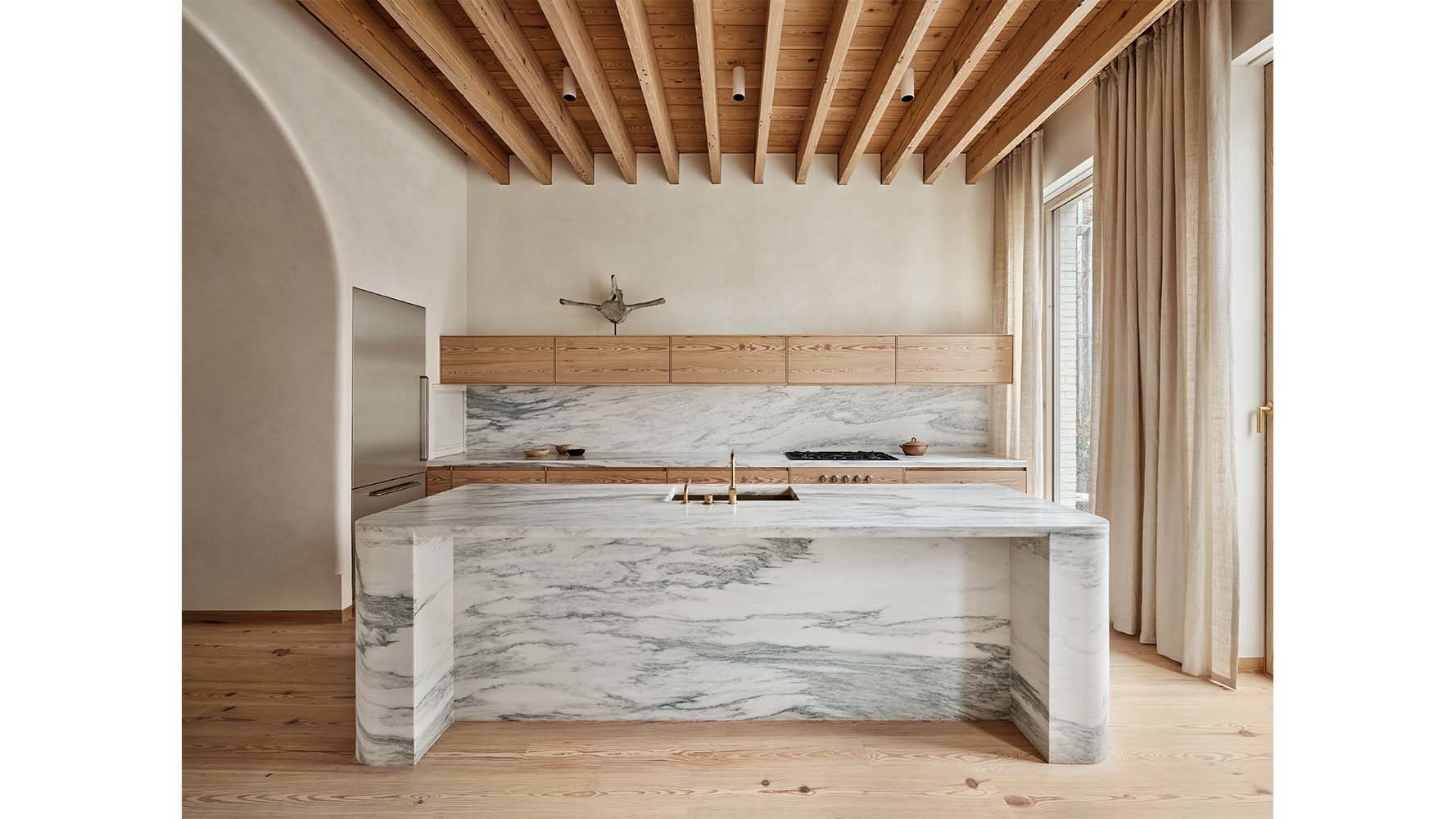
The stair is not the only place where attention to detail and material is utilized. In the kitchen, the architects developed their own surface for the cabinets when the clients and she were unable to find what they were looking for. "We back-painted matte acrylic to resemble maple wood," says Sidnam. In the public areas, the architects created a random pattern for the placement of in-ceiling lights. "Functionally, it helps you get light where you need it and avoids any mistakes during construction," she explains. And, like a kaleidoscope, the reflection of the random light patterns in the glazed enclosures alludes to the stars and the sprawling landscape just outside the window.

Gross square footage:
6,000 ft. sq.

View complete specs

ADVERTISEMENT
Special Subscription Offer: Get Architectural Record Digital Free!
© 2009 The McGraw-Hill Companies, Inc.
All Rights Reserved