Baton Rouge, La.
emerymcclure architecture
The architectural firm emerymcclure architecture
was founded in New York City in 1996 composed of the
husband/wife team Michael McClure and Ursula Emery McClure,
AIA. After years of urban living, Michael and Ursula decided
to leave New York and seek out a place to continue their architectural
works and take on teachings careers. They landed in Baton
Rouge, Louisiana.
In their search for a new home and what
turned out to be their newest project, Michael and Ursula
came across the historic neighborhood of Beauregard Townone
of the oldest planned suburbs in America in the midst of urban
renewal. Their search led to an abandoned house demolished
by fire over a decade ago. Michael explains, "It wasnt
even a house anymore, it was more like a site since only the
frame and the burnt out shell remained. Ursula and I were
inspired by the open space." Michael describes the house
as a shotgun and says "its typical to architecture
in warmer climates. The house is 12 to 14 feet wide, one room
leads to the next, all the doors line up to allow for a cooling
effect and direct light is received throughout the house."
Michael and Ursulas house was once
a shotgun duplex. "The major idea for our house was to
find a dialogue between the old and the new", Michael
explains, "we wanted to find a way to blend traditional
Southern architecture and its unique culture with our ideas
of contemporary architecture." In keeping with that spirit,
one side was kept as a traditional shotgun and the other side
was dramatically modified by realigning doors and windows.
Since the partition dividing the two
houses was badly damaged from the fire, the architect couple
was able to think creatively. Michael explains, "We kept
the old stud wall separating the duplex exposed, allowing
us to walk through easily. We mixed the Mies Van der Rohe
idea of an open plan with the traditional 2X4 construction
used in the South." With the partition still very much
a part of their design, Michael and Ursula could use the stud
wall as a way to separate public and private spaces.
The left side remained in its original
shotgun form becoming what Michael and Ursula refer to as
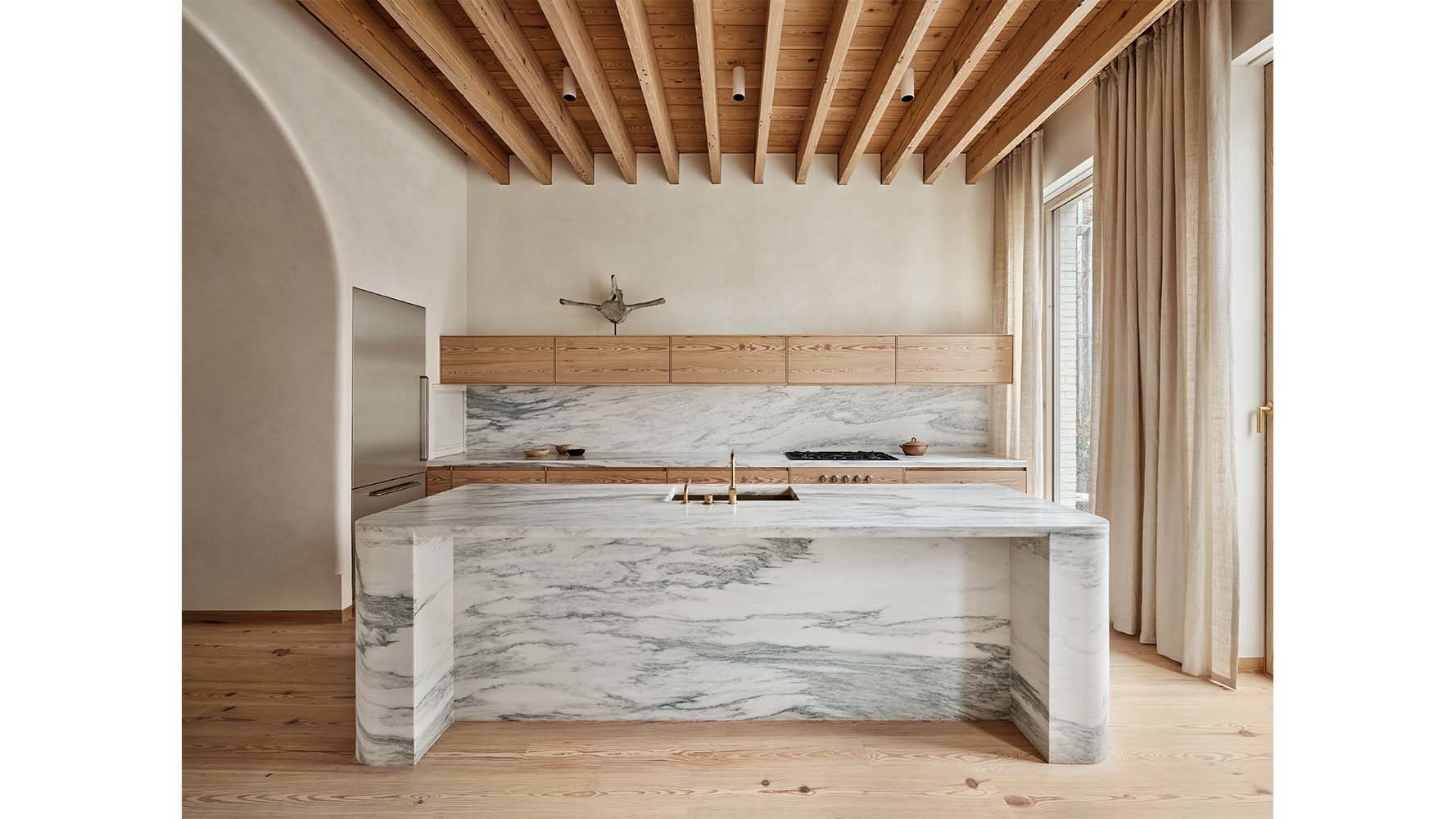
"the public realm". This section of the house contains
the kitchen, living and dining rooms, and within this section
there are no doors or solid walls. The living and dining rooms
are connected by black center-pivot shutters. Michael explains,
"Shutters are a traditionally Southern notion which you
often see hanging on the outside of homes. We decided to bring
the shutters indoors so we could modify the space between
the living and dining room by opening and closing them depending
on the occasion." Another deliberate detail on the public
side of the house is the rubber kitchen floor. Michael points
out that this detail again brought together their personal
style with the prevailing Southern influence. "Baton
Rouge has many petro chemical industries; therefore rubber
is a local product. Also, Ursula used to practice ballet on
rubber flooring and the floor represents that side of her."
The bedrooms, bathrooms, and office make
up the private side of the house. As on the public side, attention
to detail preserved the traditional style. The flooring on
this side is existing oak. Michael says, "We salvaged
what oak we could from both sides of the house in pieces and
refinished it. There was enough to cover one complete side."
The use of shutters in the guest bedroom, or what Michael
and Ursula refer to as "the green box", allows access
to the main living space when open. In the main bedroom, they
fashioned a wall with varying sized windows. Michael explains,
"We took the existing transoms from above doors and relocated
them to the bedroom."
Michael and Ursulas plan to design
by "taking what was here and moving it around" has
proved successful. Home tours often visit the 640max house
and people are delighted by the results. Michael states, "With
the creation of this house Ursula and I bridged the traditional
with the contemporary--its how we teach, how we practice,
how we try to live."
By Randi Greenberg
Gross square
footage:
1,600 sq. ft.
Total construction
cost:
$120,000
View
complete specs
|