Croton-on-Hudson, N.Y.
David Wallance, AIA
In 1991, David Wallance began working
on a spec house that he wanted to build in Croton-on-Hudson,
a village about 30 miles north of New York City along the
Hudson River. At the time, he was living in Brooklyn, and
was working with Polshek Partnership in Manhattan, where he
still works as a senior associate. He worked on the house
for several years. Then, in 1995, Wallance and his family
moved in.
"I began to realize that this wouldnt
be a truly profitable spec house," Wallance said. "It
was too nice."
Even before he decided to move his family
into the house, Wallance started adding personal touches to
the design.
"Programmatically, it was very generic,"
he said. "It boiled down to a center-stair Colonial.
But even though it started out as a spec-build, I began to
incorporate a lot of memories and references to other architecture."
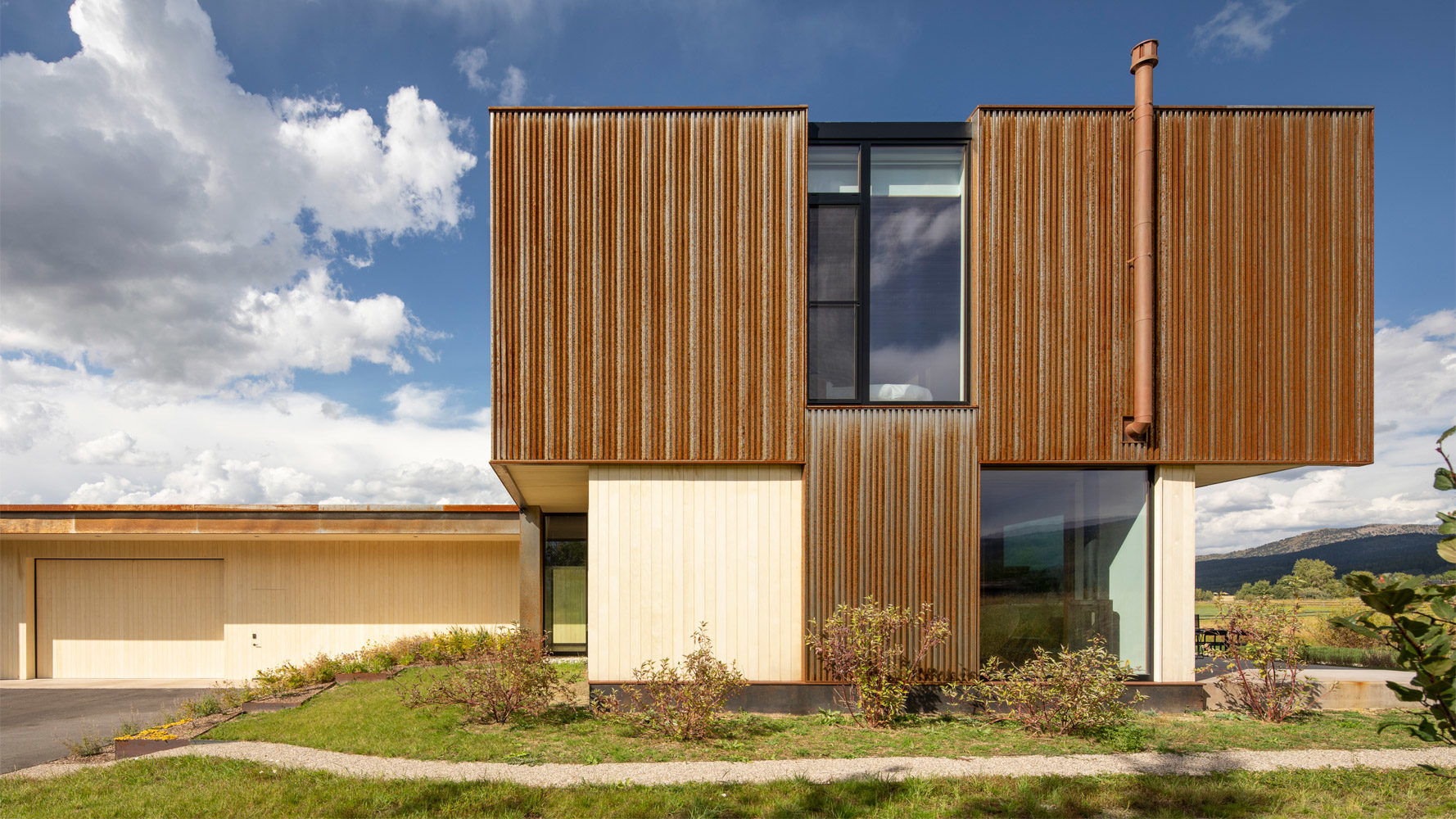
Wallance mentioned Corbusiers Villa
Stein as a specific design inspiration, since that house and
his share an almost cubic vertical arrangement and a prominent
piano nobile in their designs. Wallance challenged himself
to articulate the blank, vertical facades of the house.
"I saw it almost as an academic
exercise, as a case study," he said.
But the shape of the house was not chosen
on a whim. Zoning regulations in the village required the
house to have two complete septic fields, leaving a small
area on which the house could sit.
"The siting was very tight,"
Wallance said. "That dictated a vertical organization
to the house. The stair became very important, so I created
it as a sort of winding sculptural form that stitches the
house together."
He also noted that he designed the stair
with a shallow tread-to-riser ratio, so that they would be
easy to climb over and over again in the course of a day.
When Wallance and his family moved into
the house, it was only partially finished. Working as his
own general contractor, he finished the house over the next
five years, completing unfinished plywood interiors and refining
structural elements, such as a bracing system for the roof.
And then, in 2001, he sold the finished house.
He did not, however, sell the house because
he was unhappy with it. In fact, his eight-year-old daughter
protested the move, because she wanted to keep her room. Moving
out just completed the original plan to sell the house.
And in fact, Wallance is working on designing
another house, this one specifically for him and his family.
And he has learned from the experience of being both speculative
architect and the resident of his own spec house.
"I designed a house with 3000 square
feet of livable space," he said. "But for five years,
we were living in about 1900 square feet of space. That really
affected our thoughts on the second house. Instead of 3000
square feet, were going to build 2000."
He also realized the tension between
what makes for great architecture and what makes for a comfortable
place to live (which is not to say that he and his family
were uncomfortable in the house at all).
"If you find a place to put all
the stuff, it makes the open spaces seem that much cleaner,"
Wallance said. "Its a dichotomy. I dont think
I could live like a minimalist, but I dont think theres
a better way to create an architectural experience."
Kevin Lerner
Gross square
footage:
3,900 sq. ft.
View complete
specs
|