


Unlike the heads of neighboring cities along the Arabian Gulf on the architectural fast track to build office buildings and iconic cultural institutions, the Qatari Royal family, headed by the Emir, His Highness Hamad bin Khalifa al-Thani, has been deliberate in the planning of its emirate. The capital city of Doha is a patchwork of old quarters with a traditional bazaar, or souk; neighborhoods from the 1960s; and an emerging commercial district with glittering towers. Finally, there are patches of dusty desert, the terrain that served its disappearing Bedouin culture before the country’s newfound wealth in natural gas.
When Ieoh Ming Pei’s Museum of Islamic Art was inaugurated last fall in Doha, the occasion was more than a star-studded event of celebrities from the art and auction world. In her opening remarks as chairman of the Qatar Museums Authority, the Emir’s daughter, Her Excellency Sheikha Al Mayassa bint Hamad bin Khalifa al-Thani, dressed in a traditional black abaya and shayla (robe and head scarf), elucidated the museum’s mission as an investment in the education of Qataris through the investigation of Islamic culture throughout the world. Those in attendance felt the pulse of a cultural renaissance that joined a rich past with a hopeful future.
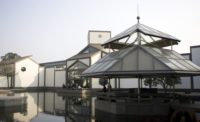
With this mission, the museum had set aside the original choice of Lebanese architect Rasem Badran, made by a jury in 1997. It offered the commission to I. M. Pei, who had been recommended by the general manager of the Aga Khan Trust for Culture, Luis Monreal. From the beginning, Pei says, he conceived of this new venture as completing a triumvirate of his museums that required specific cultural allusions because of their locations. The other two examples are the 1997 Miho Museum in Shiga, Japan, configured like a hilltop village, and the 2006 Suzhou Museum in his family’s ancestral city of Suzhou, China, rendered in the traditional whitewash with gray granite roof tiles. In both cases, he built up the walls volumetrically into the geometric forms characteristic of his architecture, at least since the East Building of the National Gallery in Washington, D.C. (1978).
Pei conducted an extensive geographic search for the essence of Islamic architecture only to discover the wide range of regional differences separating, for example, the Grand Mosque in Córdoba, Spain (begun in the 8th century), from the mosque in Fatehpur Sikri in India (completed in 1574). Finally, in the arcaded courtyard of the Mosque of Ahmad Ibn Tulun in Cairo, he found inspiration in the 13th-century domed ablution fountain with its arched base that steps up in severe block forms, where sharp angles are delineated by sunlight and shadow.
Presented with suggested building sites along Doha’s Corniche, or headland, along the Gulf, Pei feared the possible encroachment of the city. He ultimately established the museum 195 feet from the mainland on an artificial island connected to the shore by three bridges. Shortly after the island was created in December 2003, construction of the concrete structure began, and it was finished in late 2008. The museum was financed by the Qatar Petroleum Engineering Department, and the Qatar Museums Authority oversees its management.
The 376,740-square-foot building’s formation of angular volumes hiding a central dome within a tower gives the impression of a great fortress separated from land by a narrow moat. To complete the setting, Pei extended the Corniche into the Gulf, and the resulting landfill appears as a jutting crescent that embraces the museum. It also provides a promenade complete with an avenue of palm trees and other tropical flora.
With all their angularity, the museum’s blocks of creamy French limestone reflect blinding sunlight, contrasting with deep shadows that shift continually throughout the day. As with his buildings in Japan and China, Pei has successfully married motifs of indigenous architecture to his clean monumental Modernist style.
Placed around the perimeter of the museum’s central atrium, the first suite of galleries displays objects according to genre: calligraphy, ceramics, metal, glass, ivory, scientific instruments, textiles, and precious stones. In the second suite, the displays are organized geographically and historically to demonstrate the influential sweep of Islamic culture in a journey through three continents—from Córdoba to Samarkand—from the 7th to the 19th century. The objects glow against surfaces of gray porphyry stone and Louro Faya, a Brazilian lacewood that has been bush hammered and treated to give it a metallic appearance.
The secret to Pei’s creativity in his later years is the nonagenerian’s abiding curiosity and his selectivity as a means of ongoing personal growth through new challenges. Within this context, he has designed a museum that is both international in scope and design and local with respect to architectural customs inherent in the indoor/outdoor manifestations of Islamic design. Each element expresses the strength of his design concept to incorporate experiences from the past into a vision for Qatar’s future. Is this Pei’s last building? Don’t bet on it.
PeopleArchitect Design team: Gallery design: Consultants: Mechanical Engineer: Lighting Designer: Local Associate: Acoustics: AudioVisual: Fountain: Marine Engineering: Fire Protection/ Life Safety: Gallery Lighting: Signage: Audio Visual / IT Design: Security Design: Kitchen Design: Conservation: Quantity Surveyor and Manager: |
Products |


Post a comment to this article
Report Abusive Comment