San Francisco, California
Renzo Piano calls his new building for the California Academy of Sciences a “soft machine.” “It sounds better in Italian, because machine brings to mind the process of making and Leonardo in his workshop,” he explains, pronouncing the Italian word macchina. The architect and his team at the Renzo Piano Building Workshop (RPBW) conceived of the 410,000-square-foot project as a manifestation of the academy’s mission to study, store, and exhibit the wonders of natural science. “It’s a machine for preserving nature,” says Piano. Great idea. But this is a big machine, at a key location in Golden Gate Park, and it needs to engage a lot of different people: the 10-year-old kid looking for the live penguins, the 40-year-old ichthyologist working there, and the romantic couple sitting on a bench in the adjacent plaza, called the Music Concourse.

Part museum and part research-and-storage institute, the academy occupies the site of its predecessor—an 11-building complex erected piecemeal from 1916 to 1976 and damaged beyond repair by the Loma Prieta earthquake in 1989. It faces Herzog & de Meuron’s de Young Museum [record, November 2005, page 104] across the Music Concourse, creating a dialogue between equally famous foreign architects working on public buildings of equal scale. While Jacques Herzog and Pierre de Meuron wrapped their museum in an array of copper panels (dimpled, bubbled, and flat), and Piano surrounded his with extremely clear, low-iron glass, both projects attach themselves to the park—the de Young with fingers of landscaped space entwined with gallery wings, and the academy with enormous, floor-to-ceiling views outside. The firms’ very different approaches to similar sets of issues makes this pairing one of the most fascinating in the country—on par with Kahn and Ando in Fort Worth. When asked about the academy’s relationship with the de Young, Piano says he didn’t think about it much. “This is what you get when you are yourself and they are themselves.”
Piano’s initial sketch for the academy shows a long, undulating roof in section: Where large programmatic elements sit, it rises up to accommodate them, and where less is needed, it dips down. “So it becomes organic,” states the architect. “At first, I wanted to do the roof as a wood structure, to build it like the keel of a boat,” he explains. In the end, though, it was made of steel, in part to limit the number of trees cut down. From the start of the project, Piano collaborated with Chong Partners (now Stantec), even bringing designers from the San Francisco firm to work in his Genoa office for certain periods.
Piano saw the roof as a metaphor for the entire project. “I saw it as topography,” he adds. “The idea was to cut a piece of the park, push it up 35 feet—to the height of the old buildings—and then put whatever was needed underneath.” From the beginning, he envisioned a green roof that would be an extension of the park and serve as a thermal buffer for the spaces below. “Twenty-first-century architecture must be about sustainability,” he asserts. “This isn’t a moralistic stance; it’s simply what architecture must be.”
For an institution devoted to the natural sciences, such an attitude was particularly important. The building, which received a LEED Platinum rating after it opened at the end of September, employs an impressive range of green strategies, including recycling 90 percent of the demolition waste from the old buildings; using recycled material for all of its structural steel; incorporating insulation made from recycled blue jeans; employing heat-recovery systems to capture and use heat generated by HVAC equipment; using radiant heating in floors; ensuring that 90 percent of regularly occupied space has access to daylight; naturally ventilating almost the entire building (see sidebar, page66); and reducing the need for potable water by using low-flow plumbing fixtures and reclaimed water from the City of San Francisco.
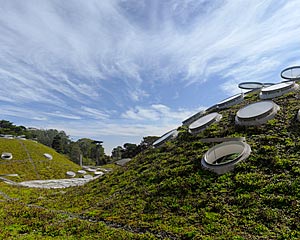
The green roof, which bulges to form seven hills, plays a critical role in the building’s sustainable-design performance—reducing storm-water runoff by 98 percent, providing thermal insulation, and creating a 2.5-acre habitat for 1.7 million native-Californian plants and all kinds of insects and birds. The undulating roof incorporates glass panels above part of a central piazza and small circular skylights set into the various “hills.” The skylights, which are controlled by an automated system, all open and close to naturally ventilate the spaces underneath. A solar canopy wrapping around the perimeter of the building contains more than 55,000 photovoltaic cells that can generate 213,000 kilowatt hours each year (at least 5 percent of the academy’s energy needs). According to Arup, which provided sustainability-consulting services, as well as structural and mechanical engineering, the building will consume 30 to 35 percent less energy than required by California’s already strict building code.




Post a comment to this article
Report Abusive Comment