St. Louis, Missouri
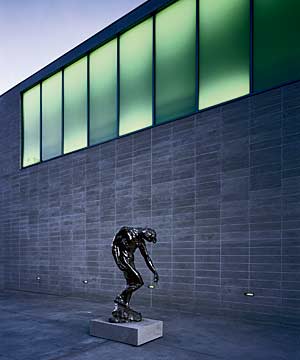
Rarely does an architect get the chance to add significantly to, much less transform, work done decades before. For the Japanese architect Fumihiko Maki, the potential for a new arts center at Washington University in St. Louis, Missouri, brought him back to the campus where he had taught and designed his first project, over 40 years ago. The Sam Fox Arts Center, situated at the southeastern border of the 13,500-student campus, tested Maki’s powers of urban and collegiate planning over the nine-year period of its gestation. Opened in 2006, the center’s two primary buildings bring modernity to the red granite Collegiate Gothic campus while knitting together formerly disparate disciplines and three existing structures into a unified place.
The story begins with Steinberg Hall. Called as a teacher to the campus from Harvard University by former Dean Buford Pickens in 1958, young Maki, identified with the Japanese Metabolist movement, received a commission to design a new structure adjacent to the existing architecture building to house the art history and archaeology departments, an art gallery, an art and architecture library, and an auditorium.
Fast forward to 1997, when a committee under the tutelage of then-dean Cynthia Weese, FAIA, selected former faculty member Maki to conduct a study for a “visual arts center.” With strong support from the university’s chancellor, Maki faced an ambitious program that included a long list of needs: new gallery space with substantial supporting facilities; space for sculpture and ceramics and graphics; increased library facilities; and room for art history and archaeology, among other requirements. “We knew he would be able to successfully deal with extremely complex programmatic elements and campus design issues,” Weese said. “And we all felt that his clear and very serene modernist vocabulary would be compatible with the existing buildings.”
Simplicity should not be confused with lack of subtlety, however. The Sam Fox Arts Center, while marked with Maki’s characteristic restraint, achieves a pared-down dignity in the smallest details. If the galleries lack the formal exuberance of certain contemporary museums, they also embody and honor their purpose, that of a university museum, in a way that bespeaks confident self-knowledge. While Maki’s hallmark restraint may not engage the public with dramatic bravado, the flow and the ease of the interlaced composition will draw the crowds in, allowing easy interactions between art and the observer, between student and the whole campus. At the larger scale, the complex suggests how to complete the total campus through specific placemaking that allows for complementary expansion, adjacent to this complex and across the university’s entrance drive.
PeopleArchitect Design Architect: Architect of Record: Structural Engineers: MEP Engineers: Lighting: Signage & Graphics: Landscape: Civil Engineers: Code: General contractor: Photographers: CAD System / Software:
|
ProductsExterior Cladding Structural System: Exterior Cladding: Aluminum Curtain Wall: Extruded corrugated aluminum wall panels - custom profile PVDF Maki Silver Window System: Roofing: Aluminum standing seam roof - PVDF Maki Silver Skylights: Interior Finishes: Integral color concrete acid washed finish Tile carpet - by C&A Roll carpet - by Karastan Exposed concrete stain finish Linoleum Flooring - Marmoleum by Forbo Interior Finsishes: Walls Painted gypsum wall board 1" x 1" mosaic ceramic tile by Daltile Fabric wall covering by Design Tex Interior Finishes: Ceilings Doors: Glass sliding doors by Hufcor Fire control doors by Adam Rite Gallery sliding doors by Modernfold Rolling overhead doors by Cookson Hardware: Hinges by Hager Closers by LCN Exit devices by von Duprin Pulls by Rockwood Cabinet harware by Soss Lighting: Exterior pole lighting - Hess America Exterior step lights - Bega Downlights by Lightolier Elevators: |


Post a comment to this article
Report Abusive Comment