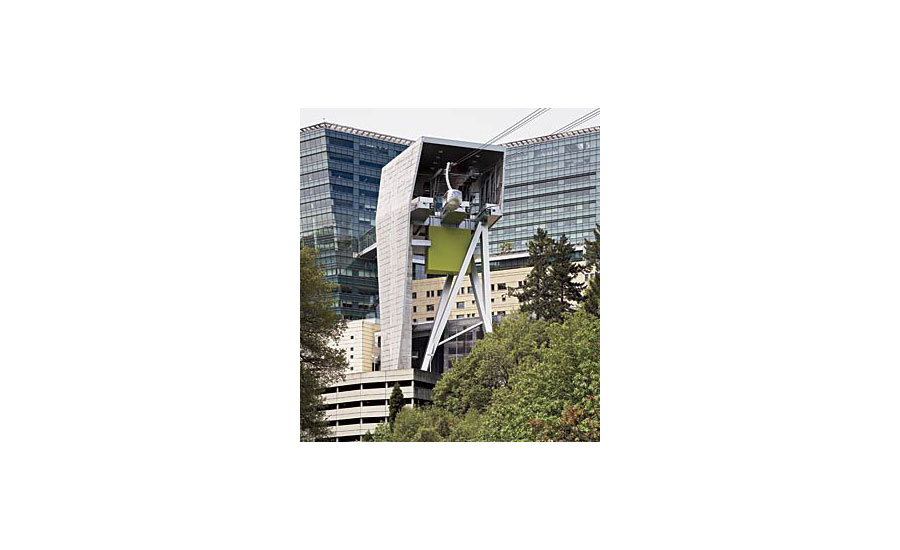
Instead of landing on a mountainside and anchoring into bedrock, Portland, Oregon’s new aerial tram soars between two 200-foot towers, representing Olympian engineering gymnastics. Similarly sized high-rise buildings, with no tram, might require a dozen load cases. By contrast, the Portland tram’s structural engineers, Arup, calculated more than 2,000 separate cases for such structural feats as bracing the 165 million pounds of overturning moment caused by holding 1 million pounds of cars and cables in the air; the 20,000 tons of torque triggered by the tram cars passing one another; and the 80 tons of wind load carried by the cables stretching along the 3,300-foot route.
In addition to constructing sky bridges and buildings that span ravines, the hilltop Oregon Health and Science University added the aerial tram as its newest connecting structure. Given that the tram cars would fly over Portland’s oldest national historic district, two parks, 13 streets, and eight freeway lanes, the architecture needed to be compelling. The developers, university, and city organized an international design competition, which the Los Angeles/Zurich firm Angelil/Graham/Pfenninger/Scholl (agps architecture) and Arup’s Los Angeles office won over three other teams. Inspired by the work of celebrated Swiss timber engineer Julius Natterer, as well as the region’s tradition of loggers’ yarding poles, the agps/Arup team initially proposed towers made of high-tech wood laminates and mirror-finished tram cars shaped like bubbles.
Reality quickly intruded. To fully integrate with the campus’s so-called ninth floor—a single-level series of corridors and sky bridges connecting all of the hilly campus’s patient-care and research facilities—the tram needed to land at a new hospital expansion already under construction. University officials worried the tram’s 470-kilowatt motor turning an 8-foot “bullwheel” coupled with a 40-ton concrete counterweight constantly moving up and down would vibrate the hospital’s microsurgery facilities. This led the engineering team to structurally separate the tram from the hospital. Thus, a freestanding tower had to serve as the upper station while holding 1 million pounds of tram cars and cables aloft.
Graham describes the tram’s design as “all engineering.” Budget cuts, for instance, nixed photovoltaic cells, glass, and polycarbonate for the tram stations’ windscreens. So, working with facade engineering specialists Dewhurst MacFarlane and Partners of New York, Graham switched to the coarsest available expanded-aluminum mesh. This first-ever application of the material as cladding required extensive wind testing. The result blankets the muscular, no-nonsense docks in ethereal shadows and shimmering moiré patterns.
PeopleArchitect: agps architecture Sarah Graham, partner in charge, AIA.
Project Team: Marc Angélil, Moshik Mah, Mark Motonaga, Joe Baldwin, Scott Utterstrom and Chet Callahan
Engineer(s): Arup, Los Angeles: Dewhurst Macfarlane and Partners: Geo Design Inc.: W&H Pacific:
Consultant(s): Landscape: agps architecture
Lighting: HLB lighting design Project Management: Portland Office of Transportation,Ethos Development
General contractor: Kiewit Pacific Co.
Photographer: Eric Staudenmaier Andrea Helbling Arazebra
|
ProductsExterior Cladding High Performance Coating (Exterior Paint on Steel Structures) Concrete Fiber Board Cladding
Elevator Schindler Elevators
Waterproofing American Hydrotech
Interior/Exterior Paint Sherwin Williams
Glass Oldcastle Glass
Storefront System Kawneer Louvers
Light Fixtures Bega Flood Barrier Gypsum Sheathing Expanded Aluminum Cladding Panels Expanded Aluminum Cladding Fastening System Structural Steel Fabrication |


Post a comment to this article
Report Abusive Comment