The southeast facade of the U.S. Federal Building in San Francisco is covered with a perforated stainless-steel scrim that seems at once to be a diaphanous veil and a sharp-edged protective shell. And the dual nature of this 18-story office tower seems just right for its rapidly changing but still gritty environs, where pawn shops sit cheek by jowl with luxury condos. Completed in March, the 240-foot-tall tower dominates the mostly low-rise South of Market skyline and is reportedly snarling traffic on nearby Interstate 80 as drivers slow down to take a look. But its height and gutsy exterior are not the only reasons the Federal Building is getting attention. It also has a set of ambitious environmental goals.
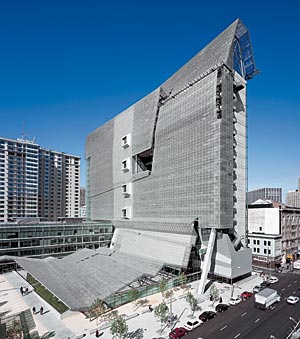
The designers and the owner, the General Services Administration (GSA), say that the tower, which relies on natural ventilation to cool its upper 13 floors, will consume 33 percent less power than an office building designed to comply with California’s stringent energy code, Title 24. The majority of the workspaces are largely illuminated by daylight, a strategy that is expected to reduce energy use associated with lighting by about 26 percent over a standard office building. In addition, replacement of half of the portland cement in the exposed-reinforced-concrete structure with blast furnace slag—a by-product of steel making—prevented release of approximately 5,000 tons of carbon dioxide into the atmosphere.
The tower is the product of a highly collaborative design process, and its form, structure, and orientation are fully integrated to achieve these efficiency targets. “The building is defined by performance,” says Thom Mayne, FAIA, principal of Morphosis, the project’s lead design architect. Of course, there are elements of the building that are more about expression than function, such as its roof, where the stainless-steel scrim angles up and folds over like a rakish cap. “At the top, the scrim is pure form,” says Mayne. “It’s a balance of poetry and pragmatics.”
Mayne’s “pragmatic” concerns are not limited to energy and resource conservation. The tower is the centerpiece of a 605,000-square-foot, $144 million, Morphosis-designed complex, which has a significant urban and civic agenda. In addition to the tower, it has a four-story barlike office annex, a freestanding café, and a day-care center. Although the day-care center is accessed through the tower lobby, enrollment is nevertheless open to neighborhood children. The architect has given this facility a strong plaza presence with the shading scrim—which pulls away from the tower near its base—unfolding to shelter the semisubmerged building like an irregularly crimped accordion.
PeopleArchitect: Lead Design Architect: Principal: Project Manager: Project Architect: Project Assistants: Caroline Barat, Gerald Bodziak, Crister Cantrell, Delphine Clemenson, Todd Curley, Alasdair Dixon, Haseb Faqirzada, Chris Fenton, Arthur de Ganay, Dwoyne Keith, Sohith Perera, Kristine Solberg, Natalia Traverso Caruana Executive Architect: Engineer(s): Natural Ventilation Modeling: Geotechnical: Consultant(s) Landscape: Lighting: Acoustical: Other: Signage: Cost Estimator: Curtain Wall: Blast Consultant: Code: Vertical Transportation: Construction Manager: Inspection & Testing: General contractor: CAD system, project management, or other software used:
|
ProductsStructural system: Concrete shear wall system, wave slave with upturned beams Annex: Childcare and Pavilion: Scrim Support: Exterior cladding Metal/glass curtainwall: Perforated stainless steel sunscreen panels with exposed galvanized Clear anodized aluminum flatlock metal panels Concrete: Roofing Glazing Doors Wood doors: Interior finishes Acoustical ceilings: Custom galvanized wire mesh panels in public areas Suspension grid: Office partitions: Cabinetwork and custom woodwork: Paints and stains: Interior stair & guardrails: Wallcoverings: Venetian Plaster Maharam Action Fabrics Paneling: Perforated maple wall and ceiling panels: Special surfacing: Floor and wall tile: Resilient flooring: Linoleum: Carpet: Raised flooring: Furnishings Lighting Downlights: Public corridor exposed downlights: MR16 downlights: Restroom and hallway sconces: Lantern fixtures: Office troffers: Lobbies linear: Exterior: Canopy linear: Neon artwork: Controls: Conveyance Mechanical Systems: Annex, Childcare, Fitness Center and Lobby: Variable-air-volume system with economizers Tower, Conference Center and Levels 2-5 Office Areas: Tower, Levels 6-18 Perimeter Areas: Tower, Levels 6-18 Enclosed Cabins: Electrical Systems: Plumbing Systems: Automatic high rise fire suppression system |



Post a comment to this article
Report Abusive Comment