Frankfurt, Germany
In recent years, Christoph Ingenhoven, who began his practice in 1985 in Dusseldorf, has emerged as a formidable player in the architectural market owing to an approach that emphasizes technology and sustainability. Ingenhoven’s major recent work in Germany, the new Lufthansa Aviation Center, is strategically located right next to Frankfurt airport––therefore subject to considerable constraints in terms of air pollution and noise emissions.
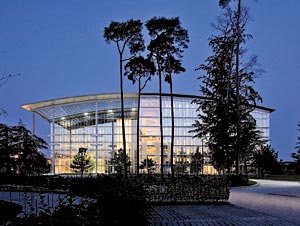
The site is squeezed in between one of the most heavily used German autobahns, the ICE high-speed railroad line from Frankfurt to Cologne, with the airfield to the south. Ingenhoven’s competition-winning scheme for Lufthansa is a powerful modern structure, subdivided into ten wings, and separated by fully glazed gardens that function as thermal buffer zones and provide fresh air to the office areas for Lufthansa’s 1850 employees. The overall envelope of double and triple-layered glass, plus various climatic tools, such as the use of embedded hydronic loop systems to activate the thermal mass of the exposed concrete surfaces in storing and dispersing heat or cold at a later time along with additional heat recovery methods, highly efficient sun-shading, and air-ventilation systems are impressive. All keep the thermal loss and energy consumption to a mere 355 kilowatt hours per square foot, at such a low level that the building comes close to complying with the German standard for low-energy houses. These astonishing results are the product of close collaboration with climate engineer Klaus Daniels, founder of the pioneering climate consultancy HL-Technik. Ingenhoven also joined forces with structural engineer Werner Sobek to define the shapes for both the glazed and concrete roof modules. The glazed atria roofs boast a free 60-foot-span and consist of barrel-shaped grid shells of non-bending, welded rectangular steel sections. They connect to the likewise barrel-shaped concrete roofs covering the office spaces, which while shell-like in appearance, are basically bent flat 11-inch-thick slabs that rest on single high-performance concrete columns or cores. At the junction of the two roof systems, Ingenhoven introduced a special wing-shaped spoiler, based on aerodynamic experiments. The spoiler creates a permanently neutral wind pressure zone above it, which helps suck exhaust air out of the atrium.
Today, the airport is already operating at full capacity and plans are afoot to build a third runway north of the highway that will enlarge the capacity of the airport from 53 million to 75 million passengers a year.
PeopleArchitect: Team Architects - Construction Team Architekten - Competition Interior designer: Engineer(s) and Consultant(s): Project Management: Structural Engineering: Building Services: Energy Strategy- Consulting for the Client: Facade Planning: Building Physics: Industrial Aerodynamics: Radar Investigation: Lighting Artificial- and Daylight: Organizational Planning: Kitchen Planning: Transportation Systems: Traffic Engineering: Surveying: Vertical Access Planning: Soils Investigation: Fire Protection: Security Planning: Facility Management: Art concept: Photographer(s) Holger Knauf, Düsseldorf CAD system, project management, or other software used:
|
ProductsFacade: Metal ceiling lining Furniture: Lighting: Room-specific control and operating unit: Washbasins: Grip/fittings: |


Post a comment to this article
Report Abusive Comment