Providence
How do you turn a Renaissance Revival banking hall from 1917 into a 21st-century visual-arts library and do it on a tight budget? That was the challenge facing Office dA, the Boston-based architecture firm headed by Nader Tehrani and Monica Ponce de Leon, when it started work on the 55,000-square-foot Fleet Library at the Rhode Island School of Design in Providence.
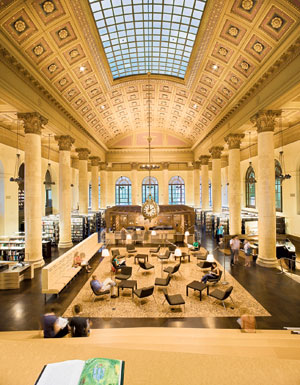
Designed by York & Sawyer and listed on the National Register of Historic Places, the old building features an interior space 180 feet long and 114 feet wide and topped by an elaborately coffered, barrel-vaulted ceiling. The banking hall might easily have served as a magnificent reading room, if only the school had the luxury of devoting all of it to one use. But the library's program called for 90,000 books in open stacks, seating for 250 people, 400 periodical titles available for browsing, and a variety of different study, administrative, and multimedia support spaces.
Even with a balcony running along one side of the banking hall and a second floor wrapping around the vaulted ceiling, there wasn't enough space for all of the programmatic elements. “We had to make the height of the space work for us,” says Tehrani, who studied at RISD and, like his partner, has taught there. Despite initial resistance from the client's design-review committee to interrupting the hall's impressive volume, Office dA developed a “double-decker” strategy that inserted a two-level study pavilion and a single-level circulation center within the grand space.
“We wanted to maintain the scale of the banking hall,” states Ponce de Leon, “so we decided to install two objects as if they were informal elements in an ancient ruin.” The old bank building was actually in good condition—hardly a ruin—but the architects imagined their project as adding a new layer to a historic place, much like the multiple strata we see today at the Roman Forum. Rather than obscuring the past, the new elements add a modern resonance. Office dA also wanted its work to have a temporary quality that contrasts with the more permanent nature of the Italianate setting.
To respect the old building, the architects developed three different strategies for the elements added inside it. The largest pieces—the study pavilion and the circulation center—are designed as insertions, milled by computer-numerical-controlled (CNC) machinery off-site, and then assembled quickly inside the banking hall. Their prefabricated nature not only sets them apart from their historic context but implies they could be dismantled and carted away if needs change in the future.
PeopleArchitect Principals in charge: Project architect: Project manager: Project team: Structural engineer Senior project manager: Mechanical/HVAC engineer Electrical engineer Consultant(s) Signage: General contractor Project manager:
|
ProductsWindow Treatments Glazing Doors Hardware Hinges: Closers: Pulls: Railings: Interior finishes Suspension grid: Cabinetwork and custom woodwork: Cabinetmaking: Paints and stains: Special surfacing: Resilient flooring: Carpet: Furnishings Reception furniture: Chairs: Tables: Upholstery: Shelving: Signage: Lighting Stack Lighting: Downlights: |




Post a comment to this article
Report Abusive Comment