|
Information Services Building
Dunedin,
New Zealand
Hardy Holzman Pfeiffer Associates
A highly dramatic gateway for a new
kind of library on an old campus

© John Gollings |
|
For more photos click on 'photos
& drawings' above.
To see the people and products
behind this project click on 'people & products.'
|
By Elizabeth Arcuri
A picturesque collection of stone-front
Victorian buildings gives a strong identity to the core of
the University of Otago, founded in 1868 on a peninsula of
the South Island of New Zealand. Between 1960 and 1980, however,
bland clusters of concrete structures along the southern part
of the campus altered the gestalt. Now Hardy Holzman Pfeiffers
(HHPA) 200,000-square-foot Information Services Building (ISB)
launches a third and more inspiring generation of development.
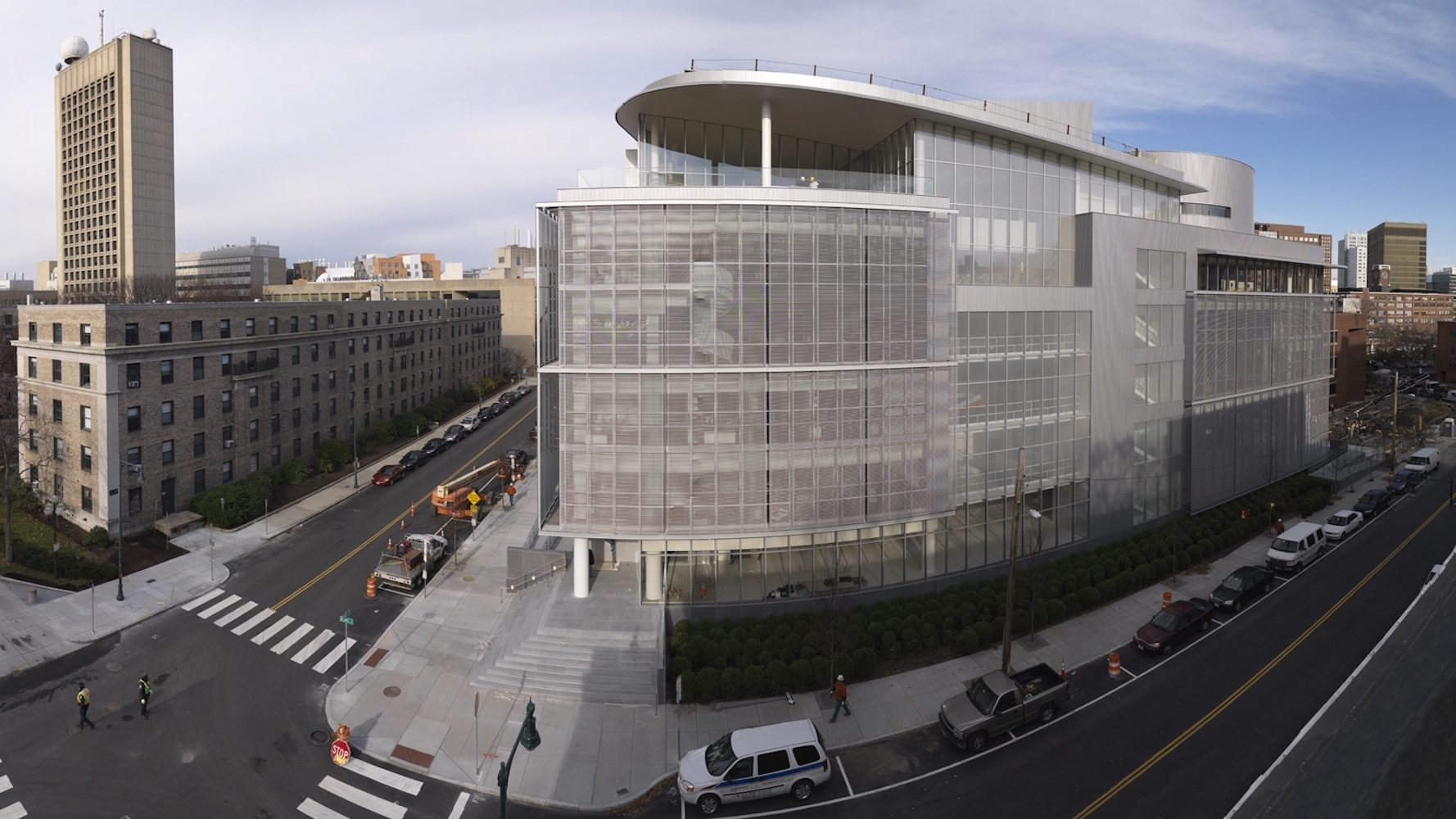
Sited on a highly public corner at the southwest edge of the
campus, the building proclaims its function as a gateway to
the university and its symbolic role as a center for learning.
In planning the building, the university
staff visited a number of American libraries, including the
Los Angeles Central Library, which had been renovated and
expanded in 1993 by HHPAs Los Angeles office. The client
group was particularly impressed by the way the librarys
atrium solved the problem of getting natural light into a
large space. Soon HHPAs Los Angeles office, headed by
partner Norman Pfeiffer, FAIA, with Stephen Johnson, AIA,
the principal architect, was commissioned to develop Otagos
l996 master plan as well as design the ISB. The Los Angeles
Library and ISB projects are drastically different in style.
The former expansion defers heavily to the Moorish Deco style
of the historic Bertram Goodhue building (1926); at ISB, HHPA
felt the design should explore (and improve upon) the Modernist
idiom of the adjoining university buildings with gridded glass
and curved metal forms.
The $35 million ISB renovation and expansion
called for demolishing about a third of the existing 1960s
Central Library (soundly built but deficient in space and
afflicted
with outdated systems) and constructing the new library to
extend beyond the original footprint. The base of the new
construction is a poured-in-place concrete grid, while a double-T-slab
construction is used above. The remaining two thirds of the
1960s library was drastically remodeled: The interior was
gutted to accommodate the information (computer) commons,
and the exterior glazed to match the curtain wall of the adjacent
new counterpart. In addition, HHPA renovated the exterior
of nearby buildings and created a glass-enclosed passage between
the ISB and the existing student union.
The transparency of ISBs exterior
is carried into the open-plan interior. The atrium at the
heart of the center is given a strong shape by a curved Oamaru
stone wall: At the plaza level, the wall separates the secure
zone for the collections (over 400,000 books and 300,000 microformat
volumes) from the 24-hour reading area and the information
commons. Open stairways and well-spaced concrete columns augment
the feeling of expansiveness, which in turn is underscored
by the use of translucent materials of glass, perforated metal,
and wire mesh.
See the August 2002 issue of Architectural
Record for full coverage of this project.
Formal name
of Project:
Information Services Building,
University of Otago
Location:
Dunedin, New Zealand
Gross square
footage:
200,000 sq. ft.
Total construction
cost:
$20 million
Client:
University of Otago
Architect:
Hardy Holzman Pfeiffer Associates
811 West 7th Street, Suite 430
Los Angeles, CA 90017
T:213-624-2775
F:213-895-0923
www.hhpa.com
|