Harvard NW Science Building
A new laboratory building aims to find its own voice on a historic campus.
Building at harvard is fraught with complication. Historic works of architecture by H.H. Richardson, Le Corbusier, and Walter Gropius are down the street. When one tries to keep to those standards, the world at large deems it wasteful (a 2009 Vanity Fair article pointed to recent construction — estimated at 6.2 million square feet and $4.3 billion since 2000 — as an example of the university’s profligate spending). And the neighbors, the faculty, and the students all have to be appeased. If that weren’t enough, when Craig Hartman, FAIA, head of Skidmore, Owings & Merrill (SOM)’s San Francisco office, designed his first university lab building for Harvard, he also had to deal with the outsize personality of then-president Lawrence Summers (who resigned in 2006 after a number of missteps, including his controversial comments on women in science, and is now director of President Obama’s National Economic Council). “He was a very, very challenging person,” recalls Hartman, whose equanimity seems an uneven match for Summers’s famed bluster. Summers’s taste tended toward a Georgian aesthetic, but then he saw the movie My Architect, a film about Louis Kahn by his son, Nathaniel. “After that,” says Hartman, “when I talked about wood, when I talked about brick, it was a home run.” Such fortuitous occurrences brought this massive steel-and-concrete structure to realization, where concerns of history and culture were balanced with the extraordinary technical requirements of a contemporary science building.
Based on what you have seen and read about this project, how would you grade it? Use the stars below to indicate your assessment, five stars being the highest rating.
The process began in 2002, when Harvard commissioned Philip Enquist, FAIA, partner in charge of urban design and planning for SOM Chicago, to design a master plan for the northwest corner of campus. That area consists of a haphazard mix of buildings, among them a 1962 lab by Minoru Yamasaki and a museum designed by Henry Greenough and George Snell in 1871. After the scheme’s completion, the university decided to pursue the construction of two new buildings at the edge of the site.
Nazneen Cooper, assistant dean for campus design and planning, worked with a faculty committee to select Hartman for the project, arguing that “you can always get a lab expert to join the team, but if you fail on the architecture, there’s no going back.” Hartman began by meeting with the residential community that borders the site to the north. While the master plan had called for a series of small buildings to connect to the neighborhood, Hartman and the faculty felt that domestically scaled structures would be insufficient for its resident scientists. Proposing instead to set the building back from the street, he offered the neighbors a generous landscape and convinced community members to support the project.
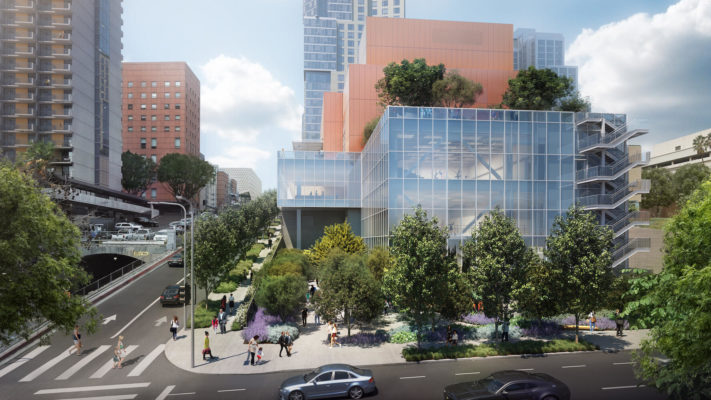
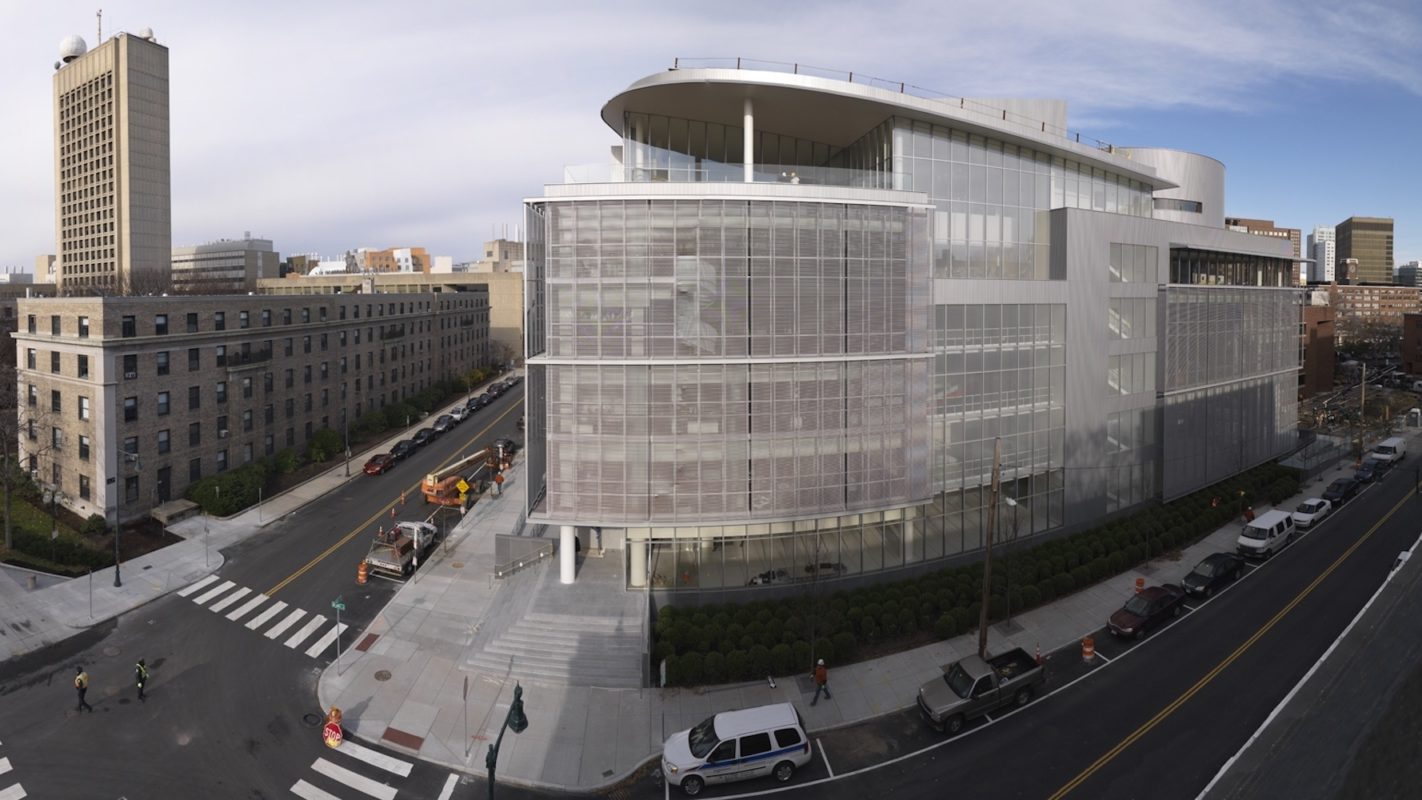
It was determined early on that the most efficient use of space would be to combine the proposed buildings — one for the Department of Engineering and Applied Sciences and the other for Organismic and Evolutionary Biology — into a single structure. To accommodate those functions, as well as to provide storage space for university collections, the four-story building twists and turns through the tangled campus fabric, never seeming as large as its 530,000 square footage suggests, partly because it cannot be perceived all at once.
Accordingly, the overall organization of the building is complex. Most of the physical-science labs run along the north and west brick elevations, next to a massive mechanical spine constructed with a steel-braced ladder-frame system that provides a large interior scaffold for the heavy m/e/p requirements of the labs. With regard to the latter, SOM worked with lab planners GPR to develop a 10-foot-6-inch module that provides flexibility for a range of uses. Across from the “wet” labs on the upper floors, the architects allowed the computational labs and offices to assume a lighter, more flexible quality. These rooms on the south and east sides are framed in glass — translucent toward the hallway, and clear with operable windows toward the exterior. There, the monotonous procession of offices is punctuated by a series of “living rooms” — informal double-height meeting spaces.
Large staircases, a ground-level café, and an underground event space also encourage an environment of openness and collaboration, as opposed to the often insular nature of science buildings. This idea is carried to the exterior planning, as well. Coming from the central campus, one approaches alongside a generous courtyard with twelve large, square, bench-height boxes. Designed by landscape architect Michael Van Valkenburgh, the lawn doubles as a green roof over the event space — the boxes act as skylights for the room below. Stacking the open and closed communal spaces directly on top of one another characterizes the building’s architectural strategies — more than half the square footage is underground, and spaces with more flexibility, like circulation corridors and stairways, are exploited to create opportunities for encounter and collaboration.
All of this is very far from Louis Kahn’s innovative design for the 1961 Richards Medical Labs at the University of Pennsylvania. There, Kahn conceived the building’s organization by proposing the idea of “served” and “servant” spaces — hollow concrete towers for mechanical equipment and circulation serving glazed labs that ended up being too small and too difficult to control temperature. Perhaps in part due to that history, SOM’s contribution seems less integral than Kahn’s, as if the architecture only needed to wrap around a technically overdetermined whole.
Because of the interior programming, the domain of architecture was pushed farther and farther out until everything jammed into a single surface. It’s not that the building doesn’t achieve its intentions — the wood and brick lend a sensitive touch. Yet, the north and west brick facades feel as if they belong to another structure. They refer to a sort of generic “Harvard brick building,” while at the same time they demonstrate their nonstructural role with syncopated fenestration. Ultimately, the gesture is neither contextual nor tectonic. On the opposite facade, SOM’s desire to express “human” materials led to placing wood beneath glass — a seemingly elegant solution that actually required a complex system of venting so the wood wouldn’t be damaged under heat stresses — showing that even small gestures were subject to severe technical demands. On both sides, Modernism’s lucid simplicity, which was conceived partly as the rejection of ornament, acts as a front (quite literally) for the complex and inscrutable contingencies of modern science.
In this way, the building begins to express the bind of architecture in the present. Hartman continually stated a desire for the building to reflect its own time, as most of the structures at Harvard have done. His achievement may not have the power and clarity seen in the works of nearby “masters,” but the complexity of our moment precludes such heroics. Hartman’s architectural decisions — weaving the building into its surroundings, creating space for collaboration — are hard-won victories in this context. Modern lab buildings are not so much works of architecture as they are machines.
Owner:
Harvard University
Architect:
Skidmore, Owings & Merrill LLP
One Front Street, Suite 2400
San Francisco, CA 94111
415.981.1555
415.398.3214
Gross square footage: 530,000 sq.ft.
|
|
Get Architectural Record digital with free bonus content not found in the magazine!
Order back issues—complete your library!