|
Carl Icahn Laboratory
Lewis-Sigler Institute for
Integrative Genomics
Princeton, N.J.
Rafael Viñoly Architects
Rafael Viñoly creates a building that
captures the sweeping nature of its users' scientific quest
By Clifford A. Pearson
© Roman Viñoly
|
For more photos click on 'photos
& drawings' above.
To see the people and products
behind this project click on 'people & products.'
|
As its name suggests, the Lewis-Sigler
Institute for Integrative Genomics at Princeton University
takes an interdisciplinary approach to the study of life sciences
and genetics. Just a few years old, the institute brings together
experimental biologists, computational biologists, physicists,
chemists, engineers, and applied mathematicians so they can
bounce ideas off one. Like the program it houses, the new
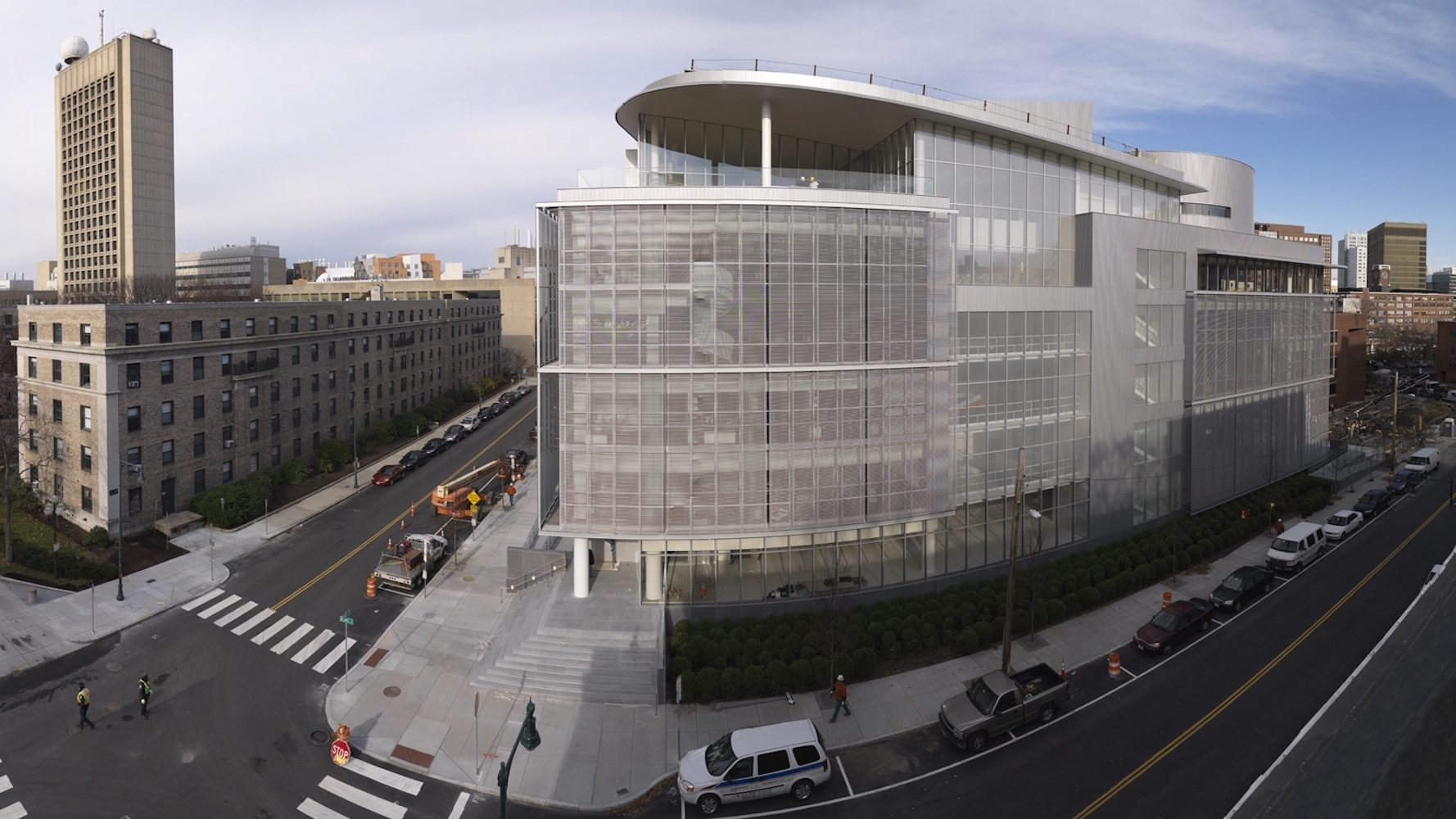
Carl Icahn Laboratory by Rafael Viñoly Architects takes
an inclusive approach to design, bringing the outdoors in
and providing an attractive venue for scientists to come together.
Because research in life sciences is changing so rapidly,
the laboratory presented a difficult design challenge.
Part of a master plan by Machado and
Silvetti Associates that creates a new quadrangle set around
an ellipse-shaped athletic field, the new lab connects underground
to the adjacent Lewis Thomas Laboratory, designed by Venturi
Scott Brown and Associates (VSBA) with Payette Associates
and completed in 1986. Although begun just a little more than
a decade after the VSBA building, the Viñoly lab needed
to reflect a new world of integrated genomic studies where
the whole is more important than any of the individual pieces.
Laboratories for about 15 faculty members
(along with their assistants and students) occupy most of
the building's 120,000 net square feet. Offices, conference
rooms, a small lecture hall, and a café round out the
rest of the dedicated space.
The social spaces, the places where the
scientists and students bump into each other, are critical
to the success of the institute. So the architects designed
a great curving atrium between two wings of labs and offices.
The two-story-high space faces south to the playing field
through a curving wall of mullionless glass panels braced
by vertical steel cables.
To protect the glazed facade from the
impact of the sun, Viñoly and his team designed an
arcade of 40-foot-tall aluminum louvers that stand outside
the building and help define a covered walkway linking the
lab to two nearby dorms. The 31 louvers, controlled by computers
and driven by hydraulic jacks, rotate in conjunction with
the movement of the sun to reduce solar heat gain.
The social hub of the building, the atrium
encompasses a small, freestanding café, a cylindrical
lecture hall, and a Frank Gehry sculpture that houses an informal
conference space. Curving stairs around the lecture hall and
a flight of straight stairs along one of the two-story lab/office
wings lead directly to the atrium, reinforcing its role as
the heart of the project.
For the laboratory spaces, Viñoly
created a system of demountable elements using commercially
available lines of modular lab benches and modular partitions.
An 8-foot-high interstitial space above each floor accommodates
all of the necessary mechanical, electrical, and venting systems.
See the November 2003 issue of Architectural
Record for full story.
Formal name
of Project:
Carl Icahn Laboratory
Lewis-Sigler Institute for Integrative Genomics
Location:
Princeton, N.J.
Gross square
footage:
138,000 sq. ft.
Total construction
cost:
$48.5 million
Owner:
Princeton University
Architect:
Rafael Viñoly Architects, P.C.
50 Vandam St.
New York, NY 10013
Tel. 212-924-5060
Fax 212-924-5858
www.rvapc.com
|