|
Hampstead Theatre
Swiss Cottage, London
Bennetts Associates Architects
Bennetts Associates gives a new face
to a venerable theater company that carries on the magic of
independent performance art
By Lucy Bullivant
© Peter Cook
|
For more photos click on 'photos
& drawings' above.
To see the people and products
behind this project click on 'people & products.'
|
Do you need to be an expert in theatrical
design to be the architect of a prestigious performance space?
Rab Bennetts, partner with his wife Denise in the London architectural
practice Bennetts Associates, thinks not. Commissioned by
Hampstead Theatre to create a new home for its activities,
the duo has designed a space with real presence and magic.
The architects created a master plan
for the whole block as well as a new building, giving the
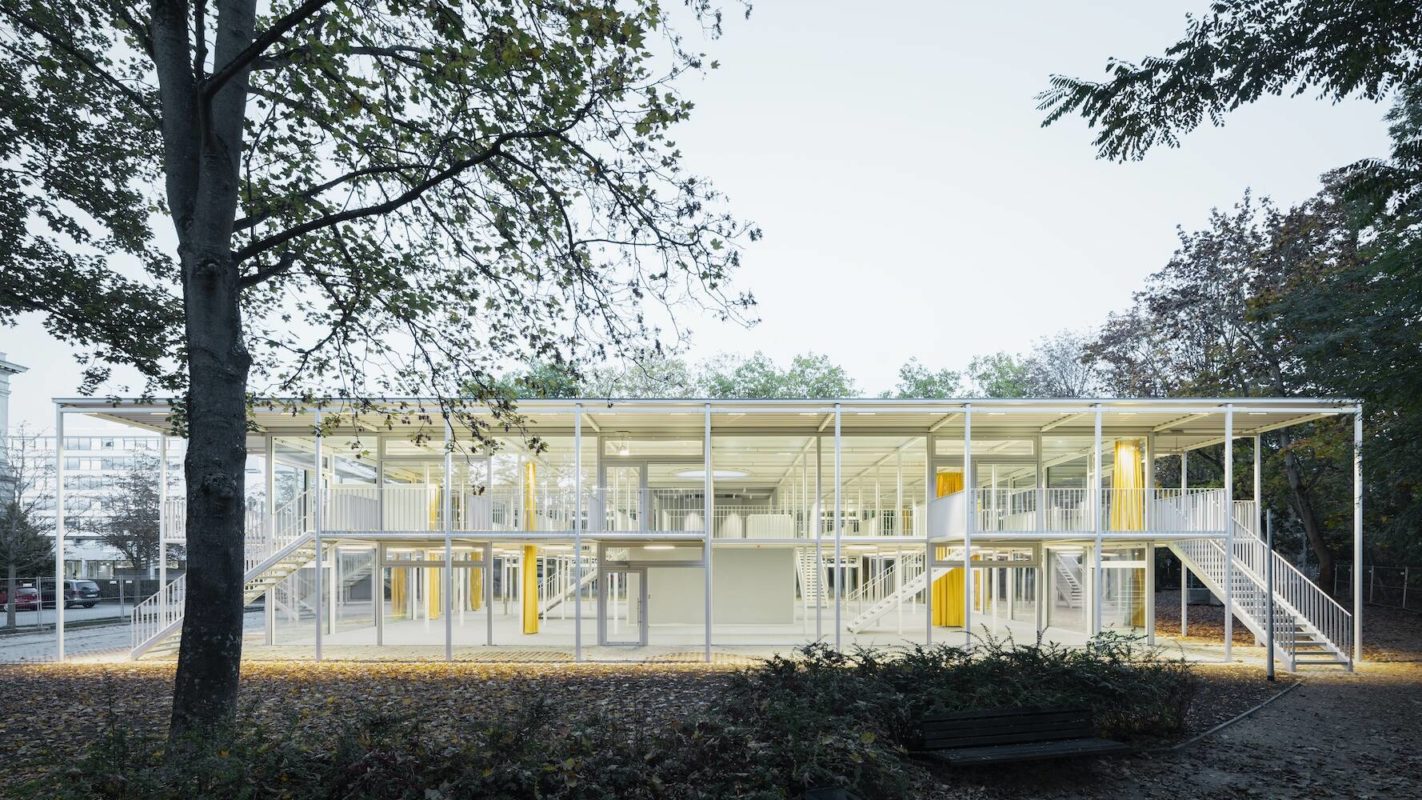
theater a more public face on the street. A simple, rectangular
pavilion in an urban park, it has two floors aboveground and
one below. The clients request for a generously proportioned
foyer space was amply met with a lobby featuring a café/bar
that sits on the main axial route from the entrance. This
pivotal space connects the performance hall with informal
meeting areas, and the street with the grassy slope and adjoining
childrens playground (to be landscaped by Gustafson
Porter) at the far end of the building. Ramped bridges lead
to the auditorium, whose zinc-clad exterior rises dramatically
from the basement foyer like the hull of a ship. Here, a reception
area adjoins a studio beneath the bar. Above the bridges,
a row of offices with street-facing windows culminate in the
greenroom, a social hub for both employees and players on
the buildings east side. This links with a corridor
of dressing rooms set at a right angle.
An upbeat street facade of glazing, timber
slating, and colored-light panels by artist Martin Richman
responds to the clients interest in balancethey
didnt want an icon on the street, nor did they want
the building to be self-effacing. The timber screens covering
the long facades echo the aesthetic of the screens within
the auditorium.
The resolution of the auditorium is the
theaters foremost strength. Avoiding the typical 1960s
black-box theater space, a flexible stage and a compact auditorium
can adapt to each production. The visually dynamic elliptical
layout, supported by a tilted balcony, maintains intimacy
and connection between actors and audience. There are light
metal technical grids for lighting instead of the visually
impeding bridges found in some new auditoriums. The downside
of choosing a curved shape for the auditorium is that it can
result in rogue sound reflections and disorienting acoustic
effects. The architects counteracted this problem by using
slatted walnut screens and balcony fronts made of materials
with a high degree of acoustic transparency, which visually
define the elliptical shape of the room.
Behind these elements lie concealed fixed
plasterboard walls and panels in convex and faceted patterns
that scatter sound around the room. The most stringent theater
critics are more than satisfied, and the auditorium has the
flexibility regular playgoers expect. The hydraulic stage
and the front bank of seats can be taken out and dropped into
the basement with a stage lift, creating a thrust stage with
seating on three sides.
The lobby fulfills the clients requirement for a space
as translucent as possible. "The idea was to get natural
light right down to the bottom and express the volume all
the way up from the basement," explains Rab Bennetts.
Tough and tactile, with zinc bar tops and steel stairs, it
confidently mediates between the steel-framed pavilion of
the building and the sculptural form of the auditorium.
The architects applied to the design
of this project their sound urban design ideas and pedigree
in the creation of advanced working environments, rather than
a track record in theater design. The result is an exemplary
and welcoming cultural facility that is humane and rational,
rather than iconic. In addition, the new theater takes the
lead in the transformation of an important neighborhood. Phase
two will entail the refurbishment of a library originally
designed by Sir Basil Spence and the creation of housing and
a new sports center by Sir Terry Farrell in a newly landscaped
framework. Bennetts Associates design is a catalyst
for creating something for everyone.
See the October 2003 issue of Architectural
Record for full coverage of this project.
Formal name
of Project:
Hampstead Theatre
Location:
Swiss Cottage, London
Gross square
footage:
43,000 sq. ft.
Total construction
cost:
$13.9 million
Owner:
Hampstead Theatre Foundation
Architect:
Bennetts Associates Architects
1 Rawstorne Place
London EC1V 7NL UK
|