|
E.J. DeSeta Building
Wilmington, Del.
Kling
Kling stylishly revamps the bleak office-warehouse norm with a structure that adeptly serves two diverse businesses

© Woodruff Brown |
For more photos click on 'photos & drawings' above.
To see the people and products behind this project click on 'people & products.'
|
By David Gissen
Shop floors with offices tacked on are ubiquitous, but they are usually anonymous, built for as little money as possible, without expressing any identity for their tenants or offering any amenity to staff. Kling’s new E.J. DeSeta building, rich with architectural detail and craftsmanship, shows that the type is anything but irredeemable. The assemblage makes a highly visible landmark for a split-personality pair of companies, one of which returns industry to increasingly white-collar Wilmington, Delaware, while the other hastens the city’s transformation into a live/work destination.
For Bernadette DeSeta, moving the family companies—E.J. DeSeta and the Buccini/Pollin Group—to central Wilmington from New Castle was a return to roots. The companies came back to where E.J. DeSeta, a metal-fabrication company, was founded, but Ms. DeSeta also wanted to visibly shore up the city’s current revitalization efforts. In Wilmington, after all, the Buccini/Pollin Group, a real estate developer, has invested in residential and mixed-use conversions of older buildings and is completing a new apartment tower. The residential growth piggybacks revitalization by banks and financial institutions that have converted former industrial structures in this “postindustrial,” credit-card-servicing capital. The commitment represented by DeSeta’s distinctive architecture is intended to help buyers, tenants, and partners alike feel that Wilmington is a good place to invest.
E.J. DeSeta, the older of the two companies, needed offices and a new, 75,000-square-foot shop floor for its 50-year-old metal-fabrication business. Known for architectural ductwork, it has been moving into ornamental architectural metalwork, including furniture, partitions, and wall coverings. Buccini/Pollin needed only office space, but the structure’s visibility would also signal the company’s commitment to this emerging market.
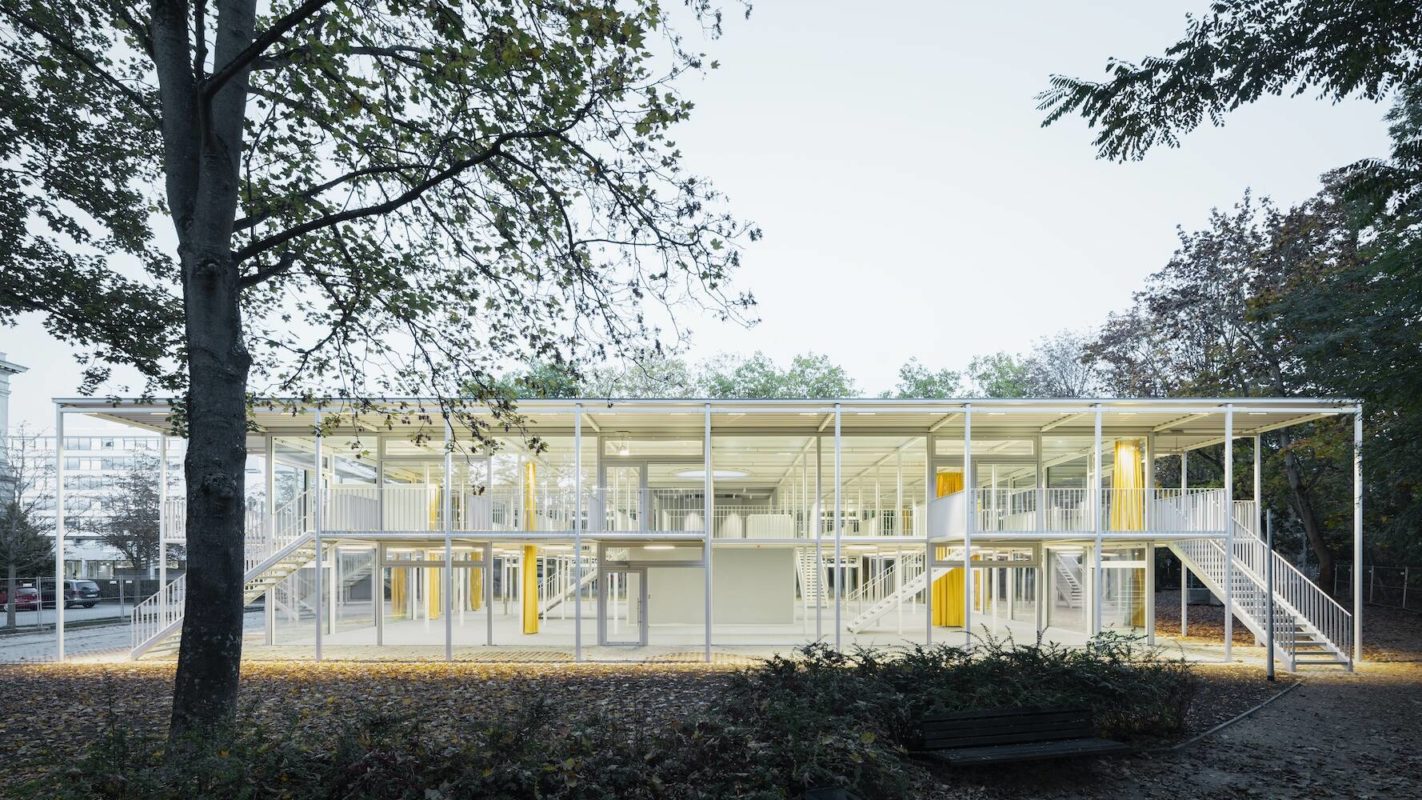
Robert Little, the design principal at Kling’s Philadelphia office, located both businesses in a shared two-story office structure that is lifted above possible floods on steel columns and skewed to aim the structure to the best views (and avoid an adjacent gas station).
The office building is shaped on what Little describes as a “European approach”—narrow, 60-foot-wide floor plates offering ample light from both sides and access to views and shared space. The floors’ perimeters are lined by offices separated from the cubicle pool only by translucent screens, so that daylight penetrates to the full floor depth. On the roof, the architects thoughtfully provided an outdoor terrace that offers sunset panoramas of the city.
Kling has produced a space for office work that is communal, bright, and open to Wilmington’s mélange of converted industrial structures and new residential ones. The proportion of bright, airy shared areas to individual workspaces is admirably high. The project’s striking geometry is visible from the freeway as you enter town, yet adeptly fits into a context it still must share with a gas station. Even the biggish production building sits comfortably as the area witnesses increased urban residential development.
Want the full story? Read the entire article in our March 2006 issue.
Subscribe to Architectural Record in print, or get Architectural Record digitally
Formal name
of Project:
E.J. DeSeta Building
Location:
Wilmington, Del.
Gross square footage:
100,000 sq. ft.
Total construction cost:
$11 million
Owner:
E.J. DeSeta & Buccini/Pollin
Architect:
Kling
2301 Chestnut Street
Philadelphia, Pa. 19103
fax-215-569-6123
www.kling.us
|