subscribe
e-newsletter
contact us
advertise
from our archive
Projects   Building Types Study - College and University Labs
Off the Record: Recent Blog Posts
The blog written by the staff of Architectural Record
View all blog posts >>
Recently Posted Reader Photos

View all photo galleries >>
Reader Commented / Recommended
Most Commented Most Recommended
Rankings reflect comments made in the past 14 days
Rankings reflect votes made in the past 14 days

Arizona State Interdisciplinary Science + Technology Building
Tempe, Ariz.
richärd + bauer, llc

Richärd + Bauer brings design sensitivity and a modernist expression of function and structure to a heavy-duty building type


Click here for slide show.

Photo © Bill Timmerman

By Suzanne Stephens

For the Interdisciplinary Science and Technology Building (the second of a series) on its Tempe, Arizona campus, Arizona State University needed a basic 66,000-square-foot structure where physical and environmental research associated with mechanical, aerospace, civil, geological, and chemical engineering could be carried out. The interdisciplinary program called for labs to be flexible in a major way: The building had to include spaces for testing earthquake-resistant structures, conducting turbine and internal-combustion engineering studies, and analyzing various kinds of soils. In addition to providing a room for a large supersonic wind tunnel, the architects were asked to create labs that could, for example, accommodate microscopy suites for scanning electrons today, and who knows what tomorrow.

Given a narrow, 38,400-square-foot site on a campus interlaced with pedestrian paths, Richärd + Bauer filled the lot with an inward-turning building. Two long bars of laboratories, each 24 feet wide, flank an interior courtyard that acts as the main circulation spine for the building. (A separate facility on the other side of a service drive accommodates storage for materials to be tested).

Initially the university and the architects were thinking of using tilt-slab concrete construction. But the site proved to be too tight for this technique. So the architects decided on a steel-truss-and-column frame, with precast-concrete floor planks, poured-in-place concrete planes, and concrete-block enclosing walls. The steel super-trusses, the height of one floor, dampen vibrations for the heavy-duty activities in the labs and, between the two floors, carry a mezzanine on their lower chords to accommodate smaller labs and walkways (section, opposite).

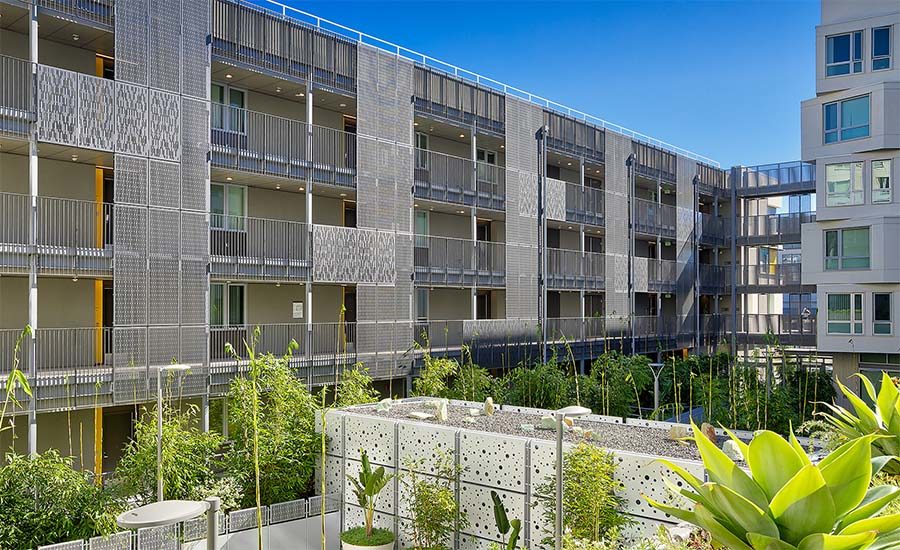
The laboratory’s courtyard contains utility cores and steel catwalks and bridges, with hospital-size poured-concrete elevator shafts located at either end of the covered space. In the true Modernist spirit of calling out service functions, the architects ran all the electrical, HVAC, and lab services through this central court within insulated ducts and painted conduits. Frosted-glass-enclosed meeting rooms are perched above the courtyard at the mezzanine level. Perforated-steel panels, now weathered to a brownish tinge, wrap the exterior of the building to help shade spaces within. The inward focus of the plan and the screen walls also keep the courtyard comfortable in the intense Arizona sun—with additional air provided by large fans and evaporative cooling systems.

Want the full story? Read the entire article in our July 2006 issue.
Subscribe to Architectural Record in print, or get Architectural Record digitally

Formal name of Project:
Arizona State Interdisciplinary Science + Technology Building

Location:
Tempe, Ariz.

Gross square footage:
66,000 sq. ft.

Total project cost:
$13.8 million

Owner:
Arizona State University

Architect:
richärd + bauer, llc
1545 W. Thomas Road
Phoenix, AZ 85015
P 602 264 1955
F 602 264 9234
www.richardbauer.com

Click here to see all the people and products behind this project

ADVERTISEMENT
Special Subscription Offer: Get Architectural Record Digital Free!
© 2009 The McGraw-Hill Companies, Inc.
All Rights Reserved