Cavallo Point, The Retreat at the Golden Gate
Leddy Maytum Stacy Architects and Architectural Resources Group turn a historic army base into an environmentally conscious hotel.
A decommissioned army base does not sound like much of a soothing vacation retreat, but this is different. Fort Baker sits at the edge of the shimmering waters on the Sausalito side of San Francisco Bay in Golden Gate National Recreation Area. Just over the Golden Gate Bridge from San Francisco, it was built, for the most part, from 1901 to 1915. Colonial Revival two- and three-story white-clapboard and white-painted-brick structures partially encircle the grassy Parade Ground, and the Golden Gate Bridge looms majestically in the distance.
Based on what you have seen and read about this project, how would you grade it? Use the stars below to indicate your assessment, five stars being the highest rating.
When the National Park Service and Golden Gate Park decided to develop the approximately 30-acre site for a hotel complex, it sent out a Request for Qualifications to developers and hotel management firms. The Fort Baker Retreat Group — composed of Equity Community Builders, Passport Resorts, and the Ajax Capital Group — won the commission. Its team includes two San Francisco architectural firms: Architectural Resources Group (ARG), which specializes in historic preservation, and Leddy Maytum Stacy, which was responsible for the new construction. The client received about $11 million in tax credits for the $98 million project.
Program
The developers and architects wisely submitted a proposal for 142 rooms, far lower than the 350 possible with the Environmental Impact Statement. Needless to say, it went over well with the surrounding community, which feared that a new lodge would chase away wildlife, change the character of the place, and add to the traffic congestion.
The plan called for ARG converting 21 original buildings to hotel uses. Thirteen of the historic buildings, replete with pressed-tin ceilings, wood floors, fireplaces, wood-sash windows, and porches, were to be turned into lodgings with one- or two-bedroom units, and in some cases single rooms. The various accommodations would range from 317 to 1,336 square feet.
Dominating the Parade Grounds are two large wood-frame structures, originally built as barracks. One, a 16,333-square-foot structure, would be devoted to hotel reception, a retail shop, and meeting spaces; the other, an 18,900-square-foot building, would contain the restaurant, bar, banquet rooms, and kitchen.
In addition, a chapel, built in 1941 with an early version of glue-laminated beams, was to be restored for various events, while a brick building, once housing the army’s gym and Postal Exchange, would be renovated for conference use.
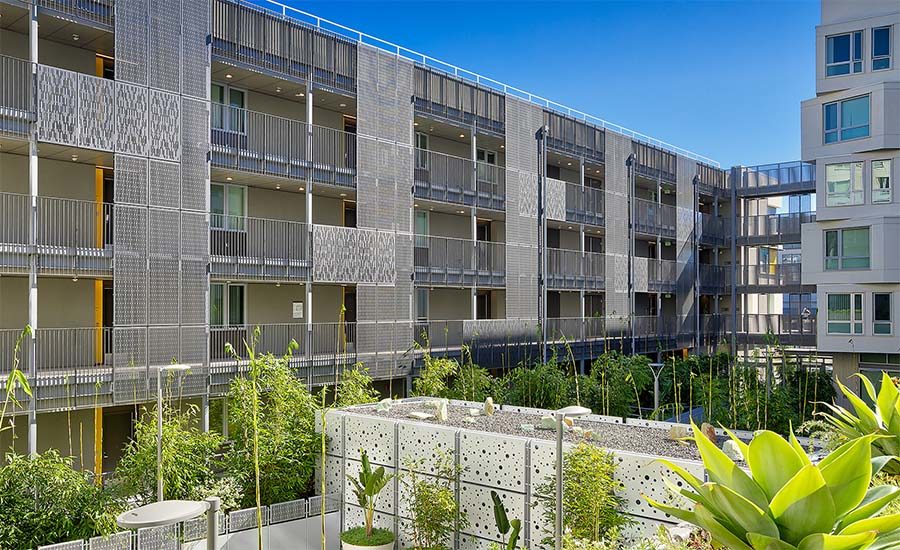
Any new construction had to occur on the footprints of nonhistoric buildings that were torn down. In this case, architects Leddy Maytum Stacy designed 13 two-story lodging units with 74 guest rooms, plus a new spa building. The team went after LEED certification for the entire complex, incorporating energy-efficient features for heating, cooling, and lighting, and using recycled materials, solar panels, and electric cars.
Solution
With the historic structures, ARG kept the building shells, plus about 75 percent of the interior walls and floors, while removing nonhistoric additions and partitions where needed. ARG removed the original tin ceilings and stripped them of chipped paint by freezing. In reinstalling them, the architects built an acoustical separation space between the floors containing batt insulation, resilient channels, and plywood.
Only fans and operable windows cool the lodgings, although air-conditioning is provided in the main buildings’ dining and event spaces. Hydronic heating is supplied through radiators in the houses, and the original fireplaces are fitted with natural-gas-flame sources.
In designing the 13 new lodging structures and spa, Leddy Maytum Stacy wanted to avoid imitating the white clapboard, turn-of-the-20th-century look of the historic houses. While still using a wood-frame structure, it adhered to a Modernist vocabulary with plaster surfaces (for fire codes) and natural colors. The new lodgings are topped with painted standing-seam steel roofs fitted with thin-film solar panels. The spacious high-ceilinged interiors are designed as luxe open-plan suites with window seats and balconies. Again, operable windows, ceiling fans, radiant-floor heating, and gas-fired fireplaces provide cooling and heating. Sloped roofs and clerestories capture the daylight and offer views of both the bay and mountains.
Siting the new buildings on the upper slope behind the original structures helped to take advantage of the view: Marsha Maytum, principal of Leddy Maytum Stacy, talks of standing on ladders to check sight lines in positioning the lodging.
Commentary
Both architectural firms were quite attentive to this spectacular setting. ARG kept the architectural character of the early-20th-century structures while still transforming the entirety into an up-to-date hotel. Placing the new construction in the background helped retain the gestalt of the old base. But while Leddy Maytum Stacy commendably did not clone the old architecture, and designed well-composed and detailed California Modern exteriors, the new lodgings seem disconcertingly raw at this moment. (More landscaping, including planting on the end walls, is to come.) Inside is another story: The wood-paneled sloping ceilings, window seats, multiple views, and ample natural light are stunning. And throughout, the interior design by Brayton Hughes Design Studios adroitly reinforces a natural, comfortably contemporary sensibility.
Formal name of project: Cavallo Point, The Retreat at the Golden Gate
Location: Sausalito, California
Gross square footage: 150,000 (historic) sq.ft.
Total construction cost: $34 million (historic)
Owner:
The Fort Baker Retreat Group, LLC
Architect:
HISTORIC BUILDINGS
Architectural Resources Group, Inc.
Pier 9, The Embarcadero
San Francisco, CA 94111
415.421.1680 tel
415.421.0127 fax
NEW BUILDING
Leddy Maytum Stacy Architects
|
|
Get Architectural Record digital with free bonus content not found in the magazine!
Order back issues—complete your library!