home
subscribe
free e-newsletter free e-newsletter
reader service
widget
advertise
Subscribe to Architectural Record today
and save 60% off the newsstand price.
comment

Jacobi Medical Center Ambulatory Care Building

The Bronx, New York
Pei Cobb Freed & Partners Architects LLP

Pei Cobb Freed & Partners creates a light, elegant ambience for a wing of a large city hospital.

By Suzanne Stephens

Although Pei Cobb Freed & Partners is not established as a specialist in hospital design, it has been making significant incursions into the field. Its Bellevue Hospital Ambulatory Care Building [record, October 2006, page 146] demonstrated how the firm’s sense of material and craft and exploitation of daylight contributes immeasurably to an often nondescript building type. Now the firm’s expansion of the Jacobi Medical Center in The Bronx, New York, offers a compelling example of hospital architecture that defers to precepts of evidence-based design.

The largest public hospital in the borough, the Jacobi Medical Center occupies a 64-acre site on the Pelham Parkway that was once the home of the fashionable Morris Park Racetrack. Long after fire destroyed its grandstands, the property was purchased by the New York City Department of Hospitals, which commissioned architects Pomerance and Breines to design a 1,640,000-square-foot hospital in 1955, a generically Modern, white-brick facility, softened by a parklike setting of (now) mature trees. Then in 2006, Cannon Design added a 365,000-square-foot inpatient building (Phase I) on the east. Soon after, Pei Cobb Freed tackled the opposite end, completing a design (Phase II) for an ambulatory-care wing on the west in 2008.

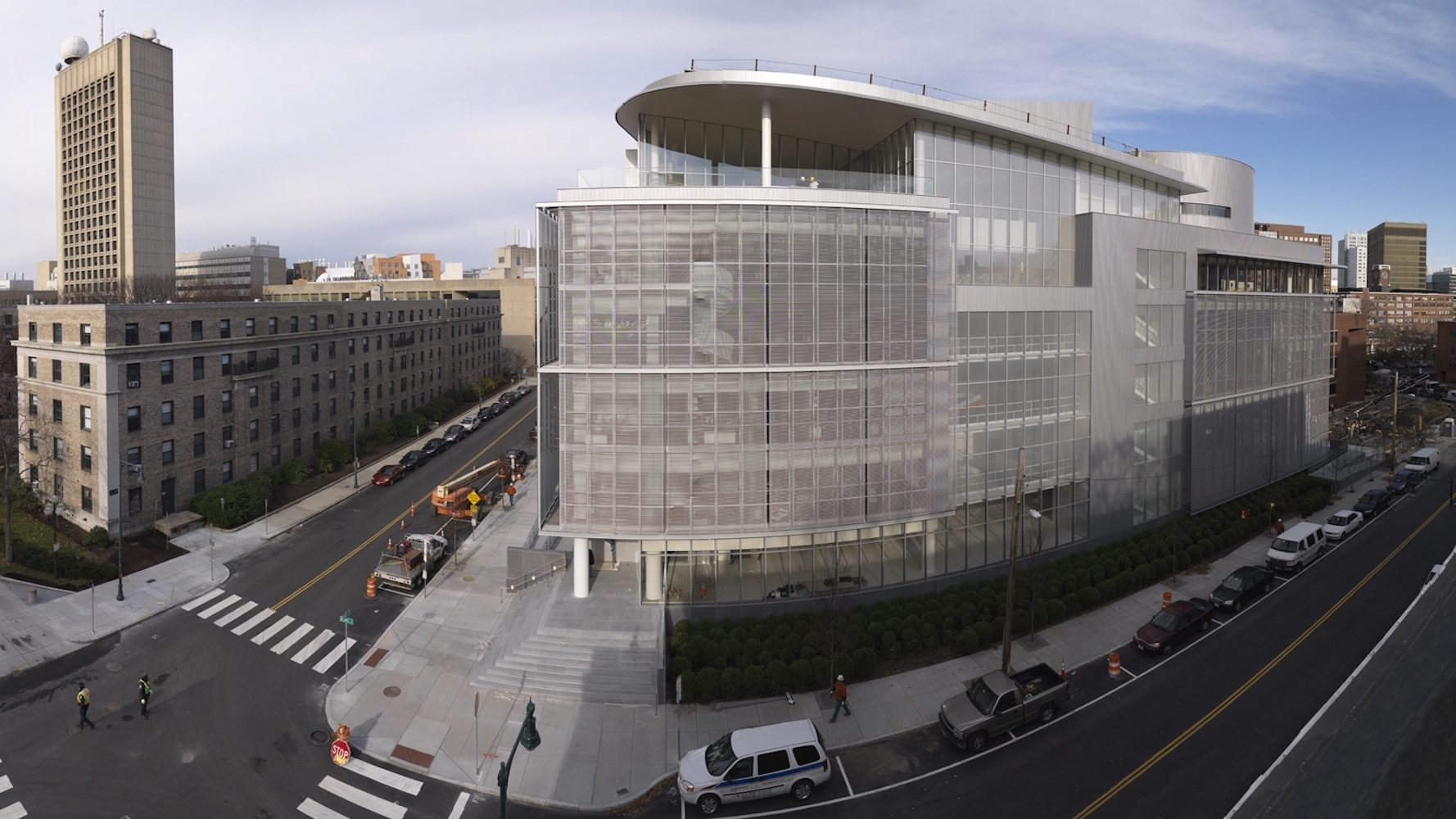
Jacobi Medical Center Ambulatory Care Building
Photo © Paul Warchol

Rate this project:
Based on what you have seen and read about this project, how would you grade it? Use the stars below to indicate your assessment, five stars being the highest rating.
----- Advertising -----

Program

The program called for 215 clinical examination rooms and 18 treatment rooms, plus reception areas, waiting rooms, medical stations, and related support spaces. They would be housed in a new 119,650-square-foot addition, with another 14,750 square feet renovated where the new wing connects to the older building. To foster the smooth connection between new and old construction, the architects avoided changes in floor heights.

Solution

The design team, led by Pei Cobb Freed partner Ian Bader, FAIA, placed the ambulatory-care functions in a four-story elongated bar in front of the existing building, leaving space for an interior garden. On the south edge of the garden, a curved, skylighted atrium, square in plan, provides a ground-floor link from the new wing to the 1955 hospital. While adhering to the original Modernist vocabulary and its orthogonal plan, Pei Cobb Freed introduced certain curvilinear elements to vary somewhat the unremitting rectilinear geometry. In addition to a segmented barrel-vaulted atrium, Bader and his team designed a slightly bowed glossy curtain wall for the entrance facade, which imparts a soigné glamour faintly evocative of 1950s South American hotels. Its low-E glass sheathes the three upper floors of the new wing, stopping above the ground level, where an open-air porch is tucked under the overhang. Defined by massive piloti reminiscent of Le Corbusier’s Unité projects, the  porch/walkway offers visitors an expansive place to fraternize in warm weather. 

Inside, creamy beige travertine walls and terrazzo floors dominate the ground-floor lobby and continue into the glazed atrium overlooking the garden. The atrium’s four bowed trusses and increasingly dense, fritted glass (for solar protection) generate a certain visual dynamism:  The trusses’ inner and outer chords seem to converge as they arc upward from their pinnings at the base to sliding connections at the top.

The interior garden, edged on one side by the beige brick wall of the new wing and on the opposite by the 1955 building, provides the main focus for the atrium and “relieves the sense of confinement from being between two buildings” says Bader. The inclusion of this interior open space also affords the rear of the new wing ample daylight and views. The wing itself, a steel-frame structure with concrete-on-metal-deck floor plates, can be flexibly partitioned and arranged in clinical modules. Although little daylight permeates interior examination rooms and certain medical stations, patients are only there briefly, and the staff has constant access to the glazed perimeter spaces.

Commentary

The Pei Cobb Freed expansion to the Jacobi Medical Center offers a sleek new visage to the community and provides luminous, immaculate spaces for the visitors and staff who spend so much time there. To be sure, the new wing cannot change the bulky gestalt of the entire 2,125,000-square-foot complex, a problem endemic to ever-expanding hospitals. Similarly, the garden, enclosed by the new and old wings, cries out for the fully developed landscaping seen in the grounds outside. Still, owing to the ample daylight and view, along with the generous use of creamy travertine and terrazzo, the place is a far cry from a municipal hospital. (The shock comes in passing through the atrium into the old building, where dark, subwaylike corridors and gloomy six-bed rooms await.)

The leitmotif of curves, starting with a bowed facade, continuing inside to the reception desks, then reappearing as a partial barrel vault in the atrium, comes to an end with the zinc barrel-vaulted roof atop the wing. It could be one motif too many, except the actual experience of the building doesn’t force this perception. Calm, clarity, and elegance reign.

Gross square footage:
172,000 sq. ft. (includes 45,000 sq. ft. of renovation)

Total construction cost:
$49,000,000

Location:
1400 Pelham Parkway, Bronx, NY

Owner: New York City Health and Hospitals Corporation

Architect:
Pei Cobb Freed & Partners Architects LLP
88 Pine Street
New York, NY 11104
T: 212-751-3122
F: 212-872-5443

share: more »

Reader Comments:

We welcome comments from all points of view. Off-topic or abusive comments, however, will be removed at the editors’ discretion.

----- Advertising -----
Reader Feedback
Most Commented Most Recommended
Rankings reflect comments made in the past 14 days
View all Record Blogs
View all
AR Selects: Project Blogs
View all Project Blogs
McGrawHill
Search