subscribe
e-newsletter
contact us
advertise
from our archive
Projects   Building Types Study - Multi-Family Housing
Off the Record: Recent Blog Posts
The blog written by the staff of Architectural Record
View all blog posts >>
Recently Posted Reader Photos

View all photo galleries >>
Reader Commented / Recommended
Most Commented Most Recommended
Rankings reflect comments made in the past 14 days
Rankings reflect votes made in the past 14 days

The Lofts at Laurel Court
West Hollywood, Calif.
Public

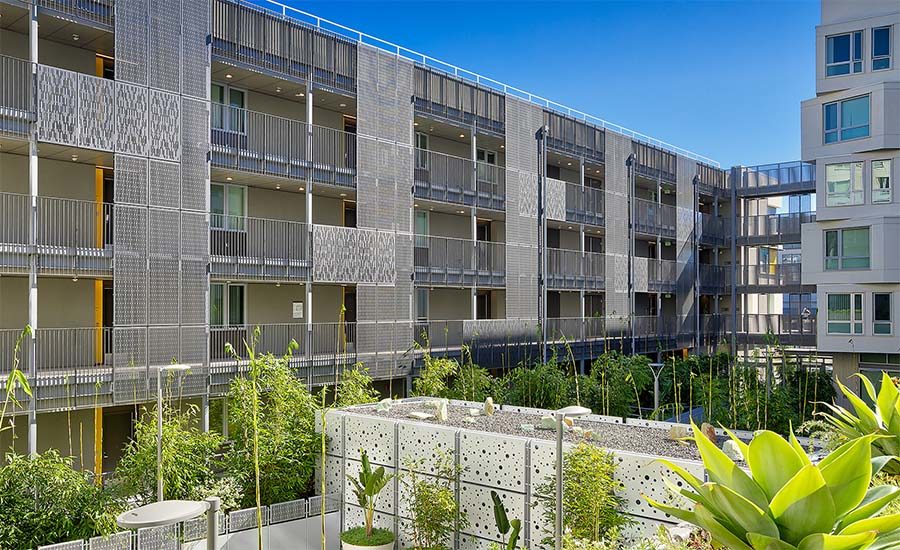
Public’s design allows residents to take refuge from urban life in ample courtyards and outdoor amenities

© Hewitt & Garrison

For more photos click on 'photos & drawings' above.

To see the people and products behind this project click on 'people & products.'

By Ann Jarmusch

West Hollywood is home to the R.M. Schindler House, 1920s bungalow courts, and tree-shaded residences evoking French châteaux, Spanish haciendas, and Tudor manses. Here, an aura of glamour and artistry has survived the onslaught of Sunset Strip–style urbanism and car culture. Unfortunately, bland, low-rise apartment buildings over gaping garages have ravished the charm of this 1.9-acre city, a plague of the character- killing typology that has proliferated here since the 1960s.

Today’s urgent need for higher-density housing coincides fortuitously with the aging of these soulless, poorly built buildings. In response, the city encourages new multifamily residences based on the area’s historic courtyard housing, originally built in Spanish Revival or Craftsman style. Today’s courtyard guidelines include doubling the usual requirement for common outdoor areas. In return, developers are allowed extra living space per unit without an increase in parking requirements, relaxed setbacks, and other concessions.

Judging from several fresh, new courtyard-housing projects, the policy seems to be working. Palisades Development Group of Santa Monica hired Public, a small San Diego architecture firm, to design the 20-unit Lofts at Laurel Court after Palisades’ president, Avi Brosh, admired Public’s mixed-media, multifamily Dutra Building in San Diego.

The 20 condominiums fill three buildings arranged around an elongated T-shaped courtyard. Except for one building that faces Laurel Street, residents enter their units from the courtyard. A wooden trellis high overhead signals the principal entrance into the landscaped courtyard of the loft buildings. Just inside a wooden gate, mailboxes, trash chutes, and an elevator are concentrated on a concrete platform elevated several steps above the curved entry path.

Public delivered the same finesse and unexpected combinations of sleek and rustic materials, artistic finishes, and wit that appealed to Brosh in the San Diego building. (Here, downspouts recall ancient Egyptian figures; vents “wear” conical hats.) Laurel Court’s simple, boxlike shells were affordable to construct and allowed Palisades to spend more money on distinctive materials and detailing.

Want the full story? Read the entire article in our November 2004 issue.
Subscribe to Architectural Record in print, or get Architectural Record digitally

Formal name of Project:
The Lofts at Laurel Court

Location:
West Hollywood

Gross square footage:
46,719 sq. ft.

Total construction cost:
$4 Million

Owner:
Palisades Development Group, Avi Brosh, Partner
1416 Second Street
Santa Monica, California, 90401
310-395-4626
310-395-5606

Architect:
Public
4441 Park Blvd
San Diego, California 92116
619-682-4083 phone
619-682-4084 fax
www.publicdigital.com


ADVERTISEMENT
Special Subscription Offer: Get Architectural Record Digital Free!
© 2009 The McGraw-Hill Companies, Inc.
All Rights Reserved