


Indianapolis, Indiana
As commissions go, only the folly offers an architect more liberty than the pavilion. Consider a Modern jewel, Mies van der Rohe’s Barcelona Pavilion, built to represent Germany at the 1929 World Exposition and to formally receive the king and queen of Spain — once — at its opening in May of that year. Having served its purpose, it was demolished in January 1930. (It was rebuilt in 1986.)
Program
In strictly functional terms, the Ruth Lilly Visitors Pavilion at the Indianapolis Museum of Art (IMA) required nothing more than a couple of Porta-Potties and a bench. The coarseness of that notion contrasts with the refined building designed by Marlon Blackwell, pointing up the real function of the pavilion as an expression of identity. “I look at it as a glorious place of respite,” says IMA director and CEO Maxwell Anderson.
The 100 Acres Art & Nature Park, where the pavilion is located, lies in the floodplain of the White River. Abandoned by its previous owners, the land fell under the control of the state of Indiana, which donated it to the IMA in 1972. The property had been farmland and, later, a portion of it became a quarry — now a 35-acre lake. Just behind the museum, a canal runs north-south and, to this day, supplies drinking water to Indianapolis. The White River enfolds the two remaining sides of the triangular park, curving from the west to the north. Hardly pristine, the land restored itself over the years. It encompasses a protected wetland and has become lightly and prettily wooded — perfect for a sculpture park coexisting with nature.
In its search for an architect, an IMA selection committee met Blackwell at Pinecote Pavilion in Picayune, Mississippi. There its members picnicked on pulled pork at Fay Jones’s open-air building with Blackwell and Ed Blake, the landscape designer who teamed with Blackwell for the IMA project and had landscaped Pinecote for Jones.
Solution
For the Indianapolis project, Blake proposed clearing nonnative species from the park and carving out pathways in the woods. When he showed a scheme with a series of low berms radiating out from the pavilion like points of a star, Blackwell was aghast. But ultimately the ingenuity of that move impressed itself on the architect, since the berms mask the fact that the building must be raised 30 inches above the ground to accommodate flooding. The berms marry the pavilion to the earth and eliminate the need for a railing. The pavilion sits on the highest point and only buildable site within the floodplain. Sadly, Blake died suddenly at age 63 in August 2010 just months after the park and pavilion opened.
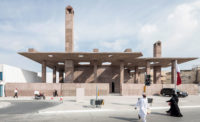
The relationship between structure and nature drove Blackwell’s design. His pavilion sifts sunlight through wooden slats that form its ceiling and 17-foot-long cantilevered canopy in the same way, he suggests, that a tree canopy does. “[The pavilion] pulses with the rhythm of the day. A cloud passes and it goes quiet,” he says. “It’s as though it inhales and exhales.”
Partly because the building is not orthogonal, it can seem animated, almost alive. As visitors walk around it, different features present themselves. The triangular tip of the cantilever tilts upward but isn’t visible from the principal approach. Similarly, the wooden ceiling slats veer off from straight parallel runs in some places to form elongated peepholes, creating an optical illusion that sometimes makes them appear inverted like a pleat and sometimes flat with the roof plane. The pavilion’s slightly canted north wall — composed of precisely spaced wood slats cut lengthwise as parallelograms — can appear, like old-fashioned Venetian blinds, solid from some angles and open at others.
Although just 1,300 square feet, the pavilion is structurally complex. It has two layers of steel in its roof — one structural, the second a lighter-gauge steel T to which heavy and dense ipé wood is attached and tied back to the primary steel frame. A layer of glass above the wood forms the actual ceiling for the interior, extending the transparent, open-air quality of the deck into the interior.
Commentary
Where the Barcelona Pavilion is an exquisite expression of formality and chilly beauty fit for royals, the Lilly Pavilion is a quiet creature revealing itself slowly and rewarding contemplation. That is as it should be for a pavilion in the woods.
Cheryl Kent is the author, most recently, of Millennium Park Chicago (Northwestern University Press).
Architect
Marlon Blackwell Architect
217 E. Dickson St., Suite 104
Fayetteville, AR 72701
P. 479.973.9121
F. 479.251.8281
Location:
100 Acres Art & Nature Park
The Indianapolis Museum of Art
Indianapolis, IN
USA
Completion Date: June, 2010
Gross square footage: 1,290 sq.ft.
Total construction cost: $2,293,575
People
Owner:
Architect
Personnel in architect's firm who should receive special credit:
Engineer(s):
MEP:
Civil:
Consultant(s):
Landscape:
Eric Fulford & Ann Reed
Acoustical: Special Contributor: Mary Miss
Other:
General contractor:
Photographer(s):
CAD system, project management, or other software used: |
Products
Structural system
Manufacturer of any structural components unique to this project:
Exterior cladding:
Metal/glass curtain wall:
Wood: Clear Western Red Cedar [core exterior] finished with Japanese Shoji-bu charring technique
Moisture barrier:
Other cladding unique to this project:
Roofing
Windows
Glazing
Skylights:
Doors
Hardware
Locksets:
Closers:
LCN 9540 [exterior restroom access door] Exit devices: Von Duprin 55 Rim Device [on Ellison pivot doors]
Pulls:
Other special hardware:
Interior finishes
Paints and stains:
Solid surfacing:
Special surfacing:
Echo Elminator
Floor and wall tile: Daltile S762 Brazilian Black Slate [vestibule & bathrooms, custom cut to size]
Raised flooring:
Special interior finishes unique to this project:
Other furniture (use additional sheet if necessary):
Lighting
Conveyance
Plumbing
Delta DEMD-311 Electronic Faucet
Surface Mounted Jumbo Roll Toilet Tissue Dispenser Toto Ecopower Flush Valves
Halsey Taylor Barrier Free Drinking Fountain Model HRFE FR
Energy |


Post a comment to this article
Report Abusive Comment