|
Maybe one day there wont be
a need to highlight sustainable building products since they
will be the norm, not the exception. Many of the products
featured this month have been recycled from materials that
would have ended up as waste, while others prevent waste in
the first place. — Rita
Catinella Orrell
| |
| Click
images to view them larger. |
 |
|
| |

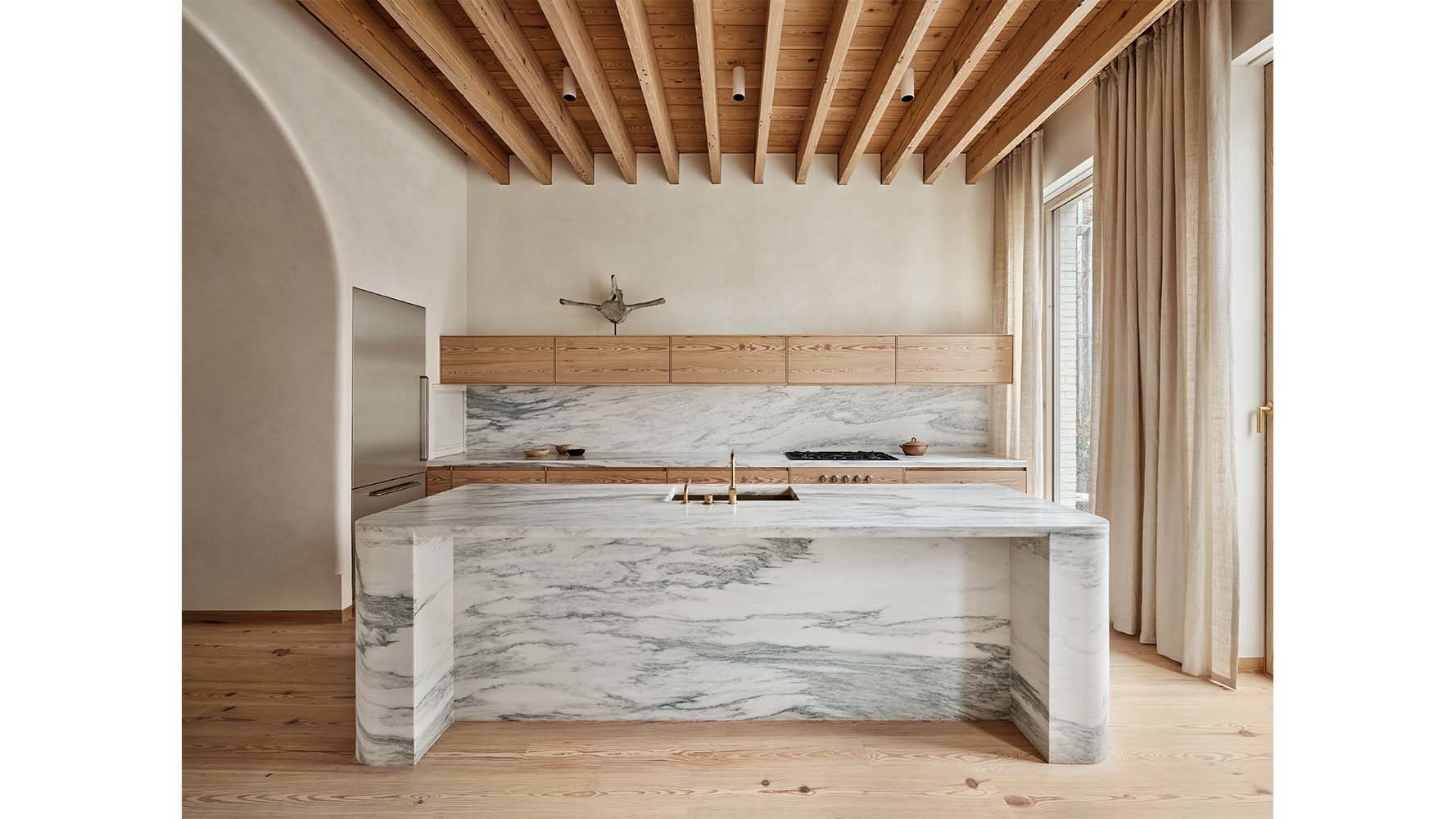
Eco-Terr has a recycled
content of 80 percent and can be specified for
countertops (top), backsplashes (bottom), or flooring.
|
Recycled granite, marble,
and glass blended into a LEED-friendly kitchen countertop
MFor his 4,000-square-foot Fischer Island home,
accessible by ferry off the coast of Miami Beach, Ron
Burton wanted to use eco-friendly finishes either made
with recycled content or emitting low or no VOCs. At
the same time, Burton required an enduring material
that would have a contemporary, Minimal look.
To match his homes white, black, and silver color
palette, Burton selected a Black Diamondcolored
Eco-Terr countertop and backsplash from Coverings Etc.
Made from recycled granite, marble, and tempered-glass
chips, and held together with a cement binder, the finish
boasts a recycled content of 80 percent.
The products high recycled content helps commercial
and residential projects attain LEED points, since it
falls under Credit 4.1 and 4.2 Recycled Content.
Eco-Terr is available in a choice of 24 colors, but
can be custom colored for larger projects. Tile sizes
are 16'' x 16'' x 5¼8'' and 24'' x 24'' x 3¼4'',
and slabs measure 100'' x 57'', in 3¼4'' and
11¼4'' widths.
In addition to countertops and backsplashes, Eco-Terr
can be specified as a sustainable flooring material.
Coverings Etc., Miami. www.coveringsetc.com
[ Reader
Service July 2005 # 211 ]
|
 |
|
| |

The systems integrate
into the
projects green spaces.
|
The next generation in wastewater
treatment
Introduced by Dharma Living Systems (DLS) at
last years USGBC national conference in Portland,
Oregon, a new generation of Living Machine wastewater-treatment
systems can provide higher levels of water quality,
use less energy, and are cost competitive with other
wastewater-treatment options. Dharma Living Systems
comprises a group of engineers, architects, and ecologists
that provide integration services for natural living
systems for projects that need water conservation methods
to reduce their impact on natural resources.
The newer machines require no environmental enclosure,
even in temperate climates, and can be integrated into
the green spaces of a variety of project scales. The
new systems do not use some of the earlier conventional
processes like clarifiers or forced-air components,
do not produce waste bio-solids, and can withstand large
variations of loadings associated with seasonal uses.
Living Machines, Taos, N.M. www.livingmachines.com
[ Reader
Service July 2005 # 212 ]
|
 |
|
| |

The panels will no
longer use formaldehyde.
|
Plywood plants switch to
soy-based adhesive
Columbia Forest Products announced it has begun
to convert its veneer-core hardwood plywood plants to
formaldehyde-free manufacturing processes using a patented,
soy-based adhesive cooperatively developed by Columbia,
the College of Forestry at Oregon State University,
and Hercules. Hercules has awarded Columbia a license
to utilize its adhesive system on an exclusive basis
for all of Columbias North American decorative-panel
markets. The new adhesive, made primarily of soy flour,
will allow Columbia to completely eliminate formaldehyde
from its veneer-core and Woodstalk agrifiber-core panel
products. The company expects the conversion to be complete
within a year. Currently, there are few no-added-formaldehyde
alternatives to UF-based adhesives on the market, and
all are significantly higher in cost. Columbia Forest
Products, Portland. www.columbiaforestproducts.com
[ Reader
Service July 2005 # 213 ]
|
| |
|