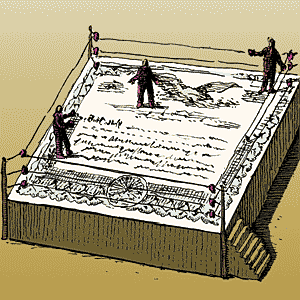
The legal climate has changed somewhat for architects who adopt the new contracts published by the AIA earlier this year [RECORD, July 2008, page 59]. Like previous contracts, A295-2008 requires the parties to conduct mediation efforts before moving to binding dispute resolution. But if mediation is unsuccessful, the latest version of the contract does not allow the parties to choose between litigation and arbitration, according to Suzanne Harness, an architect and the AIA’s managing director and counsel for contract documents. “In an effort to ensure that all disputes be resolved in one proceeding (as seems appropriate for an integrated project) the owner, architect, and contractor are required to proceed to arbitration,” she says.
The new AIA contract C195, for single purpose entities (SPEs), takes a different approach. It requires that all disputes be dealt with within the SPE. Harness explains: “SPE Members are required to make efforts to resolve all disputes amicably and through mutual consensus following the dispute resolution procedures set forth in C195. In the event they cannot reach a resolution, the matter is presented to the SPE’s governance board for consideration and resolution. If the governance board is unsuccessful at resolving the dispute, it will be referred to arbitration through a dispute resolution committee for full and final resolution.”
The basics In a nutshell, mediation is a conference between opposing parties facilitated by a neutral, mutually agreed-upon mediator. The goal of the negotiation is not to assign blame and assess damages; rather, it is to find a compromise that will “make the plaintiff whole,” in the words of Irvine, California–based construction-industry mediator Paul J. Weinberg. This could mean getting the building repaired, or whatever remedy is appropriate to the situation. During Weinberg’s mediations, which can last a few hours or a few days, the opposing parties typically occupy separate rooms. He goes from one to the other, listening to each party explain the problems and then proposing solutions. Mediators cannot impose solutions, but ideally the parties eventually agree, and their written agreement is legally binding. If no agreement is possible, the dispute moves on to the more adversarial processes of arbitration or litigation.
Mediation is voluntary and cooperative in nature. The parties agree on who is to mediate, and they share in any fees and procedural costs. Unlike lawsuits, it is private and entirely confidential. On occasion, when the issues are complex, there may be two comediators, one to lead the negotiations and the other to offer technical or legal advice. According to “Preparing for Mediation,” an AIA Best Practices article contributed by Victor O. Schinnerer & Company, mediators come in several flavors. A facilitator simply organizes the process and brings the various parties to the table. A communicator is more proactive in ensuring that each party’s point of view is reaching the other. This role requires somewhat more experience in both mediation and in construction issues. An evaluator offers his or her opinions about the responsibility of the respective parties.
Weinberg believes good mediators strike a balance between facilitative and evaluative approaches. He explains: “I don’t threaten people or impose a penalty on them. I just sit them down privately and say, ‘Look, you’ve got some potential liability. Here’s what they would throw at you in a trial.’ Then they’re more likely to accept a middle ground.” Although mediators cannot impose solutions, the Schinnerer article notes, “A nonbinding and confidential discussion with a neutral third party can be extraordinarily helpful in evaluating the alternatives to settlement. The experienced mediator knows how to explore issues with the parties in a way that is helpful and will not compromise the position of the parties in front of one another.”
The desire to avoid litigation is understandable. Lawsuits can take months or years; they are very expensive; they draw architects’ attention and energy away from their own work; and they can be emotionally draining. Moreover, juries can be unpredictable, and punitive damages can be astronomical. Mediation, by contrast, can be fast and relatively inexpensive, and there’s a good possibility that the parties can emerge feeling okay — if not happy — about the negotiated solution. In some cases, though, litigation is the only option. There may be legal issues that only a court can decide, or the case may call for a precedent-setting ruling of industrywide importance. Or extensive “discovery,” a normal and time-consuming part of litigation, may be needed to enable opposing parties to uncover background information and best present their own positions.
Besides mediation, another alternative dispute-resolution technique is arbitration. As laid out in the standard AIA contracts, arbitration occurs after mediation has failed. Like litigation, arbitration is adversarial in nature and involves the opposing parties asking one or several decision makers to weigh the evidence, make a judgment, and impose a penalty on the losing party. As in mediation, arbitration proceedings are private, and the arbitrator is chosen by the parties. Unlike in mediation, however, the decision of the arbitrator is binding, the parties must accept it, and they normally do not have the option of challenging the decision in court.
Given the many reasons mediation is a more attractive option, why aren’t architects more familiar with its workings? According to mediator Weinberg, who is a lawyer and former litigator, architects too often leave the mediation process up to their attorneys. The lawyers take charge as if to say their knowledge of the law is more important to success than the architect’s knowledge of construction. But mediation is not a legal process.
In understanding the history of a design or construction problem, the architect has far more expertise. That knowledge should be tapped to create a compelling narrative for the mediation process, and the architect should not simply be called in at the last minute as an expert witness.
Preparing for mediation
At the AIA convention in May 2008, Weinberg gave a seminar on mediation in which he offered advice on preparation and negotiation. He urged architects to become involved early and directly, not to defer to the legal team. Properly equipped with information about the case, architects improve their chances for a positive outcome, thus avoiding the suffering and expense of litigation.
Understanding the history of the problem may be a simple matter of reviewing the “paper trail.” Pertinent drawings, meeting minutes, requests for information, cut sheets, change orders, and job-site reports and photographs can combine to form a picture that will explain, even to a lay person, what went wrong and why. Weinberg advises architects to organize these documents in a tabbed, indexed binder, along with the original contract, any relevant correspondence, and affidavits or declarations by contractor and subcontractors.
The architect should also write an explanatory, chronological narrative to tie this collection of exhibits into a coherent story of how the problem occurred and what the architect did about it. This helps the architect’s lawyer focus on the crux of the problem and anticipate where the core conflict will lie, and know ahead of time who the pertinent witnesses should be. In addition, Weinberg says, “If these things are all explained to the lawyer ahead of time, the lawyer can explain them that much better to the mediator and to the opposing parties. You’ll come across as better prepared and have a much stronger case toward a settlement.” The opposing party will realize that if mediation fails and the case goes to litigation, this narrative is what a jury will hear, too.
Depending on the circumstances, the architect may want to identify outside experts who can support the case through a deposition or by appearing at the mediation. For instance, a locally known and respected architect could testify about professional “standard of care.” Or an engineer could comment on the scope of work an engineer is expected to do, in contrast to what the architect is required to do. If the architect and his or her lawyer have reviewed the project history and identified the key causes of the problem, they can ensure that the relevant subcontractors or suppliers are involved. He notes: “Many times, what frustrates me the most as the mediator is that the people who are responsible aren’t there. Either no one thought through how this happened, and they didn’t make any effort to bring the responsible people there, or the architect didn’t get involved in the process until very late.“ Because the agreement at the end of a successful mediation must be signed by the responsible parties, it’s important that they be present. If all parties agree to the rules, limited discovery is possible. Weinberg says that in his experience, this is generally limited to voluntary, confidential depositions and a few basic documents.
The mediator is chosen by consensus of the opposing parties, who should all feel confident that the person is completely neutral. The mediator need not be a lawyer, because mediation is not a legal process, but some knowledge of legal and construction-related disputes is helpful. According the Schinnerer article, “There is an advantage in letting the opposing party pick the mediator as long as all parties are satisfied that the mediator is experienced, neutral, and effective. Opponents are more likely to take bad news from their own choice of mediator than from strangers.”
Arriving at agreement
One major difference between mediation and litigation is that litigation can only result in monetary remedies. In mediation, however, negotiating strategies can consider creative alternatives. For instance, future relationships with clients and contractors may have a high inherent value, so saving face may be as important as avoiding payments. Weinberg has observed that an architect who wins a lawsuit may develop a reputation for being difficult to work with. This might be as harmful to a practice’s reputation as losing a lawsuit. To learn more about litigant psychology, Weinberg suggests that interested architects read The Mediation Process: Practical Strategies for Resolving Conflict, by Christopher W. Moore (John Wiley and Sons: 2003).
To maintain good feelings among all parties, and to aim for a “win/win” outcome to the mediation, architects should consider alternative solutions. For instance, the architect can offer a client additional services at no charge to get the problem repaired. This way, says Weinberg, “the architect isn’t out of pocket more money, their insurance premiums are far less likely to go up, and their reputation is saved. You’d never get that out of litigation.” He also persuades clients that their best solution is to get the problem fixed and not insist on punitive or delay damages. They may not end up with as much money as if the case had gone to litigation, but they can avoid the cost, inconvenience, and aggravation of spending months or years in court.
As more firms adopt the latest contract forms, and as states push for mediation to relieve courts overloaded with civil lawsuits, look for national trends to move in this direction.


Post a comment to this article
Report Abusive Comment