|
AR:
The scope of the Louvre was so vast. You literally
went through layers of history as you exposed and joined its
lower levels, as well as designing an immense addition, and
all with as little disruption as possible to the institution.
No one ever focused on thateveryone just talked about
the glass pyramid.
IMP:
Youre absolutely right. Everybody points to the pyramid,
but the total reorganization of the museum was the real challenge.
Mitterand understood that. Few people know, for instance,
that the French Ministry of Finance used to occupy the Richelieu
Wing [north wing] of the Louvre. Mitterand was very aware
of the importance of the Richelieu Wing, because without it,
the Louvre is just a long
L-shaped building instead of a U-shaped building. Soon after
he became president in 1981, Mitterand commissioned a competition
for a new building for the Ministry of Finance in Paris. That
gave him justification to move the agency to a new location,
and therefore enabled us to claim that space. Without it,
I would not have been able to do the project. I probably would
not have accepted the commissionI could not have done
anything for the museum.
And the biggest challenge of the Louvre
was beyond merely architecture. When I first went there in
1983, it was divided into seven departments, and each was
totally autonomous. The department directors would not even
talk to each other. They were very competitive for space and
money. So, architecturally we had to change this situationmake
seven departments into one and unify them as a single institution.
Im not so sure Mitterand realized how big a challenge
this was; I certainly didnt. But the result worked out.
Today the departments are all unified under one president,
and theyre also unified architecturally. The fact that
people dont realize this huge challenge of the Louvre
is totally mind-boggling to me.
AR: Lets
discuss form for a minute. We talk a lot about formit
dominates the discussion of architecture in the media these
days. You yourself are a master of formthe East Building
of the National Gallery, for instance, is a superior example
of your skills, as the AIA recognized this year. But everything
youve talked about so far is about the programmatic,
complex, deeper issues that reside within projects. How do
your formal skills interplay with this programmatic thinking?
IMP:
Ever since 1990, I havent been all that interested in
form, not at all. To create a work of architecture that looks
exciting and different is not the challenge for me anymore.
The challenge is for me to learn something about what Im
doing. Ive been more interested recently in learning
about civilization. I know something about the civilization
of China, with my background, obviously, and I think I know
something about American history. But thats about all.
And Ive traveled all over the world, and for a long
time I didnt know very much about it, really. When I
got the opportunity to do the new wing [the Schauhaus] for
the German Historical Museum, for instance, I didnt
see it as an opportunity for my own ego, to do something so
exciting that every architectural publication would want to
put it on the cover. I accepted it because I knew it was going
to be a very difficult project, and I wasnt sure I could
do something exciting there. Originally the building was to
have been located near the Reichstag, a very prominent site.
But ultimately they decided to site this tiny little building
behind an enormous military museum [the Zeughaus] dating from
the early 18th century, which is very Prussian. I visited
that museum, and youd think that any collection of military
artifacts would be all guns and cannons and whatnot, but theres
a lot more than youd expect therea lot about Prussian
history, which of course is the foundation of Germany. [The
Zeughaus, a weapons depot before becoming a museum, is now
undergoing renovation to house the permanent collection of
the German Historical Museum]. This location has much less
visibility. I had the idea to do something helical and transparent
with the new wing, something that would be symbolic of the
unification of East and West Germany. The prime minister personally
asked to see some sign of this in the building. When youre
asked that by a client, its an opportunity you just
dont waste. So, while it was an exciting challenge,
form-making is not the reason Im still engaged in projects.
One of the reasons I took this on was that I wanted to find
out as much as I could about Germanys architectural
history. The name that kept popping up was Karl Friedrich
Schinkel. Ive seen his museum, the Altes Museum in Berlin,
but I hadnt visited any of his other work until I began
designing the new wing. I think his greatest skill was the
diversity of projects he achieved, from the very monumental,
like the colonnade at the Altes Museum, to the small, domestic
skills he brought to the villas he designed in Berlin and
elsewhere.
AR: How
did your museum project in the Middle East come about?
IMP:
How do I begin? Qatar does not have much history, its
a new emirate. So I couldnt draw on the history of the
country; its history is really just being a desert. But I
thought, the one thing I must learn about for this project
is the Islamic faith. So I read about Islam and Islamic architecture,
and the more I studied the more I realized where the best
Islamic buildings were. At the beginning, I thought the best
Islamic work was in Spainthe mosque in Cordoba, the
Alhambra in Granada. But as I learned more, my ideas shifted.
To begin with, the climate of southern Spain is not at all
like desert, where most Islamic architecture is built. I kept
searching. I traveled to Egypt, and to the Middle East many
times. I saw early Islamic architecture in Damascus, Syria,
where they took some early Christian churches and transformed
them into mosques, so they were not pure Islamicjust
as in southern Spain, its no longer pure Islamic architecture
either, because it gets mingled with Christianity. Or in Turkey,
where the Ottoman influence is felt, tooits Islamic
but not pure Islamic.
I found the most wonderful examples of
Islamic work in Cairo, it turns out. Id visited mosques
there before, but I didnt see them with the same eye
as I did this time. They truly said something to me about
Islamic architecture. The museum Im designing is more
influenced by the Mosque of Ibn Tulun than any other building.
This mosque is very austere and beautiful, its geometry is
most refined. You think of Gothic architecture, its
so elaborate. This is the oppositeso simple.
AR: Its
inspiring to see that youre so engaged with these issues.
Youre still a student!
IMP:
Yes, I am. You always should be. Thats what makes life
interesting.
AR: Weve
talked a lot about museums, but there are other building types
that youve been involved with. The Bank of China building,
for instance, in Hong Konga tall building. The issues
you faced with that project are a very different set of concerns
from those of museums, arent they?
IMP:
Thats very true. Actually, many of the projects Im
most proud of are tall buildings, especially the housing projects.
In New York I have two: one in Kips Bay and one at New York
University. At that time, those projects were most challenging,
architecturallyhow do you enable redevelopment, foster
urban renewal with a tall building? For Kips Bay, I had a
wonderful client, William Zeckendorf, who was willing to gamble
with me on using concrete and not brick for a high-rise apartment
building. That was very innovative at the time.
AR: How
old were you when you got the Kips Bay project?
IMP:
I came to New York and worked with Zeckendorf in 1948. I was
30 years old. Kips Bay came to me two years later, in 1950.
Later I got my first museum project, the Everson Art Museum
in Syracuse. That was about 1960, 1961. I was very busy back
then. You dont really get a chance to do anything until
your mid-40s. I told my sons that: Dont expect to accomplish
too much in the early part of your life. I was fortunateafter
the war, I left China, in 1944; there was nothing going on
for me at the time. I went back to Harvard to teach and to
get my masters degree. I thought teaching would give
me the most flexibility in case I had to return to China to
be with my family. I didnt really practice architecture
until I got to New York; I didnt have many qualifications
or much experience at all. Becoming a designer is a long process
of learning. You make mistakes when youre young. Its
important to have the opportunity to make mistakes.
AR: What
are your days like when youre not at work?
IMP:
At home, I have a wife, fortunately, and my children are all
grown, and I have many grandchildren. I spend weekends with
my grandchildren; I adore them. On a daily basis, my home
life is very simple. I spend about 2 hours every morning reading
the newspaper. As my two assistants will tell you, I dont
come to work in the mornings, for two reasons. First, I want
to be informedthat means I go through The New York Times
every day, and then I watch some news on television. The second
is, mornings are the best time to communicate with my clients
abroad. So I communicate with Luxembourg, with Berlin, with
ParisI continue to do work on the Louvre, it didnt
end in 1993. So Im on the phone a lot to my international
clients in the mornings, after I get through the news.
Two afternoons a week I come to my office.
If Im not here, I go to my sons office. I still
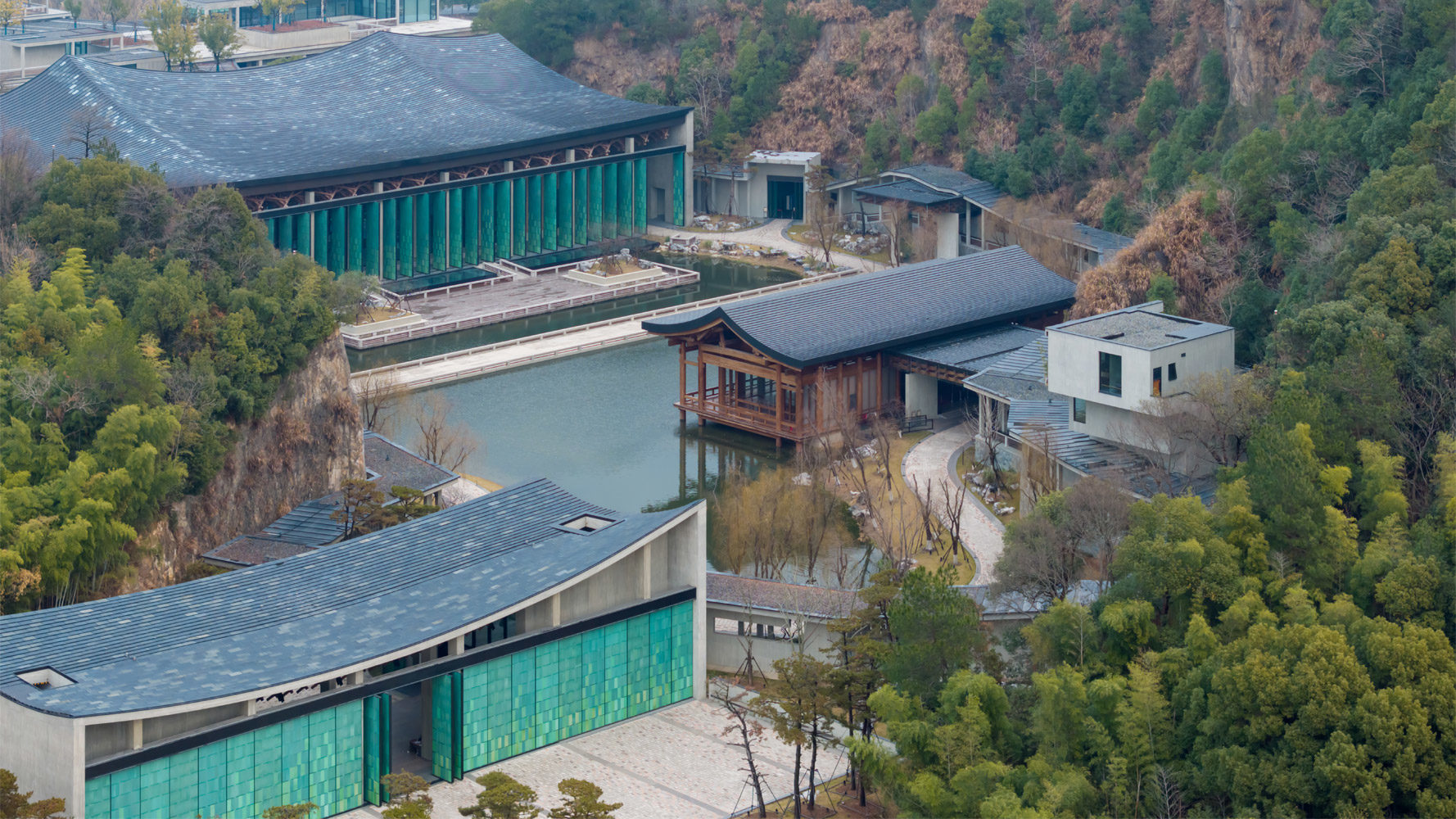
have two of my projects working through themthe Museum
of Islamic Art in Qatar and the Suzhou Museum.
AR: Did
you do any conceptualizing for the redevelopment or the memorial
in Lower Manhattan?
IMP:
No. That project probably will take 10 years, and I didnt
want to think about a project that I couldnt finish.
Thats a kind of temptation. It was the same reason I
declined to submit an entry for the U.N. addition in New York,
the one that [Fumihiko] Maki is now working on. I thought
I wouldnt be able to finish it. One has to realize ones
limitations. Why kid yourself?
For the photos that accomplany this
article, see our June 2004 issue.
Subscribe to Architectural
Record in print, or get Architectural
Record digitally.
|