|
Modernism’s elder statesman looks
back over 50 years—
and forward to finishing new museums on three continents
By Robert Ivy, FAIA

Photo courtesy the architect
|
|
I.M. Pei’s agility with the Modern
form has garnered him prestigious commissions for museums
and cultural institutions throughout his career, from the
East Building of the National Gallery of Art (winner of this
year’s AIA 25 Year
Award) to an addition and renovation of the centuries-old
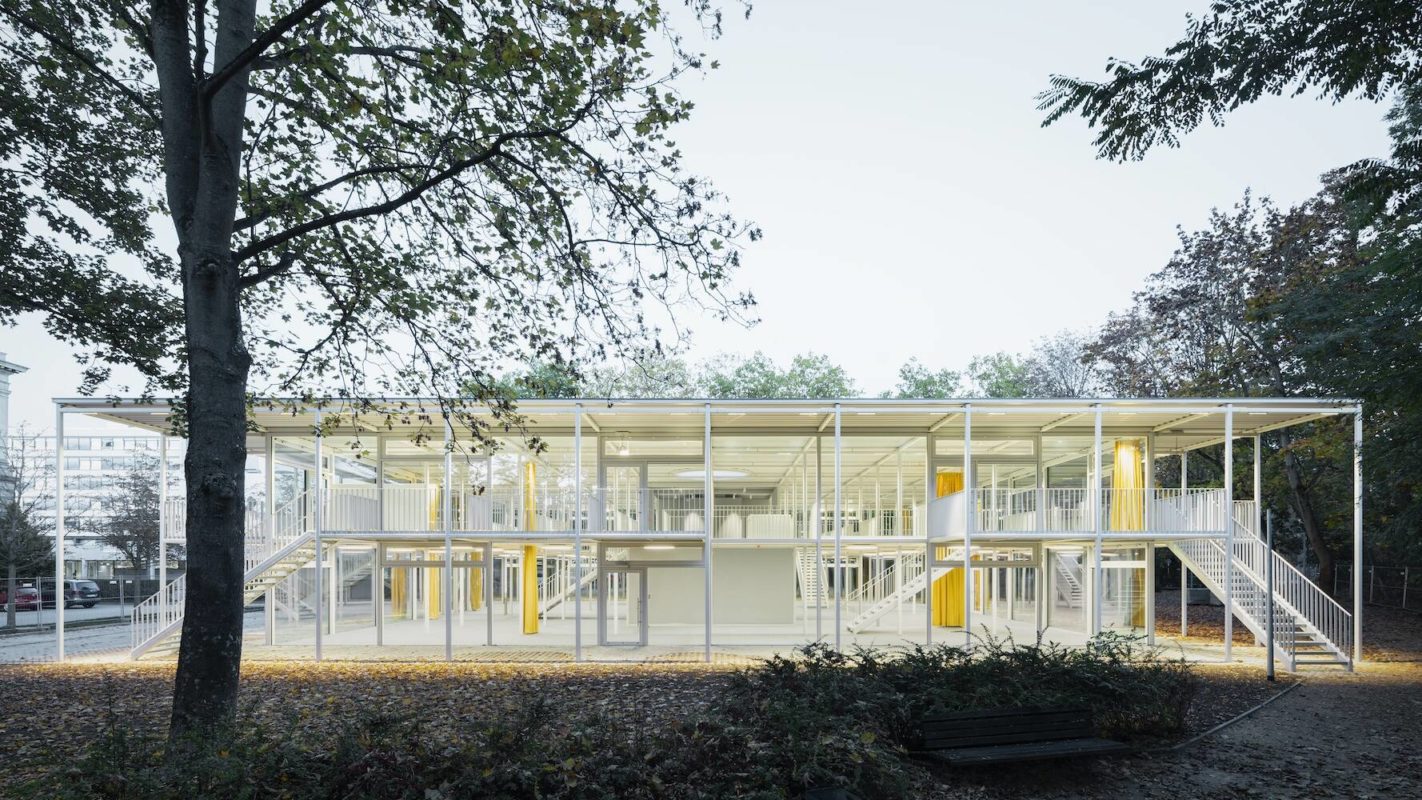
Louvre to a new wing for temporary exhibitions at the German
Historical Museum in Berlin (pictured at left). Although he’s
been “officially” retired for more than a decade, Pei still
has projects on his plate and a twice-a-week-at-the-office
habit. Shortly after the AIA Accent on Architecture dinner
on March 3 in Washington, D.C., editor in chief Robert Ivy
visited Pei at his office in Lower Manhattan, where they discussed
the evolution of Pei’s design thinking, the importance of
working abroad, and his current slate of projects.
AR:
You say you have retired, but you continue to be
involved in projects. What are you working on right now?
IMP: I havent taken any new projects
in the past three yearsI told myself, if I cannot live
long enough to finish it, I dont want it. So I have
three projects now. The first one is the Musée dArte
Moderne in Luxembourg, which is under construction right now.
The museum will be located on top of an old, old fortress,
Fort Tüngen, which the Austrians built in the 1800s.
The client is the State of Luxembourg. I accepted the commission
for the project in 1990 or 1991, after I retired, but it began
only six months agoit was stopped altogether five or
six years for various reasons. The second project is a museum
in my hometown of Suzhou, China. And I am also designing the
Museum of Islamic Art in the Middle East, in Qatar.
AR: So
do these projects involve design work, or development work
and decisions about construction?
IMP:
Its a little bit of each. I just completed the design
for the museum in Qatar, which I accepted about two and a
half years ago. Its now under construction, but thats
an exceptional one, because usually it takes longer than that.
Im doing most of the work on the Suzhou Museum on my
own.
AR: Thats
a very active, demanding schedule.
IMP:
Ive been active all my life. In 1990 I retired from
my firm, I.M. Pei & Partners, and for two years I didnt
do much. Then I started to get kind of antsy, so I decided,
Im going to do some more work. And I chose to do work
outside the U.S. because Ive spent 45 years here and
I wanted to learn more about whats happening in the
rest of the world. So I travel to the Middle East, I travel
to China, I travel to Europe. Its all very rewardingthe
only problem is the travel is getting more and more difficult
for me now. Ten years ago I would have enjoyed it a lot more.
And my projects have typically taken
a long time to complete. Buildings might take on average about
five to seven years to finish, but in my case its been
longer, because the projects I have accepted within the past
15 years have been mostly government projects, and those involve
some politics and funding issues, and approvals and so forth.
So theyre slower.
AR: Tell
me about the museum youre designing in your hometown
in China.
IMP:
When this commission came, it was very special. I was born
in Suzhou, a city not very far from Shanghai. Its a
very interesting townthere is a long artists tradition
there, especially during the Ming and Ching dynasties, which
produced many, many scholars and painters and so forth. Thats
where my family lived for 600, 700 years. When the mayor first
came to me about designing a museum, I said no, its
too far away. They invited me to go back six or seven years
ago, and I always tried to say no. But finally, a couple of
years ago I accepted it. The location could not be more exciting.
Its a very special site, surrounded by a wonderful garden.
I thought the project would touch on my relationship with
my past, my ancestors, my old home. The building is now under
construction. It has two more years to go before its
complete.
AR: How
about your other projects? Say, the museum in Luxembourg?
IMP:
That project came to me after I had completed the Louvre.
I was approached by the prime minister of Luxembourg and asked
to design a museum for modern art, near the fortress [Fort
Thüngen], which is being turned into a museum as well.
It wasnt as big of a challenge as the Louvre, but I
was very interested in it. For instance, I wanted to know
why the building would be located on top of a fortress. Luxembourg
was and still is today a crossroads, the place where Germany
meets the rest of Europe. The country lost part of its territory
to Belgium in the 1800s, and during World Wars I and II the
German military overran it. The fortress was the natural symbol,
the physical symbol of the country. Very few people have visited
Luxembourgwhen I went there and looked at it, I said,
my God, its built on a rock. And within the rock they
had a castle, and within the city theres a network of
tunnels so the residents could move around and defend themselves.
That was of great interest to me. I was curious to know how
Luxembourg remained an independent countrythats
why I accepted the commission.
AR: Lets
go back and talk about a few of your past projects. Your work
at the Louvre represented one of the first instances of an
architect being employed by a major government agency in a
way that gave you a prominent role in the countrys self-image.
Could you talk about that? Were you consciously aware of how
important the Louvre was to them at that time?
IMP:
It was a total surprise that they approached me to do the
project. You know the French, not to mention the Parisiansthey
see the Louvre as their monument, so to come to an American
for a project like that is something I never expected. I thought
perhaps they were just trying to show interest in different
architects to try out the idea. But when President Mitterand
asked me to see him, I knew that it was serious. Mitterand
was a student of architecture, he had done a lot of research
before he called me. He said, You did something special
at the National Gallery of Art in Washingtonyou brought
the new and the old together. But John Russell Pope
finished the West Building in 1941, so when the East Building
opened it was only about 40 years old. But the Louvre is 800
years old! A much bigger design challenge.
I didnt accept the project right
away, excited though I was. Instead, I told Mitterand that
I needed four months to explore the project before I could
accept it. I wanted that time so I could study the history
of France, because what is the Louvre? The first portions
were built in the 12th century, and a succession of rulers
came, added on, built something, demolished something else.
For 800 years the Louvre has been a monument for the Frenchthe
building mirrors their history. I thought by asking him for
this time it might make him say no, thank you very much, because
he was in a hurryhed been elected in 1981 and
his term would last only seven years, and this was 1983so
there was some pressure for him to accomplish something.
In those four months, I studied. I asked
for four visits to the Louvre, one visit each month. And I
asked the Louvre to keep things confidential at first, without
revealing the fact that I was asked by the president to be
involved, so that I could go to France unencumbered and visit
the Louvre, assess whats wrong with it, whats
right about it, what had to be destroyed or must be saved,
that sort of thing. Mitterand agreed to all this. You cannot
defend your design without knowing what youre designing
for. When I was being questioned by the press about the design
later on, all this preparation was very useful.
|