|
Speaks with REDORD about skyscrapers
and the city
The recent destruction of the World Trade Center in New York
casts an ominous shadow on high-rises everywhere, especially
those that aspire to landmark status. Earlier this year, well
before the tragic events of September 11, Record's editor
Robert Ivy spoke with Renzo Piano at his glazed-roofed offices
overlooking the Ligurian Sea outside of Genoa. Although the
topic of terrorism and its impact on skyscraper design did
not arise, Piano discussed his views on building in New York,
his approach to design, the problem of urban sprawl, and the
role of memory in architecture. What follows are excerpts
from that interview.
Architectural Record: You have
worked in many great cities in the worldBerlin, Paris,
Turin, Osakaand now you are designing projects for New
York, San Francisco, and Chicago. Do you think it's going
to be hard to achieve what you want in a city like Manhattan,
which has the reputation of being a tough place to build?
Renzo Piano: This is what architecture
is about. Architecture is not an art independent from reality.
Real architecture, real painting, real poetry, real music
is never detached from physicality. In architecture, thats
it. Architecture is at the edge, between art and anthropology,
between society and science, technology and history. Sometimes
memory, too, plays a part. Architecture is about illusion
and symbolism, semantics, and the art of telling stories.
Its a funny mixture of these things. Sometimes its
humanistic and sometimes its materialistic.
AR: So youre not worried
about working with tough New York developers on a project
like the New York Times Tower?
RP: No. Of course they are
developers. But what is wrong with that? In some ways the
best client is a tough client who knows what he wants. That
doesnt mean you give the client exactly what he wants.
You are responsible for doing your job well. But a good building
needs a good program. I dont think there is one single
good building without a good plan. Its impossible. Certainly
you need a good architect, but thats not enough.
AR: You have studied ceramics
and tiles more than most contemporary architects. How will
you use them in New York?
RP: Ceramics are metamorphic
materials. They have a great ability to bleach and change,
to echo the weather. For me, the most beautiful quality of
Manhattan is its ability to change with atmospheric changes.
One of the most poetic views of Manhattan is of its forest
of buildings as they take the quality of the weather. New
York is a peculiar place because its very hard, very
tough when you touch the ground. Its made of stone and
steel. But as soon as you break from the ground and go up,
you can see its one of the softest cities in the world.
AR: What will the New York
Times building do to advance your thoughts and work? Where
is it going?
RP: This is exactly the question
we ask each time. We are lucky to be able to decide what projects
we want to donot because we are snobs but because we
are in a lucky position. Lets talk about expression
in architecture. I like fighting gravity. Magic is essential
in architecture. Working in Manhattan, I love the idea that
we accept the clear and simple geometry of a building. We
accept that logic. But complexity comes from texture, from
vibration, from the metamorphic capacity of the building to
transform, to change, to breathe. Sometimes buildings even
make sounds. You know, in New Caledonia we learned from the
local culture that buildings sing. And we were actually able
to do that, to make our building [the J.M. Tjibaou Cultural
Centre in Nouvéa] make a sound when the wind blows.
So the complexity doesnt necessarily come from geometrical
complexity. The building is actually very simple. But the
complexity comes from the skin, the surface of the building
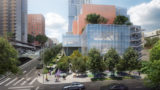
actually vibrating, working with the weather. In Manhattan,
I think the Times building will be tough when it touches the
ground and then become more light, more vibrant, more metamorphic
as it disappears in the clouds. Im working on the idea
of putting a garden on the roof, so theres a garden
in the sky. On the street level there will be a lot of activity:
a small auditorium, a small museum for the Times collection
of pictures and documents, shopslots of street life.
AR: Your work often centers
on complex issues that are resolved simply. Can you explain
your approach to design?
RP: I came to architecture
as the son of a builder, so when I was a young architect I
was devoted to developing objects. I was attracted to the
physicality. The piece-by-piece approach was essential to
me. Then I began to understand that this is not enough. Architecture
is more than just putting things together. Its about
the organic, about illusions, a sense of memory, and a textural
approach. I must admit, though, that I still love the idea
of putting parts together. That is why my office is called
the Building Workshop. I love the idea that you go from the
general to the detail and then from the detail to the general.
Its a double process. You cannot think about the presence
of the building in the city without thinking about materiality.
And when you think about materiality, you start to think about
detail.
AR: There is a lot of talk
about architecture becoming virtual. What is the role of the
computer in architecture today?
RP: The computer is essential.
When you make a building like, for example, Kansai Airport
in Osaka [RECORD, JULY 1994, Pacific Rim section, page 26],
you need a computer to optimize everythingthe structure,
the form. You know, computers are getting so clever that they
seem a bit like those pianos where you push a button and it
plays the cha-cha and then a rumba. You may play very badly,
but you feel like a great pianist. The same is true now in
architecture. You may find yourself in the position where
you feel like youre pushing buttons and able to build
everything. But architecture is about thinking. Its
about slowness in some way. You need time. The bad thing about
computers is that they make everything run very fast, so fast
that you can have a baby in nine weeks instead of nine months.
But you still need nine months, not nine weeks, to make a
baby.
AR: Lets jump around
a little here. What do you think of the role of the architect
in todays world? Where do we stand as a group?
RP: This touches on the ethics
of the profession and how we go about our work. Can I confess
one thing? I take pleasure in what I do. Pleasure is one of
the most important things. You may say this is selfish. It
is not selfish.
AR: When you accepted the Pritzker
Prize in 1998, you described architects and yourself as explorers.
Do you take an idea or a line and rework it or are you always
looking for the new?
RP: I think its important
to note the difference between style and coherence. If youre
talking about coherence, I love it. If youre talking
about style, then I start to be more suspicious. Coherence
is about the experience, about using what youve been
learning and reapplying it. Its not about making yourself
recognizable. But architecture is necessarily about exploring.
Every place is different, every client is different, every
society is different. Culturally, historically, psychologically,
anthropologically, and topographically, every job is different.
So the real risk is that as an architect you end up imposing
your stamp before you understand what is the reality of a
place. I never take a new job without visiting the place,
without trying to understand, without trying to get a basic,
fundamental emotion. Because thats what its all
aboutbuilding emotion. I try to understand what is the
real nature of a place, what is the context. My goal is not
necessarily to integrate with the context. Sometimes architecture
should not integrate but should make a contribution to the
context.
AR: Do you ever worry that
you wont find the genius of a project or make it work?
RP: Oh, yes, you worry about
that. And the next thing you worry about is staying on track,
because architecture is a very long, complex process. There
are two things I worry about. In the beginning, its
finding the emotion, the basic emotion. But then, you need
to find the direction and stay with it for sometimes five
or six or more years.
AR: Tell us a little about
how your firm operates. What is your role here?
RP: One of my favorite roles,
though not necessarily the main one, is spending timemy
colleagues might say losing my timein the model-makers
shop. I love watching things and touching. If you look around
my workplace here, I have all my small working models on the
wall. What I do is mentally I touch each one. Theyre
like my children, and I go and touch each one to understand
what is going on.
AR: Youve spent a lot
of your career working on cities such as Genoa and Berlin.
What is the state of the contemporary city today?
RP: Right now Im working
with Milan, helping it plan its peripheries. This is going
to be one of the biggest challenges in the next 50 years.
How do we transform the periphery? Its not just about
form, its about content. The real trouble is that these
urban peripheries are monofunctional, theyre all about
just one modeproduction or business or housing. But
after the citys big explosion, now were seeing
it start to implode. I like the idea that sustainable growth
is about implosion not explosion.
AR: There are some architects
who have made careers of mostly talk.
RP: Yes, theres nothing
wrong about that. But for me, I prefer to build.
Return
to Interviews Index
|