Not much rankles like large-scale urban development. Take, for instance, some of the more extreme claims regarding the plan for a sports arena at Brooklyn’s Atlantic Yards: ill-conceived, a waste of taxpayer money, a circumvention of the democratic process. But would anyone go so far as to indict it, or any other development, as a cause of death?

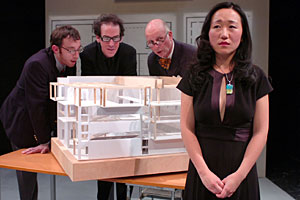
That’s the central accusation in Los Angeles writer Oren Safdie’s play, The Bilbao Effect. The new work is a tragicomic satire in which a Staten Island resident takes an architect to a court of sorts—a hearing in front of fellow American Institute of Architects members—because he blames the aggressive form and metallic skin of a project by the designer for the circumstances leading up to his wife’s suicide.
Son of architect Moshe, the younger Safdie completed an M.Arch. at Columbia University before turning to drama and film writing, and he designed original architectural models and drawings for his play’s spare, makeshift courthouse set. The Bilbao Effect will premiere on May 12 at a venue better known for lectures and exhibitions than drama, New York’s Center for Architecture, and run through June 5.
Despite parallels between Safdie’s play and the real Atlantic Yards—it contains explicit references to Frank Gehry, the project’s original architect (he stepped down in 2009)—the writer says he doesn’t intend to mirror a specific situation or designer. Rather, the work comments on what he calls “the Hollywoodization of architecture” and the tendency to build “statement” buildings, even if they don’t meet the needs of the organizations they house. The drama is also a response to what Safdie sees as a recent phenomenon: A diminished public trust in architects. “Part of the character’s accusation is that the profession is insular and is not open to hearing what the public really thinks,” he says.
The Bilbao Effect is the second installment in what Safdie envisions as a trilogy; his play Private Jokes, Public Places was presented at the Center for Architecture in 2001. Although the Center doesn’t often host theater, says its director Rick Bell, Safdie’s work is in line with the venue’s more-traditional programming. Both, he explains, “deal with the ways that decisions get made, before and after the fact.”



Post a comment to this article
Report Abusive Comment