Paolo Soleri, a renowned 91-year-old architect and urban theorist, finally will see a bridge he designed open on Dec. 11.
The $3 million cable-stay bridge provides a pedestrian crossing over the Arizona Canal from the Waterfront District on the north to Old Town on the south, just west of Scottsdale and Camelback roads.
This is the first of Soleri’s bridge designs to be built from his 60 years of drawings, models and sketchbooks. The dedication coincides with “Bridges: Spanning the Ideas of Paolo Soleri,” at the Scottsdale Museum of Contemporary Art, Oct 9, 2010–Jan. 17, 2011 — the first exhibition dedicated to his bridge designs.
“The exhibition demonstrates how the topography of Arizona’s canyons, as well as the scarcity of water and abundance of sunlight in our desert, informs Soleri’s bridge designs,” says Claire C. Carter, SMoCA assistant curator.
Italian émigré Soleri lives in nearby Paradise Valley, where he completed his home and studio, Cosanti, in 1970. He began his long career studying under Frank Lloyd Wright before pioneering “arcology,” a combination of ecology and architecture.
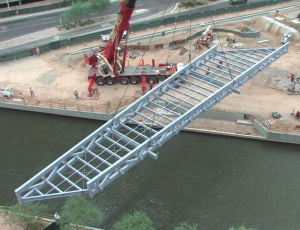
The Phoenix office of construction manager-at-risk Howard S. Wright Constructors began onsite work for the bridge in March. Gilbert, Ariz.-based Hunter Contracting Co. assisted with preliminary offsite work at Cosanti.
Douglas Architects coordinated the project, working with PK Associates, structural engineer, and Steve Martino & Associates, landscape architect — all from Scottsdale. Mesa’s Schuff Steel Management Co. Southwest provided the structural steel.
The bridge, a Scottsdale Public Art project, was funded through municipal and private contributions, says Gary Meyer, project manager for the city through its Public Works Department.
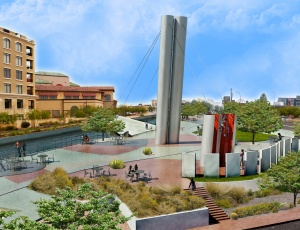
The 130-ft-long bridge spans the waterway, widening from 18 ft on the north bank to 27 ft on the south where it opens onto a 22,000-sq-ft integrally colored concrete plaza.
On the plaza side, carbon-steel rods act as suspension cables, anchored by two canted 64-ft-tall, 6-ft-8-in.-diameter steel-lattice pylons and two canted 22-ft-high reinforced concrete pylons.
Each pair of pylons is separated 6 in. through which light passes daily at solar noon. The columns will also align with the sun at noon on the summer solstice so that no shadow will appear, says John Douglas, FAIA, principal of Douglas Architects.


Post a comment to this article
Report Abusive Comment