Skidmore, Owings and Merrill has broken ground on the $1.7 billion Digital Media City Landmark Tower in Seoul, South Korea. With a planned height of 2,100 feet, it is expected to be East Asia’s tallest tower by the time it’s completed in 2014.
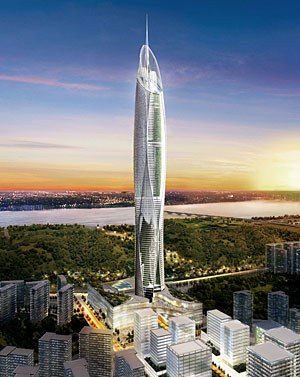
“The Korean construction industry has built supertall buildings around the world—most notably Burj Dubai,” which was built by Samsung Corporation, says Mustafa Abadan, AIA, SOM’s design partner in charge. “This building has become an important symbol for them in terms of bringing that expertise to bear at home.”
The 725,000-square-foot skyscraper—a concrete structure clad in glass and aluminum—appears to swell slightly as it rises, evoking traditional Korean pottery that is slender at the base and flared at the top. Snaking façade details, to be made of either extruded aluminum or stainless steel, soften the building’s corners, which Abadan says breaks up wind forces on the structure while also creating different shading conditions.
The tower is topped by a crown that extends beyond the inhabitable floors, which is meant to accentuate the building’s height, capture light, and help power an array of wind turbines. With a host of other energy-producing and energy-saving features, such as natural ventilation from a powerful stack effect, photovoltaic panels that double as shading elements, and radiant cooling through beams, SOM estimates it will be able to reduce the building’s energy use by up to 65 percent, compared to more conventional towers.
The 133-story skyscraper will offer retail spaces, offices, a hotel, residential units, and an observation deck; it will be the centerpiece of a new business district for media companies. It is one of several new towers planned for Seoul, including the Lotte Super Tower 123 by Kohn Pedersen Fox Associates, and a Daniel Libeskind-desigend tower in the Yongsan International Business District.



Post a comment to this article
Report Abusive Comment