
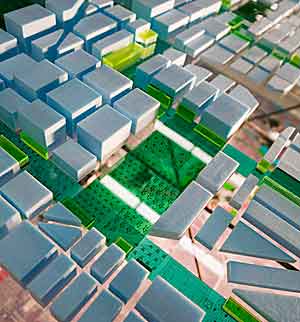
In 2007, the nine-year-old architecture studio UrbanLab won The History Channel’s City of the Future ideas competition with its entry, Growing Water. Most notably, the submission envisioned how Chicago could insert “eco-boulevards” into the street system that would clean wastewater and storm water by bioremediation. The concept has gained traction among decision makers in the city’s transportation and environmental departments, as well as the mayor’s office, according to Martin Felsen, AIA, UrbanLab coprincipal with Sarah Dunn. But for a young office juggling a gamut of residential and small commercial projects, Felsen says, “the water project is much bigger than our firm.”
The architects are about to get help with their futuristic scheme. This month, Felsen and Dunn took over as director and research director, respectively, of Archeworks, a Chicago school that pairs designers-in-training with the nonprofit community. Archeworks was founded in 1993 by designer Eva Maddox and architect Stanley Tigerman. “Initially, when Stanley asked us, we were very excited but a little worried,” Felsen says, noting that they wanted to ensure UrbanLab wouldn’t get neglected. The two principals started to develop ways the school and their firm could work together, particularly with regard to realizing Growing Water.
They have since developed four projects that will help advance the scheme. In one, students will work with residents of Little Village, a predominantly Latino neighborhood, to design pocket parks that deploy water-management strategies. In another, they will conceive an exhibition highlighting eco-boulevards in conjunction with Chicago’s bid to land the 2016 Olympics. Felsen and Dunn also plan to have students coordinate town hall discussions and create a Web site as part of a video documentary on drought, and contribute to an advocacy project concerning green transportation. All of the projects are geared toward the 20 students in this year’s post-professional certificate program.
Felsen notes that the school has focused primarily on Chicago’s underserved South Side, and these projects will continue in that tradition. “The South Side does not have to become a replica of the North Side,” Felsen says. “It can transform to be a better urban model. We want to be part of that.”



Post a comment to this article
Report Abusive Comment