The Smithsonian-affiliated National Museum for American Jewish History (NMAJH), the nation’s only museum documenting the Jewish-American experience, has assiduously expanded its collection from 40 objects, when it opened in 1976, to more than 20,000. In doing so, it has outgrown the meager 6,000 square feet of exhibition space in its current home, a half-block from the spot on Philadelphia’s Independence Mall where it is constructing a new 100,000-square-foot complex designed by Polshek Partnership. NMAJH hopes that when the $150 million space opens on July 4, 2010, it will be able to expand its programming and quintuple its attendance to 250,000 visitors a year.
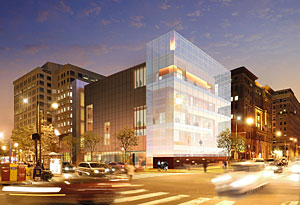

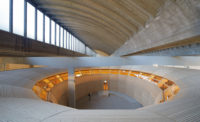
Polshek’s design for the National Museum for American Jewish History calls for two box-shaped volumes to sit atop a street-level pedestal of granite (top); one volume will be clad in terra cotta, conveying permanence and protection, while the other will be clad in glass, symbolizing a more subtle message of impermanence and fragility. Interior staircases and other circulation elements bridge the two volumes (above).
James S. Polshek, FAIA, says that his design attempts to convey one group’s story of achieving freedom in the United States. Two, four-story box-shaped volumes will sit atop a street-level pedestal of granite. One volume will be clad in terra cotta, conveying permanence and protection, while the other will be clad in glass, symbolizing a more subtle message of impermanence and fragility. The two wings establish a dialogue between the past and the present, Polshek says, enabling “a reconciliation between people through the clarity of intersecting and interacting volumes, through a conversation between the transparent and the solid.”
The terra cotta volume will house 30,000 square feet of galleries, an education center, and a 200-seat theater, while the glass-clad wing will contain event rooms as well as a series of circulation spaces and staircases. This wing will be crowned by the “Freedom Beacon,” a flame symbolizing Judaism’s 5,000-year history that will be positioned at the top of a 104-foot-tall atrium. Polshek says the museum’s facades are purposefully unadorned so as to attract visitors who are interested in experiencing how America’s promise of freedom shaped the evolution of one cultural group, rather than a specifically Jewish audience. Philadelphia’s Independence Mall, home to the Liberty Bell and other historic sites, draws more than 2 million tourists annually.





Post a comment to this article
Report Abusive Comment