| |
 Photo © Timothy Hursley |
| |
 |
| |
|
26th Street Low-Income Housing, Santa Monica, California
Kanner Architects
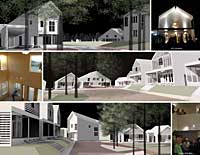
This low-income family housing project is the product of an exhaustive community outreach mission. The design incorporates the region’s mild climate, historical precedents of Southern California Modernist architecture, and the human scale of residents and pedestrians.
Delta Shelter, Mazama, Washington
Olson Sundberg Kundig Allen Architects
This 1,000-square-foot weekend cabin is essentially a steel-clad box on stilts that can be completely shuttered when the owner is away. Raised above the ground to minimize potential flood damage and take in 360° views of the surrounding forest and mountains, the cabin was conceived as a low-tech, virtually indestructible weekend house.
Griffith Observatory, Los Angeles, California
Pfeiffer Partners Architects
This renovation took the famous telescope into new dimensions, restoring its mix of Beaux Arts, Neoclassical and Art Deco features while more than doubling its size with the addition of new exhibition spaces, a theater, and a café. Griffith Observatory, one of Los Angeles’ most visible and beloved landmarks, is an iconic presence in the Hollywood Hills.
Heifer International World Headquarters, Little Rock, Arkansas
Polk Stanley Rowland Curzon Porter Architects
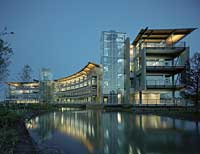
The Heifer International Headquarters is designed as a series of ringed bands that radiate outward. Its narrow corridors ensure that all offices have access to natural sunlight, and a bevy of green features earned the design a spot on the AIA Committee on the Environment’s Top 10 Green list as well as LEED Platinum certification.
Loblolly House, Taylors Island, Maryland
KieranTimberlake Associates
The Loblolly House, by the 2008 AIA Architecture Firm Award winner KieranTimberlake, draws inspiration and formal cues from the surrounding coastal flora and landscape: loblolly pines and saltmeadow cordgrass. The 1,800-square-foot house was modularly constructed with simple tools in only six weeks and is intended to sit lightly on the land.
Olympic Sculpture Park, Seattle, Washington
Weiss/Manfredi Architecture/Landscape/Urbanism
This project is located on Seattle’s last undeveloped waterfront property, sliced by train tracks and an arterial road. The design connects three separate sites with an uninterrupted Z-shaped “green” platform, descending 40 feet from the city to the water, capitalizing on views of the skyline and Elliot Bay and rising over existing infrastructure to reconnect the urban core to the revitalized waterfront.
Residence Halls Units 1 & 2 Infill Student Housing, Berkeley, California
EHDD Architecture
The architects’ solution of infill student housing remedies the urban design challenges of an existing residential site, one block south of the University of California at Berkeley campus. The project increases the density of housing units, creates more usable open space for students, maintains a street wall with units oriented toward the public street, and helps to reduce the scale disparity between the existing housing and the more modest structures in the neighborhood.
Shaw Center for the Arts, Baton Rouge, Louisiana
Schwartz/Silver Architects
The architects combined two primary public venues, the Museum of Art and the performing arts theaters, to form a single structure that cantilevers over the historic rebuilt Auto Hotel. Clad in channel glass and aluminum, the building is designed to withstand major hurricanes, as demonstrated by weathering hurricanes Katrina and Rita shortly after it opened.
The Liberty Memorial Restoration and Museum, Kansas City, Missouri
ASAI Architecture
Since structural and material decay shuttered it in 1994, the Liberty Memorial, with its iconic tower monument and public mall in Kansas City, Missouri, was the sleeping giant of early 20th century history. ASAI Architecture’s renovations restored the ailing facility and added 160,000 square feet of museum space, including an auditorium and education and research centers, that are all derived from the memorial’s original architectural vernacular.
The Nelson-Atkins Museum of Art, Kansas City, Missouri
Steven Holl Architects
The addition to the Nelson-Atkins Museum of Art places five translucent, rectangular boxes—called “lenses”—on the eastern edge of the museum’s campus. The new addition engages the existing sculpture garden, transforming the entire museum site into the precinct of the visitor’s experience. The expansion of the Nelson Atkins Museum of Art fuses architecture with landscape to create an experiential architecture that unfolds for visitors as it is perceived through each individual’s movement through space and time.
Thomas L. Wells Public School, Ontario, Toronto
Baird Sampson Neuert Architects
The first of a new generation of high-performance “green” schools by the Toronto District School Board, Thomas L. Wells is intended to serve as a model demonstrating sustainable design principles and an enhanced learning environment. The building is conceived as a “system of systems,” integrating architectural design with environmental performance.
Trutec Building, Seoul, Korea
Barkow Leibinger Architects
This 11-story building situated over a five-level underground parking structure is clad in a mirrored fractal glass articulated into a series of crystalline-formed bays projecting 20 centimeters. This pattern refracts light and images, rendering the facade as a fragmented and abstract surface.
Unilever House (100 VE), London, England
Kohn Pedersen Fox Associates
Following an extensive consultation process with Unilever, the City of London, and English Heritage, proposals were developed that achieved a balance between retaining the important parts of the historic fabric of the building and providing a transformed workplace and spatial experience for the many visitors to the building.
|