The British architect Will Alsop doesn’t do quiet buildings, so it’s fitting that his latest North American project will be an icon for an equally bold development project: a plan to build one of the largest film studios on the continent in Toronto.
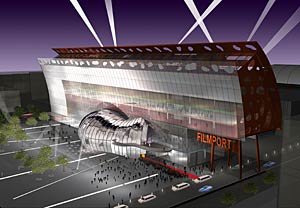
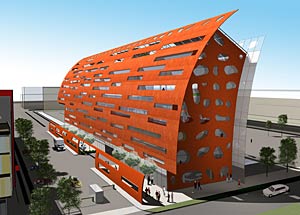
Images Courtesy ALSOP/Quadrangle
Unveiled last week, Alsop’s design calls for a cantilevered 280,000-square-foot building that will function as a gateway to the new Filmport complex, now being constructed in the city’s port area. The tower, like much of Alsop’s work, employs a bold vocabulary of forms and materials: it is a giant arc, its inner face wrapped with a glass curtain wall and the outer face with Cor-Ten steel punctuated by a series of bulbous window openings. The building “curves as it rises,” explains Alsop, who won the Stirling Prize, the highest award in British architecture, in 2000 for London’s dramatically cantilevered Peckham Library. “It bends over and gives cover to what will be a very lively, public square.”
The Filmport tower will house offices, production facilities, and retail space; a three-story glass bubble, tucked under the main curve, will serve as an atrium and restaurant. It’s likely to be the first major project completed in a broad redevelopment of Toronto’s industrial port land. The entire site, designed by Toronto’s Quadrangle Architects, is being billed as the largest studio in North America outside of California. Plans include 550,000 square feet of production space, including a one-acre soundstage designed to lure the biggest Hollywood movies to the city’s already booming film industry.
Alsop says that creating public space in the emerging neighborhood is an explicit goal of his building—and so is attracting tourists to the area. His atelier is a natural choice in that regard: it is well known in Canada for the Sharp Centre at the Ontario College of Art and Design, whose box-on-stilts form has made it one of the city’s most recognizable buildings since it was completed in 2004. Alsop says that, according to Toronto’s mayor, the Sharp Centre has increased tourism to the city by 2.3 percent. “Though I don’t know how they calculate those numbers, I’m happy to take credit,” he adds.


Post a comment to this article
Report Abusive Comment