The Government of the Republic of Sakha (Yakutia) and the United Nations Educational Scientific and Cultural Organization announced yesterday that Leeser Architecture won a competition to design a new museum in Siberia. The Brooklyn-based firm bested finalists Antoine Predock, Massimiliano Fuksas, SRL, and YakuProekt.
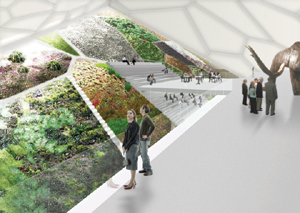
Lichen and Moss Garden.
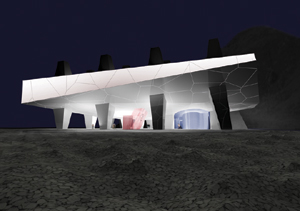
Museum entry
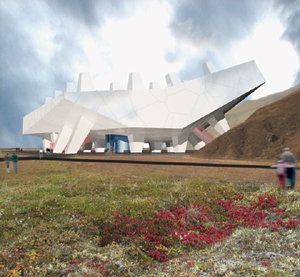
Summertime view
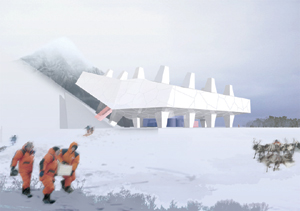
Wintertime view
While the distant location of Siberia might seem surprising, given that it attracted such international talent, the museum’s name explains a lot about its focus: the World Mammoth and Permafrost Museum. Located roughly 280 miles from the Arctic Circle, in the city of Yakutsk in the Republic of Sakha (Yakutia),it will be dedicated to the study and display of ancient mammoth remains as well as fragile permafrost landscapes.
“It’s the next best thing to building on the moon,” architect Thomas Leeser says. “In summer, it’s up to 90 degrees, and in winter it’s easily minus 40. I think there’s hardly another place on earth that has such extreme conditions.”
Leeser’s design calls for a thoroughly contemporary structure that sits lightly on the landscape. To prevent radiant heat from interfering with the frozen ground below, the 65,000-square-foot building will be elevated on 20-foot-tall stilts. While the structure will be primarily rectilinear, its roofline will rise to a peak at one corner to echo the profile of the nearby Tchoutchour Mouran hill. Its translucent skin will be composed of a double-glazed facade filled with Aerogel, a super-insulating substance featuring a cloudy, smoke-like appearance.
“The building is a little bit like an animal,” Leeser says. “It’s entirely self-contained and up on legs. It has a protective skin that is able to create an environment that responds and adapts to the light and climate conditions around it.”
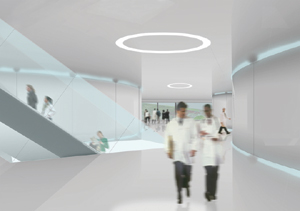
Inside, space will be split between a public museum and private research labs. Escalators enclosed in climate-controlled tubes will pass through the entire building and allow museum visitors to catch glimpses of the scientists at work. A series of light collectors will punctuate the roof and direct diffused sunlight down into the museum galleries, and sloped indoor surfaces will provide a habitat for growing gardens of lichen and moss. “Permafrost galleries,” meanwhile, will be buried underground beneath the Tchoutchour Mouran and connect to the museum via another enclosed escalator.
The preliminary construction budget is $18 million, and the estimated completion date is December 2009.


Post a comment to this article
Report Abusive Comment