Rows of Victorian-era workers’ cottages line the streets in Richmond Hill, a residential neighborhood of Melbourne, Australia. While these humble dwellings do not appear intimidating, the surrounding historic district’s covenants make some architects cringe. Jon Clements, of Jackson Clements Burrows Architects, is among them. When given the opportunity to work there in 2001, afforded by his brother’s acquisition of a house, he faced a quandary of expressing originality within preservation’s restrictive prerogatives.
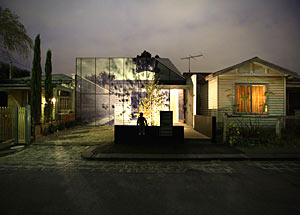
The house in question was a single-story weatherboard cottage in a significant state of decay. Clements’s brother hoped to build a new structure rather than renovate. Although the local council initially objected, it eventually determined that he could replace the building on the condition that the new structure’s height, form, and details were similar. Yet Clements was uninterested in merely rebuilding the old house. “Heritage controls often lead to the imposition of prescriptive design, resulting in ‘mock’ heritage buildings that undermine the value of quality assets,” he explains.
Clements instead wondered if he could “invoke the idea of context and memory by making it virtual.” He eventually arrived at the concept for Old House. Its front facade is a one-to-one scale graphic of the original house, printed in reverse on translucent digital film applied to the inside surface of a panelized, two-story glass wall. This projection masks a two-story contemporary residence, taller than the heritage council would otherwise allow. If Old House’s facade is seen as a Luther-style nailing of architectural theses to preservation’s door, Clements isn’t disappointed. “It’s a response to the difficulty of making architecture in heritage zones,” he admits. Finished in 2005, it has certainly invigorated the conversation about preservation.


Post a comment to this article
Report Abusive Comment