|
July 19, 2005
 |
 |

Images Courtesy HOK/ James
Carpenter Design Associates/ Neoscape |
After years of false-starts, it appears
the development of Moynihan Station, in New York City , has
finally gotten underway. Yesterday, Empire State Development
Corporation, which is responsible for promoting economic growth
in the state, announced it has selected a team of developers
and unveiled a new design for the project. It will be will
be located in the Farley Post Office on 8th Avenue, just across
the street from the present Pennsylvania Station. That station
occupies the site of McKim, Mead and Whites original
Beaux-Arts Pennsylvania Station, which was demolished in 1963.
The development team for the $818 million
transportation, office, commercial, and residential complex
will be the Related Companies and Vornado Realty Trust. Its
architects will be New York-based James Carpenter Design Associates,
with Hellmuth, Obata + Kassabuam (HOK)s New York office.
Skidmore, Owings, and Merrill, whose partner David Childs
devised an early scheme for the project, will be a consultant.
Construction is set to begin next year, and completion is
slated for 2011.
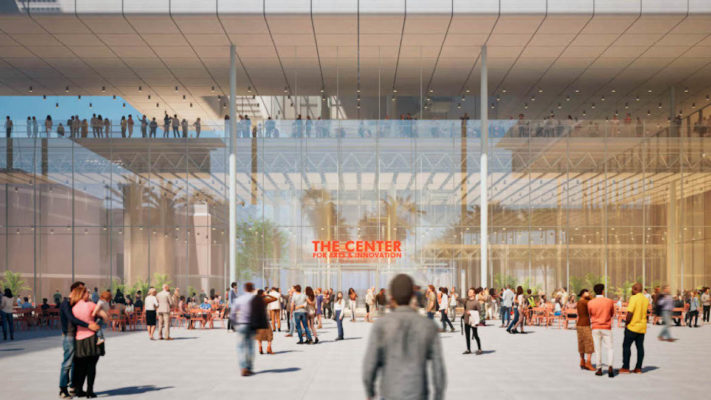
The new station, named for the late New
York Senator Daniel Patrick Moynihan, a vocal proponent of
the project, will include 300,000 square feet for a soaring,
vaulted glass station space that will respect the post offices
grand Beaux-Arts Architecture. The post office was built in
1910, and was also designed by McKim, Mead, and White.
This is a second-chance to recapture
the extraordinary station that was once Penn Station,
said Empire State Development Chairman Charles Gargano. The
post offices façade will be renovated, while
any new interior elements will likely be marked in limestone
and terra cotta, says James Carpenter. Eleven boarding platforms
will service Long Island Railroad, New Jersey Transit, and
some Amtrak passengers. The large, undulating glass-and-steel
canopy will allow daylight into the space. Carpenter says
this help recreate the awe-inspiring sense of scale that passengers
once felt when they entered Penn Station. Natural light will
be also be filtered down to the tracks via glass moats
surrounding the building, and through light tubes within the
spaces large steel columns. The space will be lined
with ticketing and customer service booths, and a retail shops
and restaurants.
The new scheme does away with David Childs
preliminary scheme for the station, whose sculptural steel-and-glass
canopy was dubbed, the potato chip, a glass and
steel canopy that rose far above the post offices roof
line. It occupied the intermodal space between
the current post office and a large warehouse and sorting
facility to its west. Carpenter says that design was removed,
in part, because the program has shifted to retain much more
of the post office than was originally planned. Entry into
the new station will take place via 8th Avenue, 9th Avenue,
and 31st and 33rd Streets. The intermodal space will likely
now serve as a check-in area for passengers planning to travel
to local airports.
|
The Moynihan Station was first proposed
in the early 1990s, and designs were first proposed
in 1999. The project has been hampered by numerous delays,
caused, among other things, by indecision on the part of the
U.S. Postal Service, and financially-strapped Amtraks
refusal to move from Penn Station.
The project will also include 850,000
square feet of commercial space, much of it located in the
large warehouse building on the west side of the Farley Post
Office, 250,000 square feet for the existing post office,
and air rights for up to one million square feet of housing,
likely on the northeast corner of 8th avenue and 32nd street,
says Carpenter. New York Governor George Pataki noted that
this teams plan to locate residential development outside
the Farley Building itself made it more appealing, so as not
to hurt the buildings character.
Construction will be paid for through
$105 million in Federal Railroad Administration Funds, $56.8
million in New York State funds, including $35 million which
will come from the Metropolitan Transportation Agency (MTA).
The Moynihan Development Corporation, made of representatives
from the city and state, will be paying $230 million for the
buildin. The developers will make an up-front payment of $150
million at closing. One year later they will pay $40 million,
and payment for $84 million will be made in 2010. The city
will contribute $133 million in Capital funds, plus $25 million
already committed of which $4 million has already been spent.
$150 million will be paid by the Port Authority of New York
and New Jersey. The New York Department of Transportation
will contribute $64 million in the form Congestion, Mitigation
and Air-quality (CMAC) funds. A $5 million lease payment from
the Port Authority will help pay the cost of a possible link
with local airports.
New York Mayor Michael Bloomberg, who
recently lost his battle to build a Jets Stadium in the area,
now appears to be focusing on the Moynihan project as a catalyst
to development on the Far West Side. This is a 60-block zone
that extends from the Moynihan Station site to the Hudson
River. He said the area, recently rezoned to allow significant
commercial and residential development, will be teeming
with life-energy, and activity every day. Answering
concerns that the Far West Side could draw resources from
Ground Zero he said, There is no competition with any
other areas. Enhancement of this neighborhood helps the development
of all neighborhoods.
Sam
Lubell
|