|
June 10, 2005
 |
 |
 |

Images Courtesy Guggenheim
Foundation |
A jury empanelled by the Guggenheim Foundation
has chosen Mexican firm Enrique Norten/ TEN Arquitectos to
develop a conceptual design for its proposed Guggenheim Museum
in Guadalajara, Mexico. The other competitors in a limited
competition for the commission were Ateliers Jean Nouvel,
and New York-based Asymptote. Nortens scheme includes
a large, rectilinear tower that would rise over the Barranca,
a 2,000-foot gorge at the northern edge of the city. The white,
largely transparent towers verticality, said competition
jurors represents a striking contrast to the sprawling citys
overwhelming horizontality, according to comments
made by the jury, which included Frank Gehry, FAIA, Guggenheim
director Thomas Krens, and Guadalajara Mayor Emilio Gonzalez
Marquez. They also noted it helps provide the iconic presence
that has become a characteristic of the Guggenheims
museums. Norten likens the building to a lighthouse that will
draw people to the museum and the area, regardless of whether
theyre looking at a map.
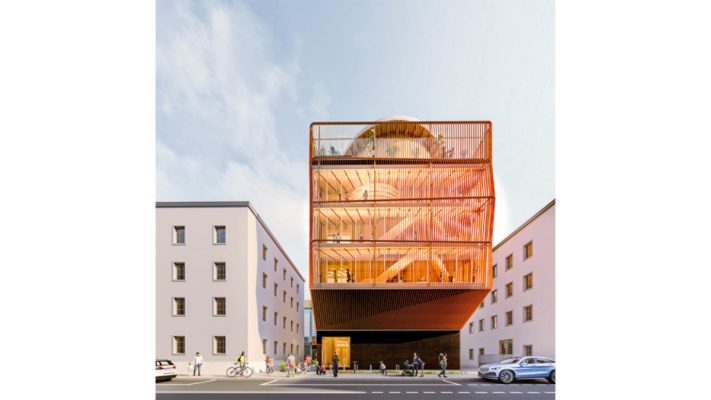
If built, the tower, will be composed
of a series of stacked white-colored steel boxes of different
sizes and configurations. These will serve as galleries, which
will display art from the Guggenheims collection and
also feature contemporary Latin American work. Its
almost like a 3-D Tetris, explains Norten, who designed
the recent Aztec Empire show for the Guggenheim,
is working with engineers Arup and Guy Nordensen on the project.
Interstitial spaces between the boxes will serve as public
congregating zones. The entire structure will be wrapped in
a double skin of glass, and innermost of these will be sealed
from the elements. A large open space at the top will either
serve as a gallery or a roof garden. Elevators will be suspended
to the side of the building, forming an attraction in themselves.
Outside, the building will have its own
plaza, designed by landscape architect James Corner/Field
Operations. Its texture will slowly morph from natural surroundings
into a hardscaped plaza, Norten notes. He adds that the space,
which will also include shops and amenities, will be the terminous
of a series of plazas within the city, starting with the 16th
Century plaza in the citys center.
Guadalajara seems to have discovered
architecture as a way to become a cultural capital. The citys
planned JVC project [RECORD
June, 1999, page 119], in which Norten has had an active role,
will also include architecture by Wolf Prix, Jean Nouvel,
Thom Mayne, FAIA, Zaha Hadid, Daniel Libeskind, Carmen Pinault,
Tod Williams and Billie Tsien and Philip Johnson Alan Ritchie
Architects.
A Guggenheim spokesperson stresses that
a Guadalajara branch of the museum is not a sure thing. The
museum, with consulting firm McKinsey & Company, is now
undertaking a feasibility study, to be completed in August,
to assess the enterprises potential costs and benefits.
Nevertheless, the new museum plan represents another significant
step from Krens to expand the Guggenheims international
reach. Since taking over as director in 1988, Krens has developed
new branches in Bilbao, Spain, Berlin, Germany, and Soho,
New York, and recently developed plans for museums in Taichung,
Taiwan (which completed a feasibility study, but it appears
that the Taichung government will not have enough funds to
proceed) and Rio de Janeiro, Brazil (which was delayed by
court injunction for some time, and now the Guggenheim has
decided not to go forward). A branch in Las Vegas closed in
2001, although part of that museum, the Guggenheim Hermitage,
is still open.
The Guadalajara project will likely be
paid for by a combination of local and federal Mexican funds,
notes Guggenheim spokesperson Anthony Calnek. The board
has decided in a broad way that its appropriate to proceed
globally with expansion, he adds. However, its
still considering in detail what the limits on that expansion
will be.
Sam
Lubell
|