For a Utah Museum, Polshek Takes Its Cue from the Land
Polshek Partnership has designed a new, 161,000-square-foot facility for the Utah Museum of Natural History in Salt Lake City. The $98 million project will enable the 45-year-old institution to better showcase its collection of fossils, rocks, minerals, and other artifacts. Presently, only 1 percent of the museum’s 1.2-million-piece collection is on display in its current location, the George Thomas Building on the University of Utah campus.
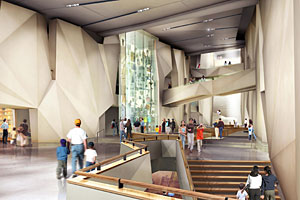
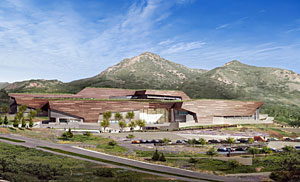
The new venue, also on the school campus, sits on a 17-acre site surrounded by 600 acres of protected desert. Nestled into a hillside overlooking the Bonneville Shoreline Trail, a popular recreational path, the building offers dramatic views of the Great Salt Lake Basin, Oquirrhs Mountains, and Kennecott copper mines, the largest copper mine in the world.
The concrete and glass building has an angled massing that follows the site topography. Clad in horizontal bands of local copper alloy, its façade mimics geological strata. “The building is conceived as an abstraction, extension and transformation of the land,” says Polshek design partner Todd H. Schliemann, FAIA.
Inside, each of the four levels has a theme: sky, life, land, and past worlds. There will be eight permanent exhibit spaces totaling about 37,500 feet, in addition to a 1,200-square-foot children’s gallery. Terraces will offer a direct connection to outdoors exhibits and the surrounding landscape. In addition, the museum will contain a 150-seat theater, a bookstore, a café, and 31,500 square feet worth of storage space.
The architects hope to achieve LEED Gold for the project. The design calls for high-performance mechanical systems, recycled building materials, and a wind turbine. The facility also will have a planted roof system that will capture stormwater for use in irrigation.
Construction began July 29 and is scheduled to be finished in early 2011. The new venue is expected to increase attendance by 65 percent, attracting 220,000 visitors annually. The local firm Gillies Stransky Brems Smith is architect of record; Ralph Appelbaum Associates is designing the exhibits.



Post a comment to this article
Report Abusive Comment