Studio Pei-Zhu Designs Museum for Iconic Chinese Artist
While the devastating Sichuan earthquake in May left a large portion of Western China in ruins, signs are emerging that some notable building projects in the area are pushing forward. One of these projects is the Art Museum of Yue Minjun, designed by Beijing-based Studio Pei-Zhu, a 2007 Design Vanguard winner.
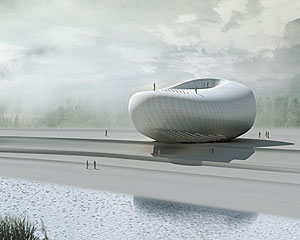
Located near the Qingcheng Mountains, and adjacent to the Shimeng River in Sichuan Province, the 10,700-square-foot museum will house the work of Yue Minjun, a Chinese contemporary artist known for his repetitive images of large, smiling figures. It will be one of 10 new museums on the same site, each dedicated to the work of an influential Chinese artist. Zhang Xiaogang and Wang Guangyi are among the other artists to be showcased. The complex, which is being developed by the local government of Dujiangyan, is the brainchild of Lu Peng, an art professor at the China Central Academy of Fine Art.
The Yue Minjun museum will contain exhibition space and a small artist’s studio. According to Pei Zhu, one of the firm’s principals, a river rock that he picked up one day inspired the building’s form—a large, oblong sphere. “Everything is based on the natural stone, which has a very strong relationship between the creek and the mountain and nature,” explains Zhu.
On the exterior, curvilinear walls will be clad in highly polished zinc, a soft metal that blends in with the natural surroundings while also giving the building a futuristic look. “Normally, architects will use a local material and vernacular language,” says Zhu. “We believe we needed to make something both futuristic and very natural.” It’s a striking departure from another recent project designed by the firm for the 2008 Summer Olympics: Digital Beijing, a control center whose façade resembles computer circuitry.
Work is already underway on the art museum. Site preparation began earlier this year, and the building should be completed by early 2009. Zhu says the earthquake delayed the project a mere three months, at most. “The developer still really wants to push this project [forward],” he says, “and we think that this will still benefit the society and the city.”


Post a comment to this article
Report Abusive Comment